🥳 Skip the subscription. Pay $299 once for lifetime access— See lifetime plans
🥳 Skip the subscription. Pay $299 once for lifetime access—

8 MIN READ
Discovery
Discovery
5 Signs You're Overpaying for Your Influencer Marketing Platform
5 Signs You're Overpaying for Your Influencer Marketing Platform
5 Signs You're Overpaying for Your Influencer Marketing Platform

Rashmi Singh
Rashmi Singh
Rashmi Singh
Content Marketer @impulze.ai
Sections
Build your first creator list on Solo, $29 a month.

Blog in Short ⏱️
Blog in Short ⏱️
A quick glance at the highlights—perfect for when you're short on time.
A quick glance at the highlights—perfect for when you're short on time.
Most influencer marketing platforms are built to win sales demos, not to help you run campaigns faster.
Feature bloat is real and you're probably paying for a lot of things you've never clicked.
The 5 signs covered here will tell you whether your platform is working for you or against you.
Complexity isn't a proxy for capability. The best tool is the one your team actually uses.
If more than two of these signs apply, it's worth re-evaluating what you're spending and what you're getting.
There's a specific kind of pain that hits when you're prepping for a campaign, you open your influencer marketing platform, and your first instinct is to close it again.
Not because you don't know what you're doing. But because the tool has seventeen tabs, four dashboards, a CRM module you've never touched, and a workflow builder that requires a 45-minute onboarding video just to understand what it does.
This is more common than the industry admits. A lot of brands and agencies are paying premium prices for platforms that were engineered to impress procurement teams during demos, not to help a two-person marketing team move fast on Monday morning.
The hard question worth asking: is your influencer marketing platform actually making your job easier, or have you just gotten used to working around it?
Here are five signs the answer might be the latter.
Sign #1: You're Using Maybe 20% of What You're Paying For
Open your platform right now. How many features have you used in the last 30 days, genuinely used, not just clicked past?
Most enterprise influencer platforms come loaded: influencer discovery, relationship CRM, outreach sequences, contract management, payment processing, content approval workflows, campaign reporting, ROI dashboards, audience overlap analysis, brand safety scoring, competitor benchmarking... the list goes on.
That's not necessarily bad if your team is large enough to actually use those features. But for most brands and boutique agencies, 80% of that sits untouched. You're paying for the full gym membership and going twice a month.
The real-world version of this:
A DTC skincare brand running two to three influencer campaigns per quarter doesn't need a contract management module with e-signature integration. They need to find the right creators quickly, check their engagement quality, send an outreach email, and track whether the post went live. That's it. If your platform can't do those five things cleanly without requiring you to set up a workflow first, it's over-engineered for your actual use case.
A good rule of thumb: if you can't describe what your platform does in two sentences, it's probably doing too many things for someone else's use case.
Also Read: Influencer Marketing Automation: 6 Tasks Slowing Your Campaigns Down
Sign #2: Your Team Needed More Than a Week to Get Comfortable With It
Onboarding complexity is one of the most telling signals of a bad tool-fit.
There's a reason platforms like Notion, Linear, and Figma spread through companies without top-down mandates. They're intuitive enough that people pick them up and keep using them. The same principle applies to your influencer marketing software.
If your team needed extensive training, watched onboarding videos, or still relies on your CSM to explain how to pull a basic report, that's a problem that doesn't fix itself over time. It just becomes the baseline you accept.
Why this matters beyond convenience:
Tool friction kills consistency. When pulling campaign data feels like work, people start keeping notes in spreadsheets on the side. When discovery requires navigating three filters and a boolean search just to see fitness creators in the US, people start DMing influencers they already know rather than finding better fits. The platform stops being used the way it was designed and the results reflect that.
Complexity isn't sophistication. A platform that requires a learning curve just to run a basic discovery search has a UX problem, not a features advantage.
Sign #3: You Still Do the Most Important Work Outside the Platform
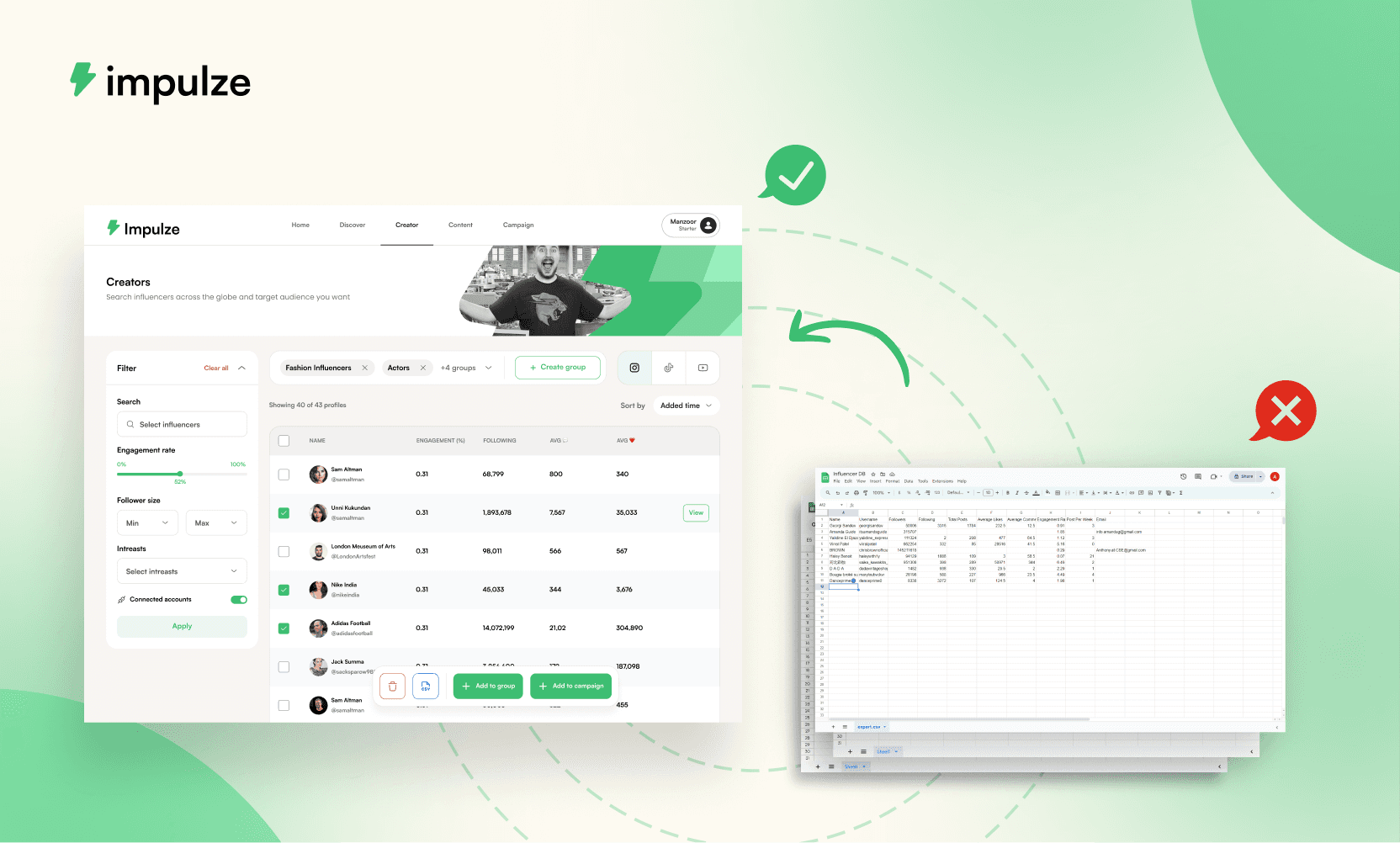
This is the one that stings. You're paying for an influencer marketing platform, but your actual campaign lives in a Google Sheet.
The outreach tracking is in Gmail. The creator briefs are in Notion. The performance data is in a separate analytics tab you check manually. The platform is technically involved somewhere, but it's not the center of gravity.
If this describes your current setup, you're not getting the core value proposition of the tool. You're paying for infrastructure and still building the house yourself.
Here’s an example to understand:
Gymshark grew its influencer program before sophisticated platforms existed, largely through spreadsheets and direct relationships. But as they scaled, the reason they invested in proper tooling was specifically to get everything in one place: discovery, outreach history, content tracking, and results. If a platform isn't delivering that consolidation, it's not solving the right problem.
The question to ask yourself: if you stopped using the platform tomorrow, how much of your workflow would actually break? If the honest answer is "not much," you're not using a platform, you're paying for one.
Sign #4: Reporting Takes Longer Than the Campaign Itself
One of the clearest signs of platform over-complexity is when generating a post-campaign report becomes a half-day task.
Good influencer marketing software should make reporting faster — pulling reach, engagement, story views, link clicks, and conversion data into something you can present without rebuilding it from scratch every time.
If you're still exporting CSV files, copy-pasting stats from Instagram, and formatting everything in Slides manually, your platform isn't doing its job.
This is especially painful for agencies. If you manage campaigns across five or six brand clients and reporting for each one takes three to four hours, that's time you're not billing for and time that could go toward strategy, outreach, or actually building better campaigns.
What this often looks like in practice:
The platform has a reporting module. It technically generates reports. But the data isn't pulling correctly for one client, the branding doesn't match what you need, and the metrics it tracks don't map to what your client actually cares about. So you end up doing it manually anyway, while still paying for the platform that was supposed to solve exactly this.
For instance, impulze.ai's campaign analytics pulls post performance automatically — reach, engagement, story views, and conversion data — into a dashboard you can share with clients without rebuilding it every time. The data is there when the campaign ends, not two hours after you've chased it down.
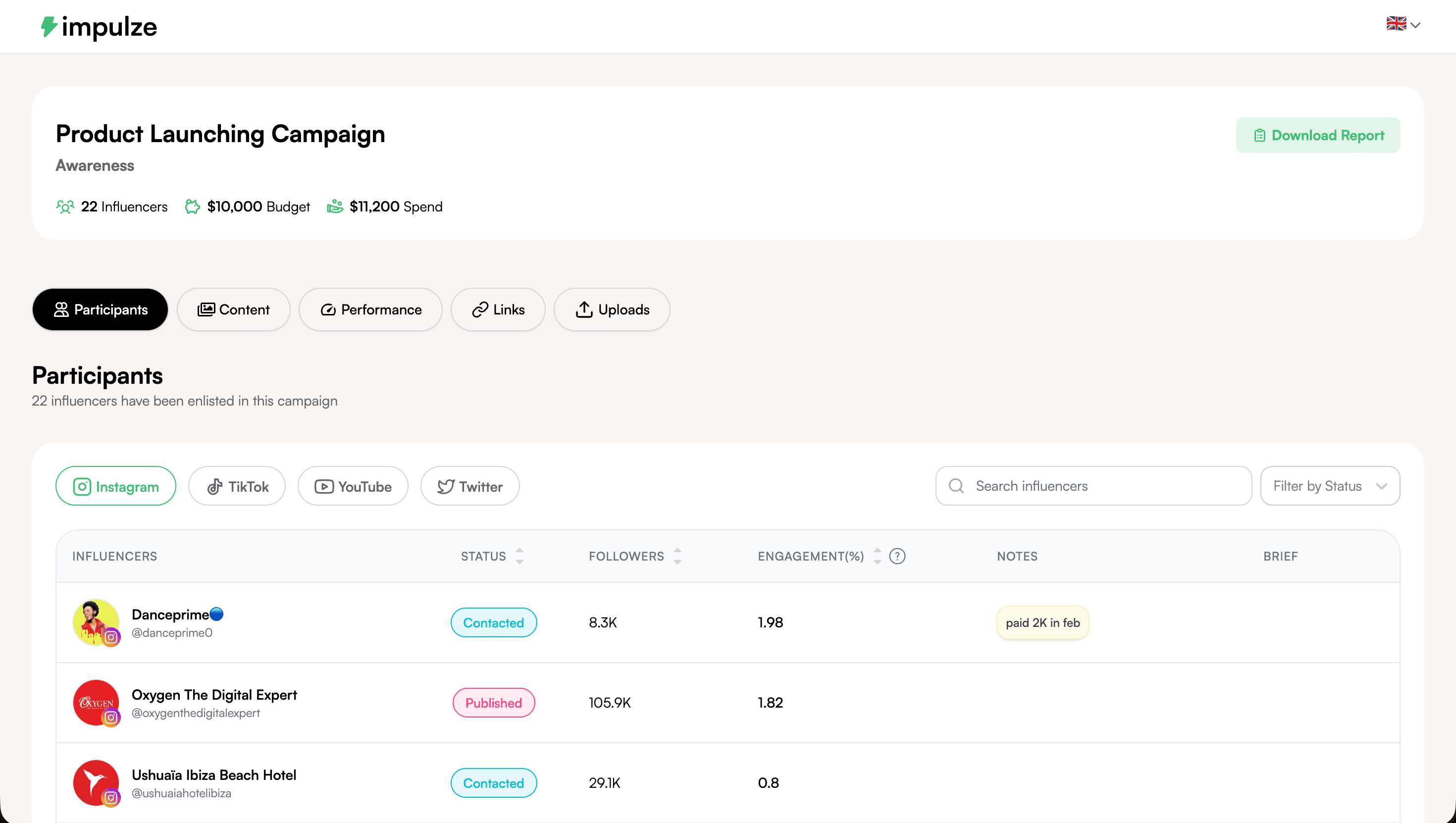
Plus, you can also use whitelable service to make it a perfect match with your branding.
Sign #5: The Pricing Scaled Up Before Your Results Did
Enterprise influencer platforms often price on tiers that sound reasonable at entry level and then jump significantly the moment you need more creator searches, more seats, or access to the analytics that actually matter.
You start on a mid-tier plan. You hit the search limit after one good campaign. You upgrade. Now you're at $500–$800 per month and the core functionality is still the same, you just unlocked more of the features you're not using.
The pattern worth recognizing:
Influencer marketing platforms like Traackr, Grin, and AspireIQ are genuinely powerful — for enterprise teams running always-on influencer programs with dedicated headcount. If you're a DTC brand with one marketing hire or an agency where three people split everything, you don't need enterprise infrastructure. You need something that does the essential things well and gets out of your way.
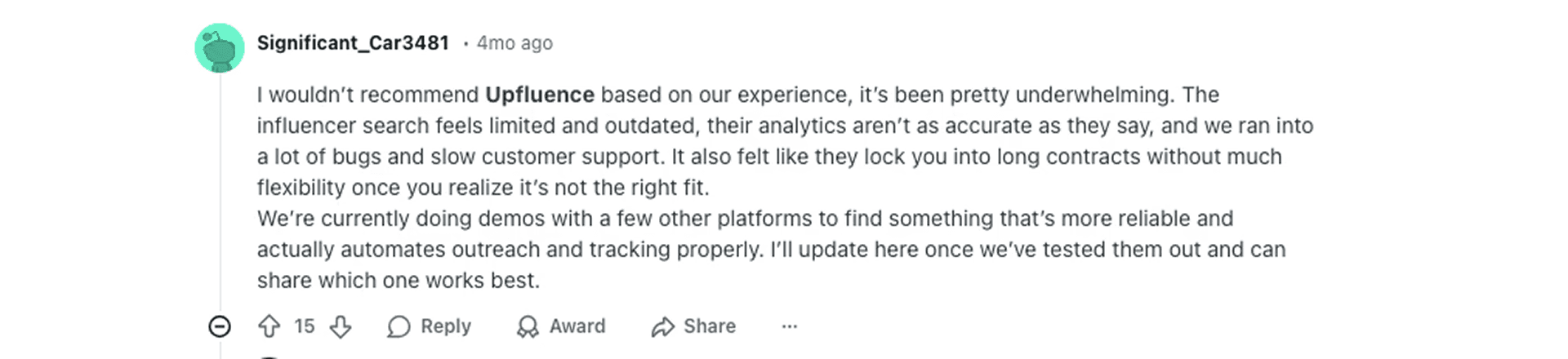
(A Reddit user sharing review of Upfluence)
Overpaying for an influencer marketing platform isn't always about the absolute dollar amount. It's about whether the value scales with your usage. If your monthly cost went up 40% but your campaign output stayed flat, that's a mismatch worth addressing.
What to Actually Look For in an Influencer Marketing Platform
If you're re-evaluating your current tool — or picking one for the first time — here's the honest short list of what matters:
Fast, accurate discovery. You should be able to find relevant creators in your niche, in your target market, with real audience data, in under five minutes. Not fifteen, not thirty — five.
Engagement quality signals, not just follower counts. Any platform worth using should show you whether an audience is real and engaged, not just large. Fake follower detection and audience authenticity scoring should be baseline, not an add-on.
Outreach that doesn't require a separate tool. If you're copying influencer emails out of the platform and into Gmail, you've already lost time. Outreach should live in the same place as discovery.
Campaign tracking without manual data entry. Posts should be tracked automatically. Metrics should pull without you having to chase them down. Reporting should take minutes, not hours.
Pricing that matches how you actually work. Flat-rate, predictable pricing that doesn't penalize you for running a successful campaign by bumping you into a higher tier.
That's it. Everything else is a nice-to-have that becomes a liability if it makes the core experience harder to navigate.
The Bottom Line
Complexity is easy to mistake for capability. A platform with forty features feels more powerful than one with ten until you're three months in and still only using the same three things you needed on day one.
The best influencer marketing platform for your team isn't the one with the most features. It's the one that makes discovery, outreach, and reporting so straightforward that your team actually uses it.
If two or more of the signs above describe your current setup, it's worth taking an honest look at what you're paying for versus what you're getting. impulze.ai offers a free plan to get started. No credit card, no sales call, no 45-minute onboarding video. Just the tool.
Start free →
There's a specific kind of pain that hits when you're prepping for a campaign, you open your influencer marketing platform, and your first instinct is to close it again.
Not because you don't know what you're doing. But because the tool has seventeen tabs, four dashboards, a CRM module you've never touched, and a workflow builder that requires a 45-minute onboarding video just to understand what it does.
This is more common than the industry admits. A lot of brands and agencies are paying premium prices for platforms that were engineered to impress procurement teams during demos, not to help a two-person marketing team move fast on Monday morning.
The hard question worth asking: is your influencer marketing platform actually making your job easier, or have you just gotten used to working around it?
Here are five signs the answer might be the latter.
Sign #1: You're Using Maybe 20% of What You're Paying For
Open your platform right now. How many features have you used in the last 30 days, genuinely used, not just clicked past?
Most enterprise influencer platforms come loaded: influencer discovery, relationship CRM, outreach sequences, contract management, payment processing, content approval workflows, campaign reporting, ROI dashboards, audience overlap analysis, brand safety scoring, competitor benchmarking... the list goes on.
That's not necessarily bad if your team is large enough to actually use those features. But for most brands and boutique agencies, 80% of that sits untouched. You're paying for the full gym membership and going twice a month.
The real-world version of this:
A DTC skincare brand running two to three influencer campaigns per quarter doesn't need a contract management module with e-signature integration. They need to find the right creators quickly, check their engagement quality, send an outreach email, and track whether the post went live. That's it. If your platform can't do those five things cleanly without requiring you to set up a workflow first, it's over-engineered for your actual use case.
A good rule of thumb: if you can't describe what your platform does in two sentences, it's probably doing too many things for someone else's use case.
Also Read: Influencer Marketing Automation: 6 Tasks Slowing Your Campaigns Down
Sign #2: Your Team Needed More Than a Week to Get Comfortable With It
Onboarding complexity is one of the most telling signals of a bad tool-fit.
There's a reason platforms like Notion, Linear, and Figma spread through companies without top-down mandates. They're intuitive enough that people pick them up and keep using them. The same principle applies to your influencer marketing software.
If your team needed extensive training, watched onboarding videos, or still relies on your CSM to explain how to pull a basic report, that's a problem that doesn't fix itself over time. It just becomes the baseline you accept.
Why this matters beyond convenience:
Tool friction kills consistency. When pulling campaign data feels like work, people start keeping notes in spreadsheets on the side. When discovery requires navigating three filters and a boolean search just to see fitness creators in the US, people start DMing influencers they already know rather than finding better fits. The platform stops being used the way it was designed and the results reflect that.
Complexity isn't sophistication. A platform that requires a learning curve just to run a basic discovery search has a UX problem, not a features advantage.
Sign #3: You Still Do the Most Important Work Outside the Platform
This is the one that stings. You're paying for an influencer marketing platform, but your actual campaign lives in a Google Sheet.
The outreach tracking is in Gmail. The creator briefs are in Notion. The performance data is in a separate analytics tab you check manually. The platform is technically involved somewhere, but it's not the center of gravity.
If this describes your current setup, you're not getting the core value proposition of the tool. You're paying for infrastructure and still building the house yourself.
Here’s an example to understand:
Gymshark grew its influencer program before sophisticated platforms existed, largely through spreadsheets and direct relationships. But as they scaled, the reason they invested in proper tooling was specifically to get everything in one place: discovery, outreach history, content tracking, and results. If a platform isn't delivering that consolidation, it's not solving the right problem.
The question to ask yourself: if you stopped using the platform tomorrow, how much of your workflow would actually break? If the honest answer is "not much," you're not using a platform, you're paying for one.
Sign #4: Reporting Takes Longer Than the Campaign Itself
One of the clearest signs of platform over-complexity is when generating a post-campaign report becomes a half-day task.
Good influencer marketing software should make reporting faster — pulling reach, engagement, story views, link clicks, and conversion data into something you can present without rebuilding it from scratch every time.
If you're still exporting CSV files, copy-pasting stats from Instagram, and formatting everything in Slides manually, your platform isn't doing its job.
This is especially painful for agencies. If you manage campaigns across five or six brand clients and reporting for each one takes three to four hours, that's time you're not billing for and time that could go toward strategy, outreach, or actually building better campaigns.
What this often looks like in practice:
The platform has a reporting module. It technically generates reports. But the data isn't pulling correctly for one client, the branding doesn't match what you need, and the metrics it tracks don't map to what your client actually cares about. So you end up doing it manually anyway, while still paying for the platform that was supposed to solve exactly this.
For instance, impulze.ai's campaign analytics pulls post performance automatically — reach, engagement, story views, and conversion data — into a dashboard you can share with clients without rebuilding it every time. The data is there when the campaign ends, not two hours after you've chased it down.
Plus, you can also use whitelable service to make it a perfect match with your branding.
Sign #5: The Pricing Scaled Up Before Your Results Did
Enterprise influencer platforms often price on tiers that sound reasonable at entry level and then jump significantly the moment you need more creator searches, more seats, or access to the analytics that actually matter.
You start on a mid-tier plan. You hit the search limit after one good campaign. You upgrade. Now you're at $500–$800 per month and the core functionality is still the same, you just unlocked more of the features you're not using.
The pattern worth recognizing:
Influencer marketing platforms like Traackr, Grin, and AspireIQ are genuinely powerful — for enterprise teams running always-on influencer programs with dedicated headcount. If you're a DTC brand with one marketing hire or an agency where three people split everything, you don't need enterprise infrastructure. You need something that does the essential things well and gets out of your way.
(A Reddit user sharing review of Upfluence)
Overpaying for an influencer marketing platform isn't always about the absolute dollar amount. It's about whether the value scales with your usage. If your monthly cost went up 40% but your campaign output stayed flat, that's a mismatch worth addressing.
What to Actually Look For in an Influencer Marketing Platform
If you're re-evaluating your current tool — or picking one for the first time — here's the honest short list of what matters:
Fast, accurate discovery. You should be able to find relevant creators in your niche, in your target market, with real audience data, in under five minutes. Not fifteen, not thirty — five.
Engagement quality signals, not just follower counts. Any platform worth using should show you whether an audience is real and engaged, not just large. Fake follower detection and audience authenticity scoring should be baseline, not an add-on.
Outreach that doesn't require a separate tool. If you're copying influencer emails out of the platform and into Gmail, you've already lost time. Outreach should live in the same place as discovery.
Campaign tracking without manual data entry. Posts should be tracked automatically. Metrics should pull without you having to chase them down. Reporting should take minutes, not hours.
Pricing that matches how you actually work. Flat-rate, predictable pricing that doesn't penalize you for running a successful campaign by bumping you into a higher tier.
That's it. Everything else is a nice-to-have that becomes a liability if it makes the core experience harder to navigate.
The Bottom Line
Complexity is easy to mistake for capability. A platform with forty features feels more powerful than one with ten until you're three months in and still only using the same three things you needed on day one.
The best influencer marketing platform for your team isn't the one with the most features. It's the one that makes discovery, outreach, and reporting so straightforward that your team actually uses it.
If two or more of the signs above describe your current setup, it's worth taking an honest look at what you're paying for versus what you're getting. impulze.ai offers a free plan to get started. No credit card, no sales call, no 45-minute onboarding video. Just the tool.
Start free →
Frequently Asked Questions
What is an influencer marketing platform?

What is an influencer marketing platform?
How much should I pay for an influencer marketing platform?
How much should I pay for an influencer marketing platform?
What's the difference between influencer marketing software and an influencer marketplace?
What's the difference between influencer marketing software and an influencer marketplace?
What features do I actually need in an influencer marketing platform?
What features do I actually need in an influencer marketing platform?
How do I know if I'm overpaying for my influencer marketing platform?
How do I know if I'm overpaying for my influencer marketing platform?
Author Bio
Author Bio
Rashmi Singh
Rashmi Singh
Rashmi Singh is a writer and strategist with more than 7 years of experience. When not writing, she is either spending time with her friends or planning her next trip. You can learn more about her here.
Rashmi Singh is a writer and strategist with more than 7 years of experience. When not writing, she is either spending time with her friends or planning her next trip. You can learn more about her here.
We Also Recommend To Read