🥳 Skip the subscription. Pay $299 once for lifetime access— See lifetime plans
🥳 Skip the subscription. Pay $299 once for lifetime access—

9 MIN READ
Discovery
Discovery
What is an AI agent in Influencer Marketing (and why it matters for your team)
What is an AI agent in Influencer Marketing (and why it matters for your team)
What is an AI agent in Influencer Marketing (and why it matters for your team)

Rashmi Singh
Rashmi Singh
Rashmi Singh
Content Marketer @impulze.ai
Sections
Build your first creator list on Solo, $29 a month.

Blog in Short ⏱️
Blog in Short ⏱️
A quick glance at the highlights—perfect for when you're short on time.
A quick glance at the highlights—perfect for when you're short on time.
AI agents are not just smarter tools. They are systems that can plan, act, and optimize influencer marketing workflows without constant input.
Here are the key takeaways:
• AI tools respond when prompted. AI agents work toward a goal continuously
• Agents can handle discovery, outreach, monitoring, and reporting end-to-end
• They reduce operational work like follow-ups, tracking posts, and updating pipelines
• Teams can scale from managing ~20 creators to 60–80 relationships efficiently
• Best use cases today include monitoring, reporting, and outreach automation
• Fully autonomous strategy and budget decisions are still evolving
AI agents don’t replace marketers. They free up time so teams can focus on strategy and relationships.
Every week, another platform adds "AI" to their feature list. AI discovery. AI fraud detection. AI reporting. And now AI agents.
The term is everywhere. It's also genuinely confused with everything else. Most things being called AI agents right now are just AI-assisted tools with better marketing copy.
But actual AI agents who can plan, decide, act, and adjust without being prompted at every step are a real thing, and they're starting to show up in influencer marketing workflows in ways that matter. The brands and teams that understand the difference between an AI tool and an AI agent will be in a different position from those who don't, and the gap is growing.
This guide explains what an AI agent actually is, where it fits in an influencer marketing workflow right now, and what it means for how your team operates. So, let’s get begin!
What is an AI Agent in Influencer Marketing?
Start with the cleanest definition available.
Google Cloud defines an AI agent as: "an autonomous entity designed to perform specific tasks — part of a broader system that uses LLMs as a brain to execute actions in underlying systems to achieve higher-level goals."
MIT Sloan puts it more specifically: AI agents are "autonomous software systems that perceive, reason, and act in digital environments to achieve goals on behalf of human principals, with capabilities for tool use, economic transactions, and strategic interaction."
Strip out the jargon and it means this: an AI agent doesn't wait for you to tell it what to do next. It understands a goal, figures out the steps, takes action, and adjusts based on what happens.
A standard AI tool is reactive. You open it, you ask it something, it responds, you take the output and do something with it. Every step requires your input.
An AI agent is proactive. You give it a goal — "monitor these 30 creator partnerships and flag anything that needs attention" — and it works toward that goal continuously, without you re-prompting it every time.
In influencer marketing specifically, that difference shows up like this:
An AI tool runs a fake follower check when you ask it to.
An AI agent monitors audience quality across your active creator roster on an ongoing basis, alerts you when a creator's follower growth pattern changes suspiciously, and logs the anomaly in your CRM, before you'd even thought to look.
One of those is a feature. The other is a team member that doesn't clock out.
Why This Matters Now
Influencer marketing has a scale problem.
The global influencer marketing industry is projected to reach USD 97.55 billion by 2030, up from $24 billion in 2024. Programs that were being run with five creators two years ago are now running with fifty. But teams haven't grown at the same rate.
The result: most of what influencer marketers actually spend their time on is operational work like pulling metrics, sending follow-up emails, updating pipeline statuses, checking whether posts have gone live, chasing invoices, and the list is long and mundane. The crucial part of their job i.e, strategy often gets sidelined when so much is on their plate.
Now, this not only impacts the campaign performance but also leads to gaps in the process. If the team of three is managing forty creator relationships, something is getting missed every week. Posts going unmonitored. Follow-ups falling through the gaps. Performance data that's always a week behind.
In such cases, AI agents don't solve the creative or strategic problem but they solve the operational problem that's eating up the time your team needs to focus on the creative and strategic work.
A spring 2025 survey by MIT Sloan and Boston Consulting Group found that 35% of organizations had already adopted AI agents, with another 44% planning to deploy them shortly. Gartner expects 40% of enterprise applications to include task-specific AI agents by 2026, up from less than 5% in 2025.
This is not five years away. It's happening in the tools your team is evaluating right now.
AI Tool vs. AI Agent — What's the Difference?
This distinction is the one most confusing in practice because vendors use the terms interchangeably.
Writer.com's framing is the clearest available:
"Generative AI is the freelance writer: You give it a specific assignment (a prompt), and it delivers that single piece of work. Agentic AI is the project manager and the team: You give it a strategic goal, and it both orchestrates the entire process and executes it."
Here's a practical breakdown for influencer marketing:
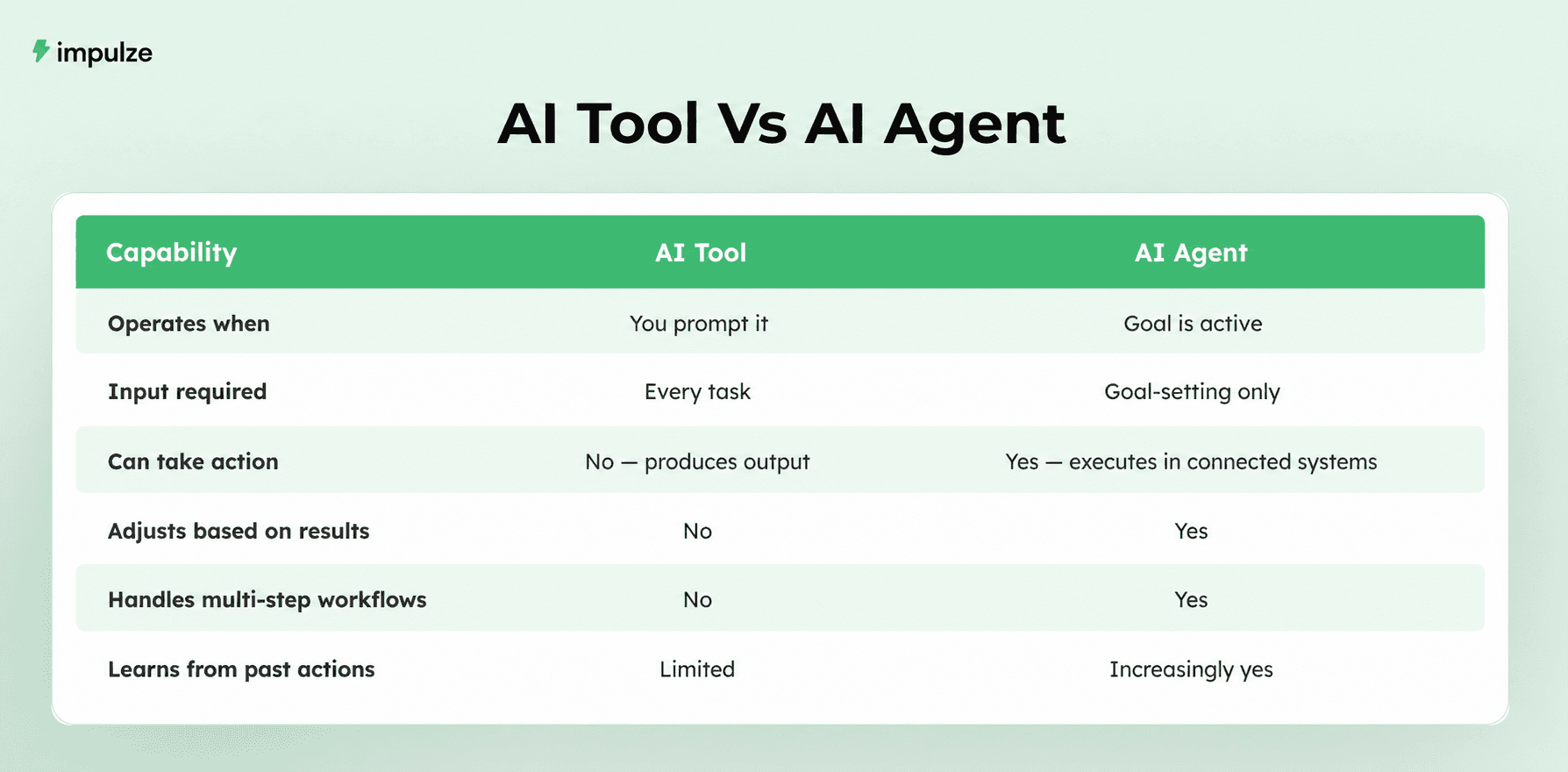
Practical example:
You want to find 20 YouTube creators in the fitness space, reach out to them, and track responses.
With an AI tool:
You search a platform, export a list, manually write or adapt outreach emails, send them one by one, and update a spreadsheet with who responded.
With an AI agent:
You set the brief. The AI agent searches the database against your criteria, drafts personalized outreach for each creator based on their recent content, sends the emails, logs each response, updates the pipeline status automatically, and schedules a follow-up for the ones who didn't respond, while you're in a different meeting.
The tool handles one step.
The agent handles the workflow.
What Jobs an AI Agent Can Do for an Influencer Marketing Team
This is the section that matters most. Not what AI agents can theoretically do but what they can actually do right now, at each stage of an influencer marketing program.
1. Continuous Creator Discovery
Most tools wait for you to search but an AI agent does not. You give it a brief once, and it keeps scanning in the background.
Tracks creators entering your niche
Detects rising profiles based on growth + engagement patterns
Surfaces new matches automatically
You do not “run searches” anymore. You get ongoing recommendations without asking.
Where you step in: Final call on brand fit and voice.
2. Personalized Outreach at Scale
Most teams either send generic emails or burn hours personalizing. An AI agent handles this end-to-end.
Reads a creator’s recent content
Identifies relevance to your product
Writes a contextual pitch
Sends it (after your approval)
Logs it
Follows up automatically
All without you touching each message. The difference is simple: Manual teams personalize one by one. Agents personalize at scale
Where you step in: Approve the message and build relationships after replies come.
3. Ongoing Vetting and Risk Monitoring
Most tools audit creators once. But an AI Agent keeps watching. It does the following in backgroun:
Tracks follower growth over time
Flags unusual spikes or drops
Monitors engagement consistency
Alerts you before payments or renewals
This shifts vetting from a one-time check to a continuous safety layer.
Where you step in: Deciding whether a signal is a red flag or a normal spike.
4. Smart Brief Creation
Templates give you structure. Agents give you context. An AI agent can:
Analyze past campaign performance
Identify formats that worked
Study the creator’s content style
Generate a brief tailored to both
It can even flag when your ask does not match what the creator’s audience engages with. Instead of generic briefs, you get creator-specific direction.
Where you step in: Final creative direction and brand voice.
5. Real-Time Campaign Monitoring
Most teams check dashboards. Agents act on signals and data:
Tracks whether posts go live on time
Sends reminders if deadlines slip
Flags missing disclosures
Alerts you if early performance is off-track
You are no longer reacting late. You are notified when action is still possible.
Where you step in: Decisions like boosting, responding, or handling issues.
6. Automated Reporting with Context
Tools show data. Agents interpret and deliver it. They
Pulls performance across creators
Compares against past campaigns
Writes a summary of what worked
Shares reports automatically
You do not chase metrics anymore. You receive ready-to-use insights.
Where humans step in: Turning insights into strategy.
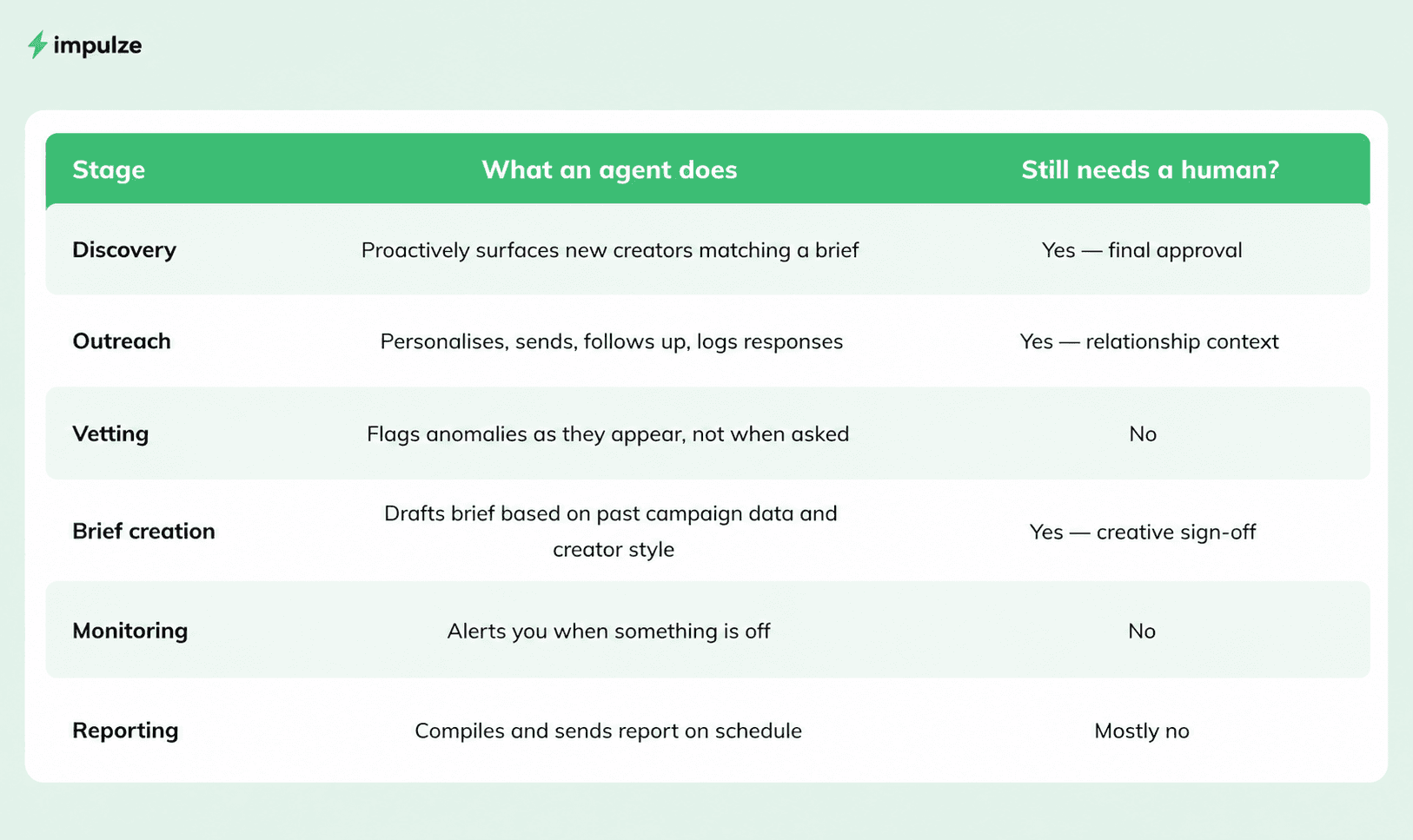
What's Real Right Now vs. What's Still Maturing
This is where most AI marketing content misleads people. They present theoretical capabilities as if they're available today at the push of a button.
Here's an honest assessment.
Working reliably right now:
Automated content monitoring (posts live, disclosure tags, basic performance alerts)
AI-assisted outreach personalisation at scale
Ongoing audience quality monitoring across an active roster
Automated reporting and data compilation
Creator-brief matching based on past campaign performance
Working but requiring significant setup and human oversight:
End-to-end outreach sequences (personalisation quality varies significantly)
Autonomous brief generation (drafts are useful; still need human refinement)
Cross-platform campaign coordination (integration reliability varies by platform)
Still maturing and not production-ready at scale for most teams:
Fully autonomous contract negotiation
AI agents making budget allocation decisions independently
Creative strategy generation without meaningful human direction
The teams getting value right now are starting with one well-defined, repeatable workflow, usually content monitoring or reporting, and automating that completely before expanding.
Try AI Agent in Real-time
Agentic AI in influencer marketing still feels like magic to those who haven’t tried it. We realized that, and so we are building one for you. Scout will be like your AI colleague who will do whatever you ask. It will find creators, do the outreach, get you all the campaign insights, and keep learning from your brand to be a better teammate with time.
We’re launching it soon, but before that, we want to share it with selected users. If you want to be among those, join the waitlist.
Every week, another platform adds "AI" to their feature list. AI discovery. AI fraud detection. AI reporting. And now AI agents.
The term is everywhere. It's also genuinely confused with everything else. Most things being called AI agents right now are just AI-assisted tools with better marketing copy.
But actual AI agents who can plan, decide, act, and adjust without being prompted at every step are a real thing, and they're starting to show up in influencer marketing workflows in ways that matter. The brands and teams that understand the difference between an AI tool and an AI agent will be in a different position from those who don't, and the gap is growing.
This guide explains what an AI agent actually is, where it fits in an influencer marketing workflow right now, and what it means for how your team operates. So, let’s get begin!
What is an AI Agent in Influencer Marketing?
Start with the cleanest definition available.
Google Cloud defines an AI agent as: "an autonomous entity designed to perform specific tasks — part of a broader system that uses LLMs as a brain to execute actions in underlying systems to achieve higher-level goals."
MIT Sloan puts it more specifically: AI agents are "autonomous software systems that perceive, reason, and act in digital environments to achieve goals on behalf of human principals, with capabilities for tool use, economic transactions, and strategic interaction."
Strip out the jargon and it means this: an AI agent doesn't wait for you to tell it what to do next. It understands a goal, figures out the steps, takes action, and adjusts based on what happens.
A standard AI tool is reactive. You open it, you ask it something, it responds, you take the output and do something with it. Every step requires your input.
An AI agent is proactive. You give it a goal — "monitor these 30 creator partnerships and flag anything that needs attention" — and it works toward that goal continuously, without you re-prompting it every time.
In influencer marketing specifically, that difference shows up like this:
An AI tool runs a fake follower check when you ask it to.
An AI agent monitors audience quality across your active creator roster on an ongoing basis, alerts you when a creator's follower growth pattern changes suspiciously, and logs the anomaly in your CRM, before you'd even thought to look.
One of those is a feature. The other is a team member that doesn't clock out.
Why This Matters Now
Influencer marketing has a scale problem.
The global influencer marketing industry is projected to reach USD 97.55 billion by 2030, up from $24 billion in 2024. Programs that were being run with five creators two years ago are now running with fifty. But teams haven't grown at the same rate.
The result: most of what influencer marketers actually spend their time on is operational work like pulling metrics, sending follow-up emails, updating pipeline statuses, checking whether posts have gone live, chasing invoices, and the list is long and mundane. The crucial part of their job i.e, strategy often gets sidelined when so much is on their plate.
Now, this not only impacts the campaign performance but also leads to gaps in the process. If the team of three is managing forty creator relationships, something is getting missed every week. Posts going unmonitored. Follow-ups falling through the gaps. Performance data that's always a week behind.
In such cases, AI agents don't solve the creative or strategic problem but they solve the operational problem that's eating up the time your team needs to focus on the creative and strategic work.
A spring 2025 survey by MIT Sloan and Boston Consulting Group found that 35% of organizations had already adopted AI agents, with another 44% planning to deploy them shortly. Gartner expects 40% of enterprise applications to include task-specific AI agents by 2026, up from less than 5% in 2025.
This is not five years away. It's happening in the tools your team is evaluating right now.
AI Tool vs. AI Agent — What's the Difference?
This distinction is the one most confusing in practice because vendors use the terms interchangeably.
Writer.com's framing is the clearest available:
"Generative AI is the freelance writer: You give it a specific assignment (a prompt), and it delivers that single piece of work. Agentic AI is the project manager and the team: You give it a strategic goal, and it both orchestrates the entire process and executes it."
Here's a practical breakdown for influencer marketing:
Practical example:
You want to find 20 YouTube creators in the fitness space, reach out to them, and track responses.
With an AI tool:
You search a platform, export a list, manually write or adapt outreach emails, send them one by one, and update a spreadsheet with who responded.
With an AI agent:
You set the brief. The AI agent searches the database against your criteria, drafts personalized outreach for each creator based on their recent content, sends the emails, logs each response, updates the pipeline status automatically, and schedules a follow-up for the ones who didn't respond, while you're in a different meeting.
The tool handles one step.
The agent handles the workflow.
What Jobs an AI Agent Can Do for an Influencer Marketing Team
This is the section that matters most. Not what AI agents can theoretically do but what they can actually do right now, at each stage of an influencer marketing program.
1. Continuous Creator Discovery
Most tools wait for you to search but an AI agent does not. You give it a brief once, and it keeps scanning in the background.
Tracks creators entering your niche
Detects rising profiles based on growth + engagement patterns
Surfaces new matches automatically
You do not “run searches” anymore. You get ongoing recommendations without asking.
Where you step in: Final call on brand fit and voice.
2. Personalized Outreach at Scale
Most teams either send generic emails or burn hours personalizing. An AI agent handles this end-to-end.
Reads a creator’s recent content
Identifies relevance to your product
Writes a contextual pitch
Sends it (after your approval)
Logs it
Follows up automatically
All without you touching each message. The difference is simple: Manual teams personalize one by one. Agents personalize at scale
Where you step in: Approve the message and build relationships after replies come.
3. Ongoing Vetting and Risk Monitoring
Most tools audit creators once. But an AI Agent keeps watching. It does the following in backgroun:
Tracks follower growth over time
Flags unusual spikes or drops
Monitors engagement consistency
Alerts you before payments or renewals
This shifts vetting from a one-time check to a continuous safety layer.
Where you step in: Deciding whether a signal is a red flag or a normal spike.
4. Smart Brief Creation
Templates give you structure. Agents give you context. An AI agent can:
Analyze past campaign performance
Identify formats that worked
Study the creator’s content style
Generate a brief tailored to both
It can even flag when your ask does not match what the creator’s audience engages with. Instead of generic briefs, you get creator-specific direction.
Where you step in: Final creative direction and brand voice.
5. Real-Time Campaign Monitoring
Most teams check dashboards. Agents act on signals and data:
Tracks whether posts go live on time
Sends reminders if deadlines slip
Flags missing disclosures
Alerts you if early performance is off-track
You are no longer reacting late. You are notified when action is still possible.
Where you step in: Decisions like boosting, responding, or handling issues.
6. Automated Reporting with Context
Tools show data. Agents interpret and deliver it. They
Pulls performance across creators
Compares against past campaigns
Writes a summary of what worked
Shares reports automatically
You do not chase metrics anymore. You receive ready-to-use insights.
Where humans step in: Turning insights into strategy.
What's Real Right Now vs. What's Still Maturing
This is where most AI marketing content misleads people. They present theoretical capabilities as if they're available today at the push of a button.
Here's an honest assessment.
Working reliably right now:
Automated content monitoring (posts live, disclosure tags, basic performance alerts)
AI-assisted outreach personalisation at scale
Ongoing audience quality monitoring across an active roster
Automated reporting and data compilation
Creator-brief matching based on past campaign performance
Working but requiring significant setup and human oversight:
End-to-end outreach sequences (personalisation quality varies significantly)
Autonomous brief generation (drafts are useful; still need human refinement)
Cross-platform campaign coordination (integration reliability varies by platform)
Still maturing and not production-ready at scale for most teams:
Fully autonomous contract negotiation
AI agents making budget allocation decisions independently
Creative strategy generation without meaningful human direction
The teams getting value right now are starting with one well-defined, repeatable workflow, usually content monitoring or reporting, and automating that completely before expanding.
Try AI Agent in Real-time
Agentic AI in influencer marketing still feels like magic to those who haven’t tried it. We realized that, and so we are building one for you. Scout will be like your AI colleague who will do whatever you ask. It will find creators, do the outreach, get you all the campaign insights, and keep learning from your brand to be a better teammate with time.
We’re launching it soon, but before that, we want to share it with selected users. If you want to be among those, join the waitlist.
Frequently Asked Questions
What's the simplest definition of an AI agent in influencer marketing?

What's the simplest definition of an AI agent in influencer marketing?
How is an AI agent different from an AI-powered influencer platform?
How is an AI agent different from an AI-powered influencer platform?
Is this technology mature enough to use right now?
Is this technology mature enough to use right now?
What's the risk of deploying AI agents in influencer marketing?
What's the risk of deploying AI agents in influencer marketing?
Will AI agents make influencer marketing less authentic?
Will AI agents make influencer marketing less authentic?
How many creators can a team manage with AI agent support vs. without?
How many creators can a team manage with AI agent support vs. without?
What should I look for in an influencer marketing platform that has genuine agentic capabilities?
What should I look for in an influencer marketing platform that has genuine agentic capabilities?
Author Bio
Author Bio
Rashmi Singh
Rashmi Singh
Rashmi Singh is a writer and strategist with more than 7 years of experience. When not writing, she is either spending time with her friends or planning her next trip. You can learn more about her here.
Rashmi Singh is a writer and strategist with more than 7 years of experience. When not writing, she is either spending time with her friends or planning her next trip. You can learn more about her here.
We Also Recommend To Read