🥳 Skip the subscription. Pay $299 once for lifetime access— See lifetime plans
🥳 Skip the subscription. Pay $299 once for lifetime access—

7 MIN READ
Management
Management
Influencer Marketing Automation: 6 Tasks Slowing Your Campaigns Down
Influencer Marketing Automation: 6 Tasks Slowing Your Campaigns Down
Influencer Marketing Automation: 6 Tasks Slowing Your Campaigns Down

Rashmi Singh
Rashmi Singh
Rashmi Singh
Content Marketer @impulze.ai
Sections
Build your first creator list on Solo, $29 a month.

Blog in Short ⏱️
Blog in Short ⏱️
A quick glance at the highlights—perfect for when you're short on time.
A quick glance at the highlights—perfect for when you're short on time.
Influencer marketing does not break because of strategy. It breaks because of manual work piling up as campaigns grow.
The tasks slowing teams down the most:
• Finding creator contact details
• Sending outreach and follow-ups
• Tracking posts and stories manually
• Managing contracts and payments
• Compiling performance reports
👉 Want to see which tasks you should automate first? Read the full guide.
If your daily "marketing" routine involves more than 20% data entry, there will be times, you will feel more like an unpaid assistant to an algorithm than a marketer.
We live in an era where an API can do in four seconds what takes a human four hours. Yet, most brand managers are still trapped in "Spreadsheet Prison," manually copying handles, hunting for emails, and hovering over Instagram Stories to hit "screenshot" before the 24-hour timer runs out.
In 2026, the gap between a high-performing campaign and a total flop is determined by workflow automation.
If you want to stop the leak in your operational efficiency, these are the influencer marketing tasks you need to offload to the machines immediately.
1. Finding Contact Details & Influencer Discovery
Most people start their "Discovery" by opening TikTok or Insta and typing in keywords. This is the first mistake. You are at the mercy of the platform’s discovery algorithm, which is designed for entertainment, not influencer procurement.
And even if you do find a needle in this haystack, you will later realize that the haystack was also full of fake accounts and expired email addresses.
The Manual Trap:
Spend hours scrolling through social feeds.
Click every link in a creator’s bio, only to find a personal email or an agency contact form.
Send DMs that often get lost in "message requests" limbo.
Rely on guesswork for audience demographics or engagement quality.
How to automate this:
Simple. Use an influencer search platform like impulze.ai. Sign up for free, add search filters and it can give you a list of hundreds in minutes, complete with their verified contact information.
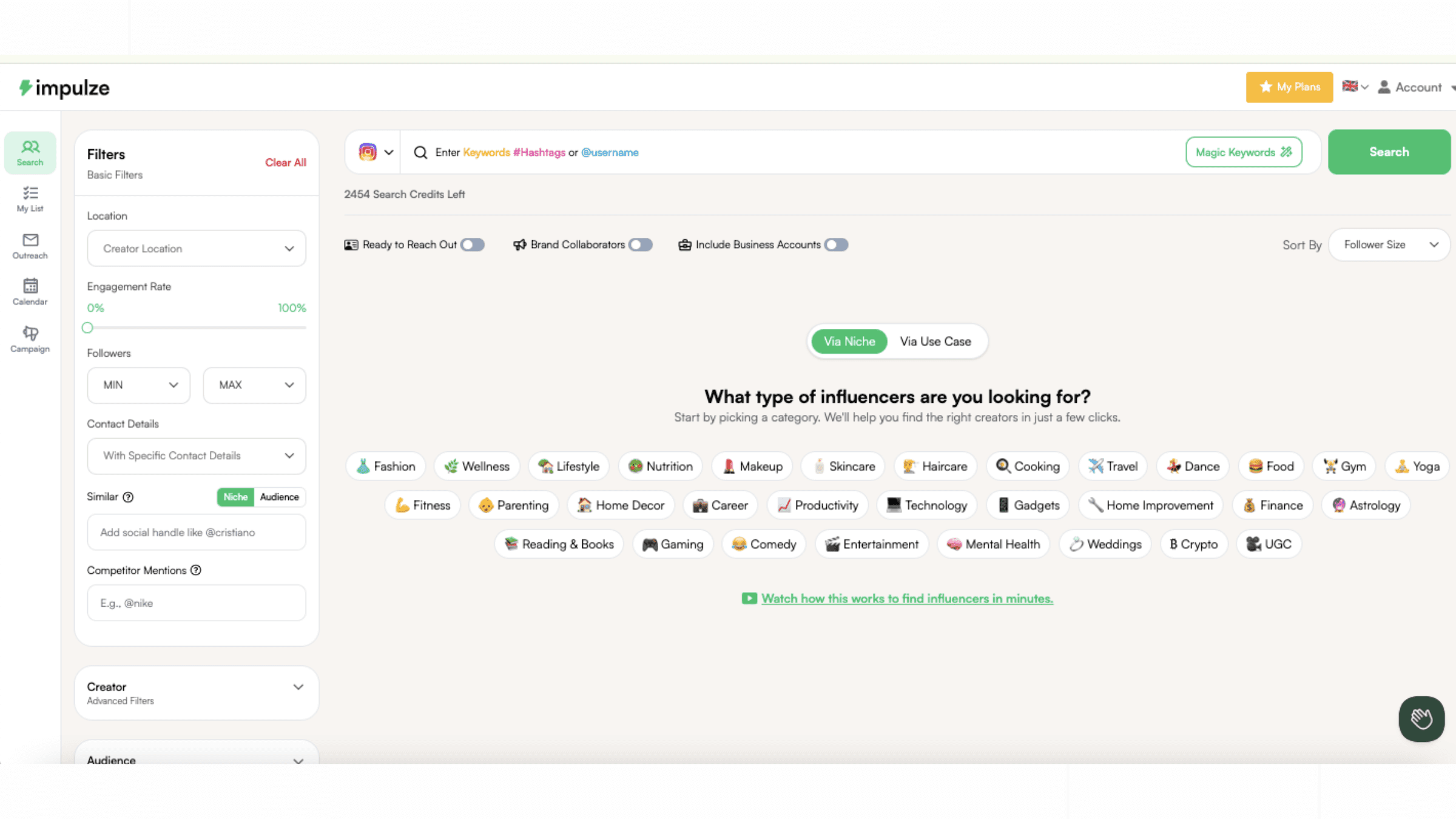
Yes, turn on the toggle button for contact details, and it turns a 10-minute "hunt" into a 0.1-second data fetch!
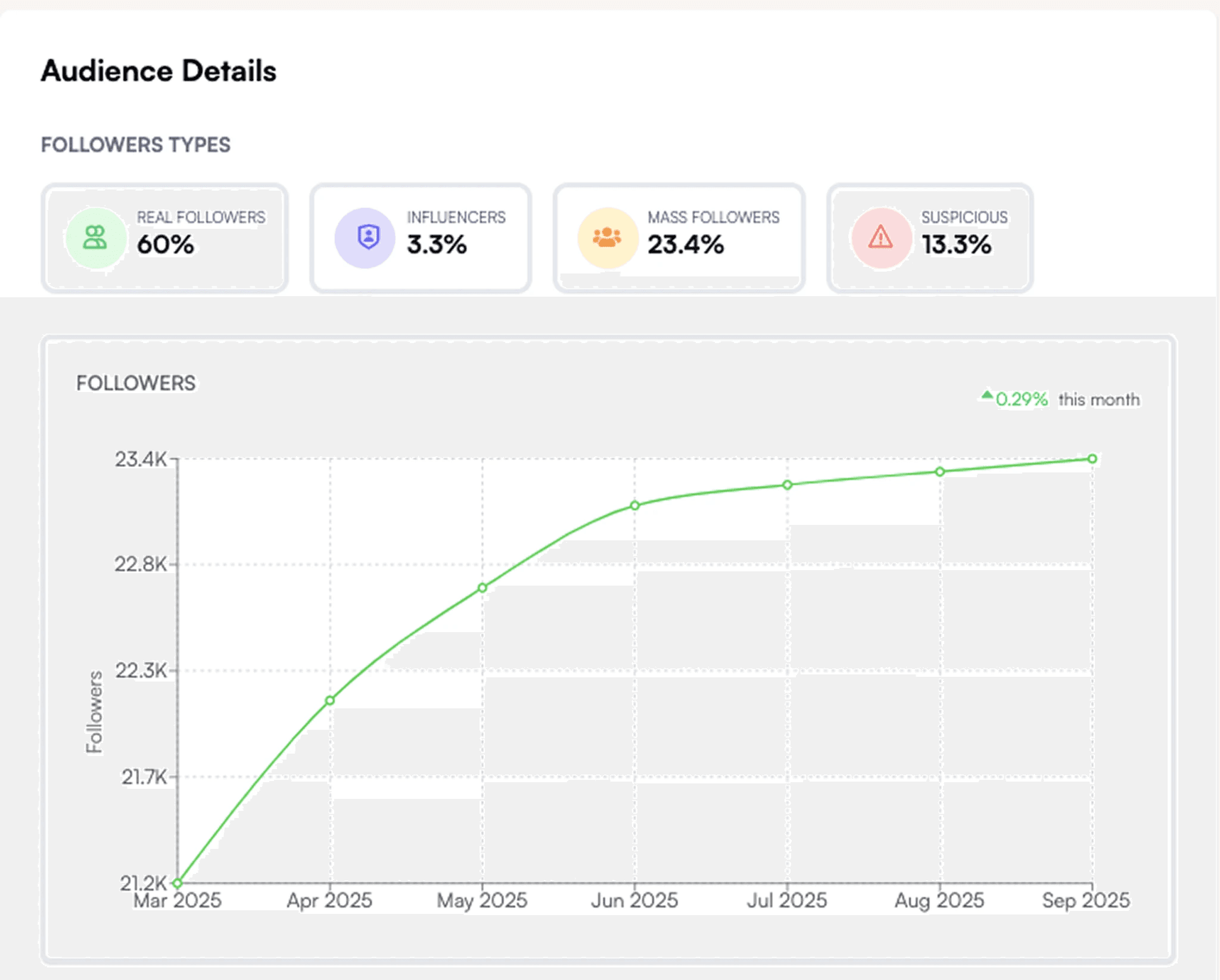
Plus, the platform also gives you a detailed profile that instantly flags "bot" behavior, shows you audience insights, and also past brand collaborations, so you can decide within minutes if the creator is worth working with or not.
Download For Free: Influencer Vetting Checklist
2. Sending Pitches & Follow-ups
So, you’ve found your ideal creators, and now it’s time to reach out.
Sending 50 individual, personalized emails or DMs is a recipe for burnout and a cluttered inbox. And let's not even talk about the agony of manually tracking who you've followed up with and when.
The Manual Trap:
Copy-pasting the same "Hey [Name], love your content!" message over and over.
Losing track of who replied, who didn't, and who you still need to chase.
Forgetting to send follow-ups entirely, meaning lost opportunities.
Manually logging communication in a spreadsheet.
How to automate this:
This is where smart CRM tools and outreach platforms become your best friend. They allow for personalized, scalable communication.
If you are planning to run influencer campaigns, it’s best to use a influencer marketing platform that also offers outreach so you can manage everything in one place. With impulze.ai, this is possible as you can launch automated email sequences to multiple creators at once. You start by sending your campaign brief to your curated list, followed by up to three automatic follow-ups scheduled at intervals you choose.
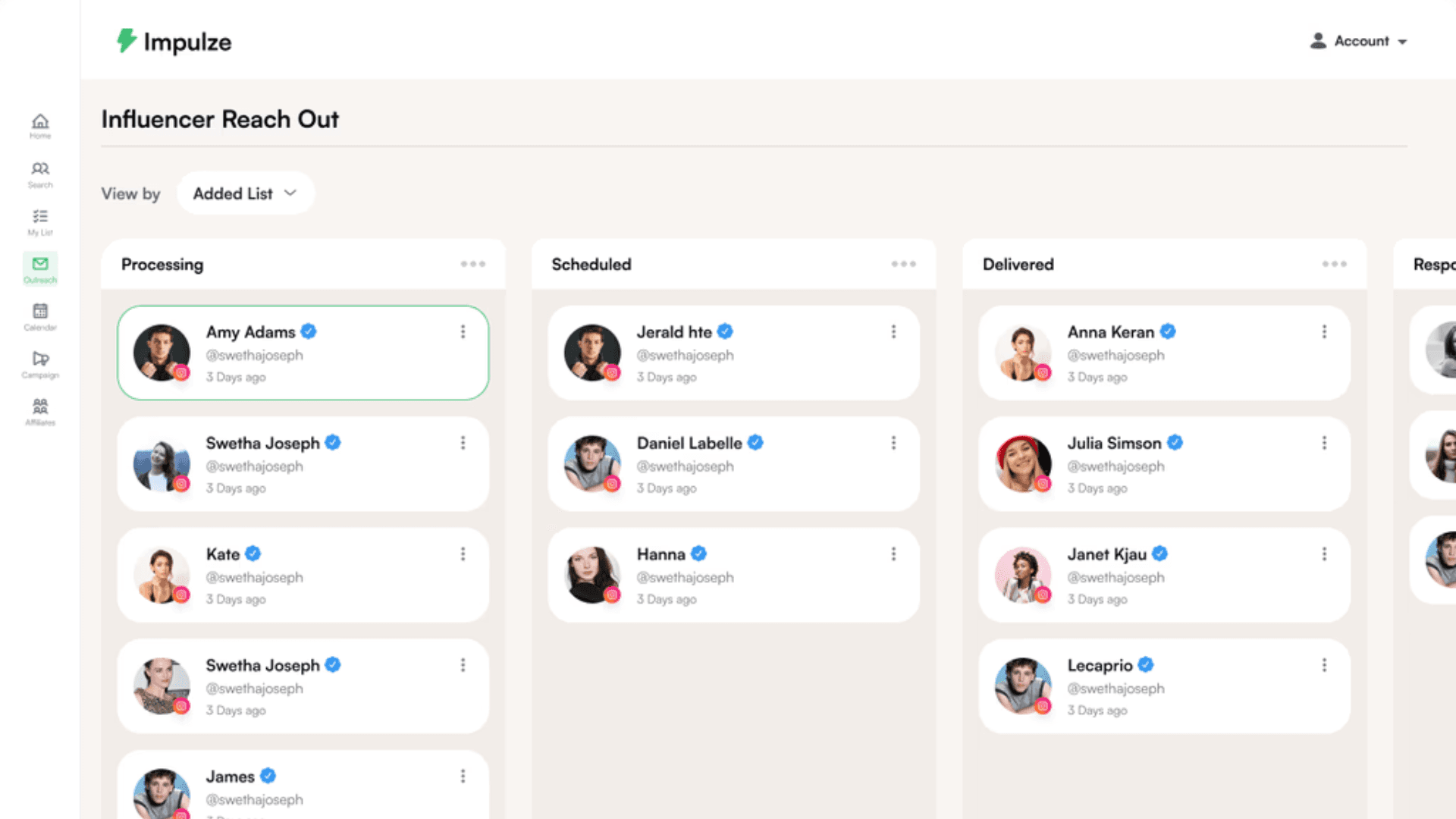
The system does the "heavy lifting" of checking for replies. You only see responses in your inbox when they actually happen, meaning you’re not wasting hours chasing dead ends or checking "Sent" folders to see who ignored you. It turns the "black hole" of outreach into a streamlined, hands-off pipeline.
If you prefer a more granular CRM approach, you can use platforms like Attio or Brevo. These are excellent if you want to integrate your influencer outreach into a wider brand ecosystem or manage complex, multi-stage partnership negotiations.
Pro Tip: When setting up your automated sequence, always use dynamic tags (like {{first_name}} or {{social_handle}}). Even though the machine is sending the email, these tags ensure the creator feels like you’ve actually done your homework.
3. Tracking Influencer Content
The campaign is live! Now comes the anxiety.
Did they post?
Did they include the right hashtag?
Is the link working?
Checking an influencer's Stories every hour to see if they’ve posted, especially for time-sensitive content, is a poor use of your valuable time and a recipe for exhaustion.
The Manual Trap:
Constantly refreshing social feeds.
Manually screenshotting Stories before they disappear (within 24 hours) to prove the post happened and for your own records.
Trying to manually verify hashtags, @mentions, and call-to-actions.
Missing content because you weren't online at the right time.
How to automate this:
Use dedicated influencer marketing platforms like impulze, or social listening tools such as Brandwatch or Sprout Social. These tools can often "scrape" content or monitor specific hashtags, keywords, and @mentions.
They automatically capture and save the content, captions, and links the moment they go live, even for ephemeral content like Instagram Stories.
This creates a permanent archive for your brand, verifies campaign compliance (correct hashtags, disclosures, links), and gives you peace of mind, all without you having to be glued to your phone. You can quickly see if a creator went live, if they used your specific tracking link, and if the post meets your brand guidelines.
4. Contract Management & E-Signatures
Nothing kills the momentum of a new partnership faster than a clunky, messy PDF exchange. You've built excitement, agreed on terms, and then you have to wade through printing, signing, scanning, and emailing. Ugh.
The Manual Trap:
Emailing a Word document or PDF, hoping the influencer has a printer and scanner.
Waiting days for a physical signature.
Chasing down missing pages or illegible scans.
Filing contracts in a random desktop folder or a confusing cloud drive structure.
How to automate this:
Use platforms like DocuSign, HelloSign, PandaDoc, or the built-in contract management modules found in comprehensive influencer CRM platforms. These tools allow you to create templates, send contracts digitally for e-signature, and automatically store executed agreements in a centralized, secure location. Many platforms can even trigger a contract the moment a creator accepts a proposal.
It keeps your legal protections centralized, professional, and easily accessible. It accelerates the onboarding process, making your brand look organized and efficient, and reduces friction for your creators. Plus, it eliminates the "dog ate my contract" excuses.
Also Read: How to Stay Legal When Working With Influencers on Social Media
5. Handling Payments
Ah, money. The part everyone cares about, and often the most cumbersome to manage, especially when dealing with dozens or hundreds of creators globally.
Processing individual invoices, cross-referencing completed work, and managing different payment cycles manually is a nightmare.
The Manual Trap:
Manually requesting invoices from each creator.
Cross-referencing payment terms with completed content.
Manually initiating bank transfers or PayPal payments one by one.
Dealing with international payment complexities and fees.
Tracking payment statuses in a separate spreadsheet.
How to automate this:
Many top-tier influencer marketing platforms have integrated payment systems.
Alternatively, you can use specialized payment solutions that integrate with your accounting software, such as Bill.com, Veem (great for international payments), or even advanced payroll systems like Gusto for contractors. These systems can process batch payments, handle different currencies, and automatically generate payment reports.
Automated payments ensure creators are paid on time (which builds goodwill and encourages repeat collaborations), simplify accounting, and reduce errors. It turns a time-consuming administrative burden into a smooth, seamless process, especially when scaling.
Also Read: How to Pay Influencers: A Guide for Brands
6. Performance Reporting & ROI Calculation
You’ve done all the work, the campaigns are live, and now the critical question: What’s the ROI?
Calculating the total impact of 20 different creators across three different platforms shouldn't require a math degree, a pile of spreadsheets, and a sleepless night.
The Manual Trap:
Asking creators for screenshots of their "Insights" dashboards (which can be manipulated or inconsistent).
Manually typing those numbers (likes, comments, shares, views, clicks) into a master Excel sheet.
Trying to manually calculate Cost Per Acquisition (CPA) or Return on Ad Spend (ROAS) based on disjointed data.
Struggling to create visually appealing reports for stakeholders.
How to automate this:
The best approach is to create a campaign via influencer marketing platforms like impulze.ai.
This pulls real-time, verified data directly from social platforms (Instagram, TikTok, YouTube, etc.) into a live dashboard. These platforms can then automatically calculate key metrics like engagement rates, reach, impressions, click-through rates, and even track conversions if integrated with your e-commerce platform.
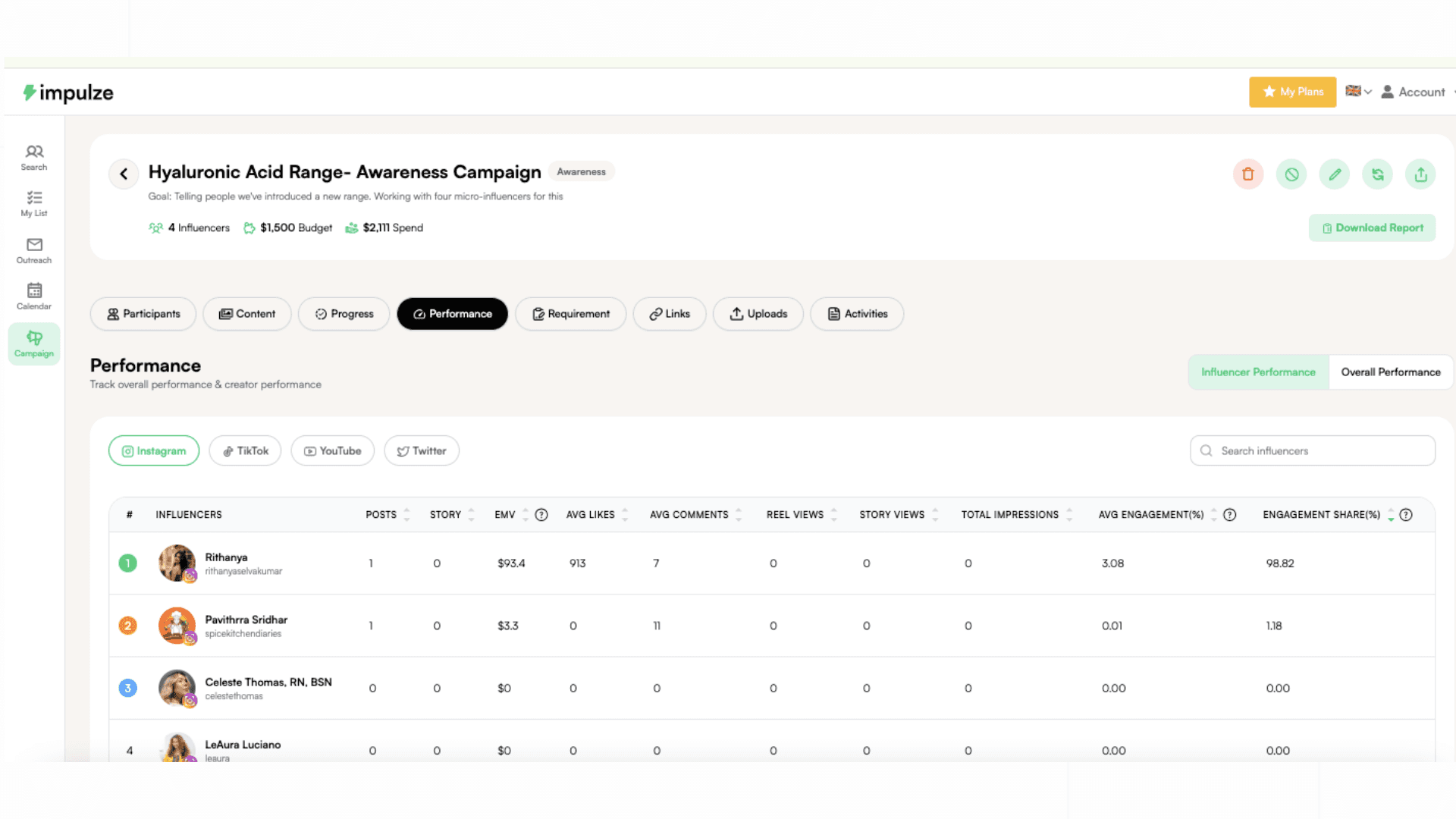
This way, if you your CEO asks for a quarterly influencer marketing report. Instead of spending two days compiling data, you can open your impulze.ai dashboard, select the relevant timeframe, and generate a beautiful, data-rich PDF or live link report in minutes, showing everything from top-performing creators to overall ROI.
Manual vs. Automated Workflow: A Stark Reality
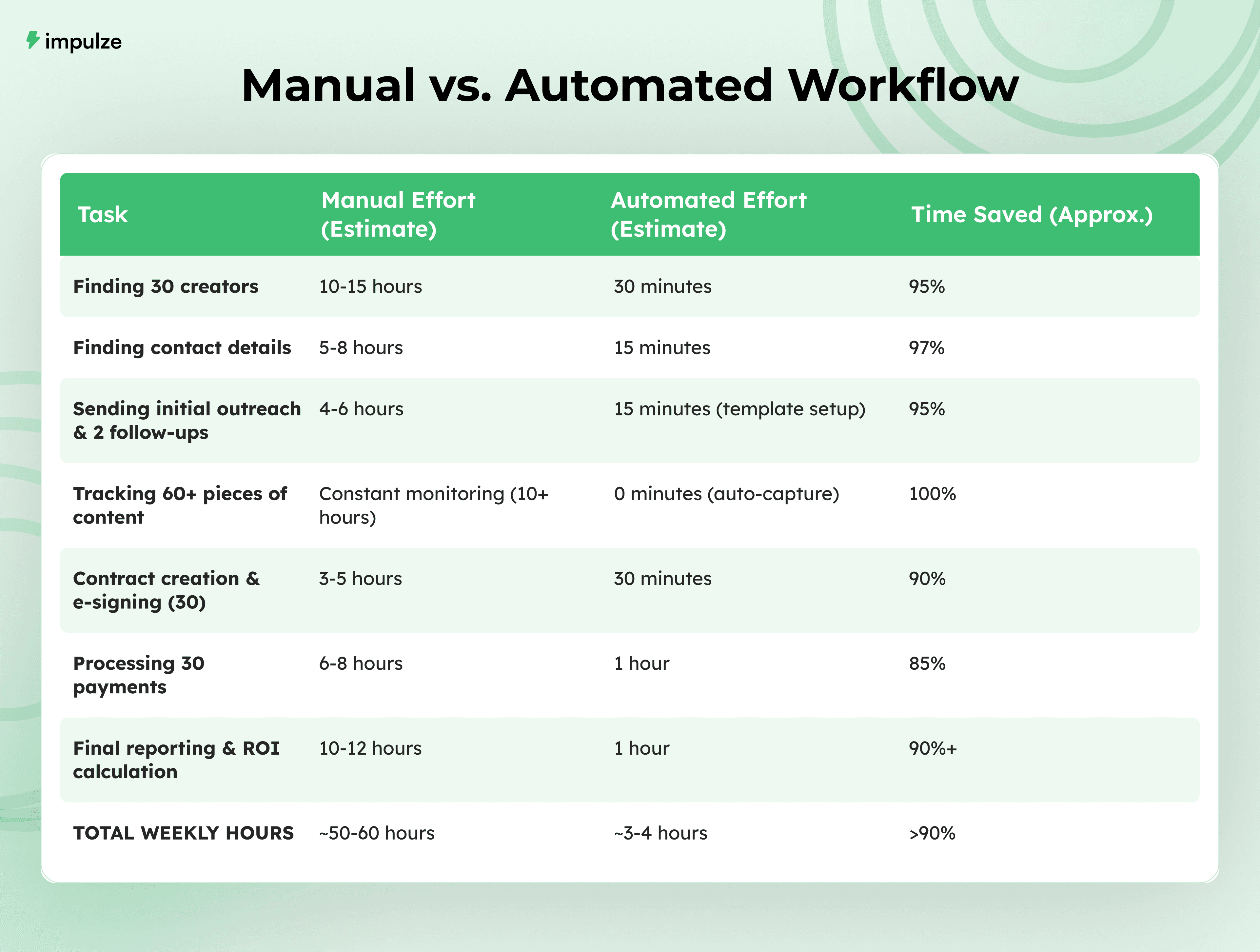
To underscore just how much time and effort you save, let's look at a quick comparison for a moderately sized campaign involving, say, 20-30 influencers:
The Bottom Line: Your Time is Gold
If you look back at the comparison table, the numbers speak for themselves: automation shrinks a 28-hour manual workload into just 30 minutes of oversight.
That is nearly an entire work week reclaimed!
In 2026, the brands that win aren't the ones with the biggest budgets, they’re the ones with the best systems.
When you automate the "boring" stuff—finding emails, tracking stories, and chasing signatures—you free up your brain to do the "human" stuff: creative strategy and relationship building.
Stop being a data entry clerk and start being a marketer.
If you want to start saving time and scale your efforts without the stress, create a free account on impulze.ai now.
If your daily "marketing" routine involves more than 20% data entry, there will be times, you will feel more like an unpaid assistant to an algorithm than a marketer.
We live in an era where an API can do in four seconds what takes a human four hours. Yet, most brand managers are still trapped in "Spreadsheet Prison," manually copying handles, hunting for emails, and hovering over Instagram Stories to hit "screenshot" before the 24-hour timer runs out.
In 2026, the gap between a high-performing campaign and a total flop is determined by workflow automation.
If you want to stop the leak in your operational efficiency, these are the influencer marketing tasks you need to offload to the machines immediately.
1. Finding Contact Details & Influencer Discovery
Most people start their "Discovery" by opening TikTok or Insta and typing in keywords. This is the first mistake. You are at the mercy of the platform’s discovery algorithm, which is designed for entertainment, not influencer procurement.
And even if you do find a needle in this haystack, you will later realize that the haystack was also full of fake accounts and expired email addresses.
The Manual Trap:
Spend hours scrolling through social feeds.
Click every link in a creator’s bio, only to find a personal email or an agency contact form.
Send DMs that often get lost in "message requests" limbo.
Rely on guesswork for audience demographics or engagement quality.
How to automate this:
Simple. Use an influencer search platform like impulze.ai. Sign up for free, add search filters and it can give you a list of hundreds in minutes, complete with their verified contact information.
Yes, turn on the toggle button for contact details, and it turns a 10-minute "hunt" into a 0.1-second data fetch!
Plus, the platform also gives you a detailed profile that instantly flags "bot" behavior, shows you audience insights, and also past brand collaborations, so you can decide within minutes if the creator is worth working with or not.
Download For Free: Influencer Vetting Checklist
2. Sending Pitches & Follow-ups
So, you’ve found your ideal creators, and now it’s time to reach out.
Sending 50 individual, personalized emails or DMs is a recipe for burnout and a cluttered inbox. And let's not even talk about the agony of manually tracking who you've followed up with and when.
The Manual Trap:
Copy-pasting the same "Hey [Name], love your content!" message over and over.
Losing track of who replied, who didn't, and who you still need to chase.
Forgetting to send follow-ups entirely, meaning lost opportunities.
Manually logging communication in a spreadsheet.
How to automate this:
This is where smart CRM tools and outreach platforms become your best friend. They allow for personalized, scalable communication.
If you are planning to run influencer campaigns, it’s best to use a influencer marketing platform that also offers outreach so you can manage everything in one place. With impulze.ai, this is possible as you can launch automated email sequences to multiple creators at once. You start by sending your campaign brief to your curated list, followed by up to three automatic follow-ups scheduled at intervals you choose.
The system does the "heavy lifting" of checking for replies. You only see responses in your inbox when they actually happen, meaning you’re not wasting hours chasing dead ends or checking "Sent" folders to see who ignored you. It turns the "black hole" of outreach into a streamlined, hands-off pipeline.
If you prefer a more granular CRM approach, you can use platforms like Attio or Brevo. These are excellent if you want to integrate your influencer outreach into a wider brand ecosystem or manage complex, multi-stage partnership negotiations.
Pro Tip: When setting up your automated sequence, always use dynamic tags (like {{first_name}} or {{social_handle}}). Even though the machine is sending the email, these tags ensure the creator feels like you’ve actually done your homework.
3. Tracking Influencer Content
The campaign is live! Now comes the anxiety.
Did they post?
Did they include the right hashtag?
Is the link working?
Checking an influencer's Stories every hour to see if they’ve posted, especially for time-sensitive content, is a poor use of your valuable time and a recipe for exhaustion.
The Manual Trap:
Constantly refreshing social feeds.
Manually screenshotting Stories before they disappear (within 24 hours) to prove the post happened and for your own records.
Trying to manually verify hashtags, @mentions, and call-to-actions.
Missing content because you weren't online at the right time.
How to automate this:
Use dedicated influencer marketing platforms like impulze, or social listening tools such as Brandwatch or Sprout Social. These tools can often "scrape" content or monitor specific hashtags, keywords, and @mentions.
They automatically capture and save the content, captions, and links the moment they go live, even for ephemeral content like Instagram Stories.
This creates a permanent archive for your brand, verifies campaign compliance (correct hashtags, disclosures, links), and gives you peace of mind, all without you having to be glued to your phone. You can quickly see if a creator went live, if they used your specific tracking link, and if the post meets your brand guidelines.
4. Contract Management & E-Signatures
Nothing kills the momentum of a new partnership faster than a clunky, messy PDF exchange. You've built excitement, agreed on terms, and then you have to wade through printing, signing, scanning, and emailing. Ugh.
The Manual Trap:
Emailing a Word document or PDF, hoping the influencer has a printer and scanner.
Waiting days for a physical signature.
Chasing down missing pages or illegible scans.
Filing contracts in a random desktop folder or a confusing cloud drive structure.
How to automate this:
Use platforms like DocuSign, HelloSign, PandaDoc, or the built-in contract management modules found in comprehensive influencer CRM platforms. These tools allow you to create templates, send contracts digitally for e-signature, and automatically store executed agreements in a centralized, secure location. Many platforms can even trigger a contract the moment a creator accepts a proposal.
It keeps your legal protections centralized, professional, and easily accessible. It accelerates the onboarding process, making your brand look organized and efficient, and reduces friction for your creators. Plus, it eliminates the "dog ate my contract" excuses.
Also Read: How to Stay Legal When Working With Influencers on Social Media
5. Handling Payments
Ah, money. The part everyone cares about, and often the most cumbersome to manage, especially when dealing with dozens or hundreds of creators globally.
Processing individual invoices, cross-referencing completed work, and managing different payment cycles manually is a nightmare.
The Manual Trap:
Manually requesting invoices from each creator.
Cross-referencing payment terms with completed content.
Manually initiating bank transfers or PayPal payments one by one.
Dealing with international payment complexities and fees.
Tracking payment statuses in a separate spreadsheet.
How to automate this:
Many top-tier influencer marketing platforms have integrated payment systems.
Alternatively, you can use specialized payment solutions that integrate with your accounting software, such as Bill.com, Veem (great for international payments), or even advanced payroll systems like Gusto for contractors. These systems can process batch payments, handle different currencies, and automatically generate payment reports.
Automated payments ensure creators are paid on time (which builds goodwill and encourages repeat collaborations), simplify accounting, and reduce errors. It turns a time-consuming administrative burden into a smooth, seamless process, especially when scaling.
Also Read: How to Pay Influencers: A Guide for Brands
6. Performance Reporting & ROI Calculation
You’ve done all the work, the campaigns are live, and now the critical question: What’s the ROI?
Calculating the total impact of 20 different creators across three different platforms shouldn't require a math degree, a pile of spreadsheets, and a sleepless night.
The Manual Trap:
Asking creators for screenshots of their "Insights" dashboards (which can be manipulated or inconsistent).
Manually typing those numbers (likes, comments, shares, views, clicks) into a master Excel sheet.
Trying to manually calculate Cost Per Acquisition (CPA) or Return on Ad Spend (ROAS) based on disjointed data.
Struggling to create visually appealing reports for stakeholders.
How to automate this:
The best approach is to create a campaign via influencer marketing platforms like impulze.ai.
This pulls real-time, verified data directly from social platforms (Instagram, TikTok, YouTube, etc.) into a live dashboard. These platforms can then automatically calculate key metrics like engagement rates, reach, impressions, click-through rates, and even track conversions if integrated with your e-commerce platform.
This way, if you your CEO asks for a quarterly influencer marketing report. Instead of spending two days compiling data, you can open your impulze.ai dashboard, select the relevant timeframe, and generate a beautiful, data-rich PDF or live link report in minutes, showing everything from top-performing creators to overall ROI.
Manual vs. Automated Workflow: A Stark Reality
To underscore just how much time and effort you save, let's look at a quick comparison for a moderately sized campaign involving, say, 20-30 influencers:
The Bottom Line: Your Time is Gold
If you look back at the comparison table, the numbers speak for themselves: automation shrinks a 28-hour manual workload into just 30 minutes of oversight.
That is nearly an entire work week reclaimed!
In 2026, the brands that win aren't the ones with the biggest budgets, they’re the ones with the best systems.
When you automate the "boring" stuff—finding emails, tracking stories, and chasing signatures—you free up your brain to do the "human" stuff: creative strategy and relationship building.
Stop being a data entry clerk and start being a marketer.
If you want to start saving time and scale your efforts without the stress, create a free account on impulze.ai now.
Frequently Asked Questions
Does automating outreach make my brand look like a "bot"?

Does automating outreach make my brand look like a "bot"?
Will automation help me calculate my actual ROI, not just "likes"?
Will automation help me calculate my actual ROI, not just "likes"?
What is the difference between an Influencer CRM and a standard Sales CRM?
What is the difference between an Influencer CRM and a standard Sales CRM?
Does automation work for micro and nano-influencers?
Does automation work for micro and nano-influencers?
Author Bio
Author Bio
Rashmi Singh
Rashmi Singh
Rashmi Singh is a writer and strategist with more than 7 years of experience. When not writing, she is either spending time with her friends or planning her next trip. You can learn more about her here.
Rashmi Singh is a writer and strategist with more than 7 years of experience. When not writing, she is either spending time with her friends or planning her next trip. You can learn more about her here.
We Also Recommend To Read