🥳 Skip the subscription. Pay $299 once for lifetime access— See lifetime plans
🥳 Skip the subscription. Pay $299 once for lifetime access—

7 MIN READ
Discovery
Discovery
How to Find Lookalike Influencers in 2026: The "One Creator = 500 More" Method
How to Find Lookalike Influencers in 2026: The "One Creator = 500 More" Method
How to Find Lookalike Influencers in 2026: The "One Creator = 500 More" Method
Sections
Build your first creator list on Solo, $29 a month.

Blog in Short ⏱️
Blog in Short ⏱️
A quick glance at the highlights—perfect for when you're short on time.
A quick glance at the highlights—perfect for when you're short on time.
Most brands find one creator who works, then go back to scrolling Instagram by hand for the next ten. The faster move: feed the one that worked into a lookalike engine and surface 500 more — matched on audience overlap, not aesthetic. Total time per source creator: 90 seconds.
Here are the key takeaways:
A lookalike match is about audience overlap, not vibes
Impulze's Similar field has a Niche / Audience toggle — Audience is the higher-signal one for performance campaigns
Every Impulze Influencer Report surfaces a Lookalikes section automatically — deep-vet one creator and get 10+ similar names for free
Rank lookalikes by Credibility Score so you're not chasing inflated numbers
Manual scrolling caps discovery at ~20 creators a day; this method clears 500 in one search
Your first creator drove 200 signups off a single Reel. Your CMO opens Slack: "Can we hit 2,000 next month? Find 10 more like her."
You stare at the screen. Your last 90 minutes were spent scrolling hashtags by hand to find that first creator. Multiplying that by 10 means a full week of searching, screenshotting, and DMing — and most of the candidates will be wrong.
There's a faster move. The creator who already converted is the single best clue you have about who to partner with next. Their audience matches your customer. Their format matches your funnel. Their voice matches your brand. You don't need to start over — you need to extract the pattern and run it 500 more times.
This guide shows you exactly how to do that inside Impulze. Total time per source creator: about 90 seconds.
Open Impulze and run your first similar-creator search →
Why "find more like this one" is the most underused workflow in influencer marketing
Most small teams treat every campaign like a cold start. They forget that the winning creator from their last campaign is a signal — and a powerful one.
Lookalike discovery flips that. You take one creator that converted, paste their handle into a similar-creator engine, and let the data find the rest. The output isn't 20 maybe-matches. It's a ranked list of creators whose audiences, formats, engagement profiles, and collaboration histories most closely match the one you already trust.
What a lookalike actually is (and what most tools get wrong)
The phrase "find me 500 creators like Emma Chamberlain" sounds like it means "find me 500 creators who look like Emma." Most cheap tools interpret it that way — they match on niche, follower band, and aesthetic. Their output is full of generic Gen Z lifestyle accounts that have nothing to do with your customer.
A proper lookalike match isn't about how the creator looks. It's about who's watching.
The signal that matters is audience overlap. Two creators with completely different aesthetics can have nearly identical audiences — same age range, same income band, same purchase intent. That's the match worth chasing, because the audience is the asset.
Niche match vs Audience match — the toggle most marketers miss
Inside Impulze's Creator Discovery, the Similar field in the left filter panel lets you toggle how the engine matches:
Similar by Niche — finds creators in the same content category as your seed. Useful when format consistency matters (e.g., you want only Reel-first creators in beauty).
Similar by Audience — finds creators whose audiences overlap with your seed's audience, even if their content category is different. Higher-signal for performance campaigns.
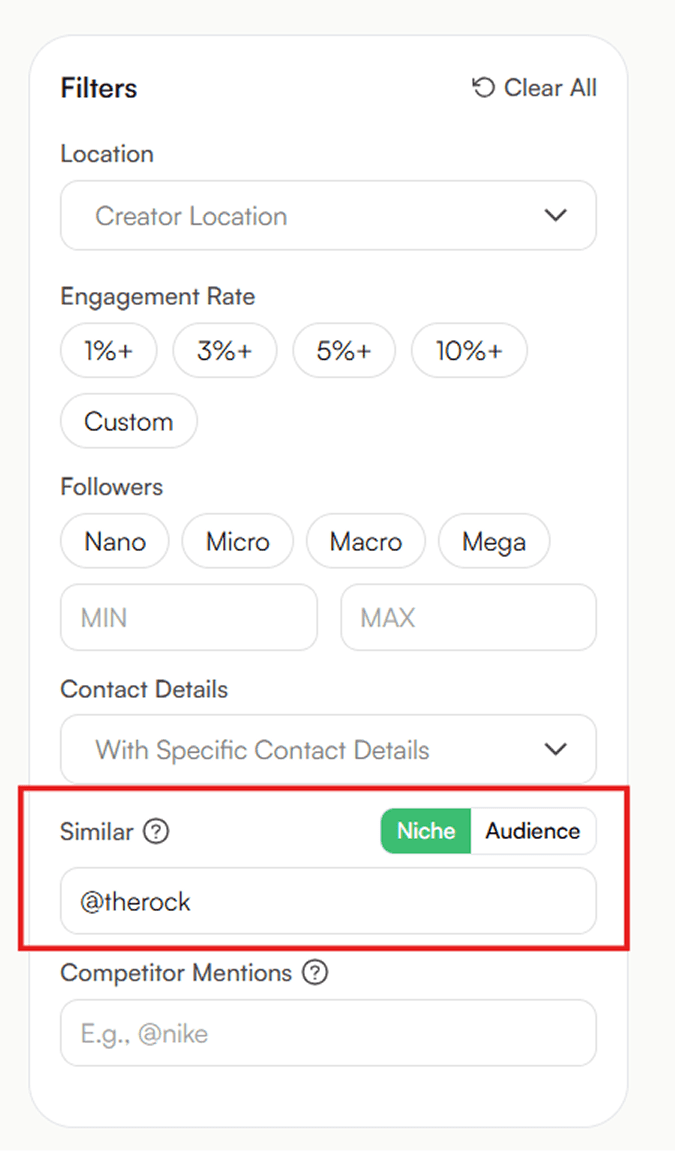
The Niche toggle is what most "Find similar creators" tools default to. The Audience toggle returns lookalikes who actually convert for your category. Default to Audience first; switch to Niche only if you need format alignment.
The 5 signals a good lookalike engine compares
When a similar-creator search is doing its job, it's weighing these five signals together — not just one.
1. Audience overlap, not aesthetic match
The engine compares the source creator's audience demographics (age, gender, geography, interests, income tier) against every other creator in the database and ranks by overlap percentage. Two creators in completely different categories can still hit 80%+ overlap if their followers are the same humans.
2. Posting cadence and format mix
If your source wins because she posts 3 Reels a week with product integrations, you don't want lookalikes who only post static carousels twice a month. A good engine weights format match so the top results aren't just audience-similar — they can actually run the same campaign structure.
3. Engagement quality (and Credibility Score)
Most lookalike searches rank by average ER, which is easy to fake. Inside Impulze, every creator in the Discovery results — and every result inside an Influencer Report's Lookalikes section — comes with the Credibility Score baked in. Filter on it to keep only the lookalikes whose numbers are real.
4. Geography and language
Surface-level filters are easy to forget. If your source creator's audience is 70% US and you greenlight a lookalike whose audience is 60% Brazil, you've matched the vibe and missed the customer. Lock geography and language as hard filters in the Audience panel.
5. Brand collaboration history
The smart-matches signal. Look at what your source creator has worked with, then look at what your lookalike candidates have worked with. If three of your top matches have collaborated with brands in your competitor set, that's a strong signal they convert for your category.
The "One Creator = 500 More" workflow
Here's how the full loop runs inside Impulze. Total time: about 90 seconds per source creator.
Step 1. Copy the handle of the creator who already converted on a campaign you ran.
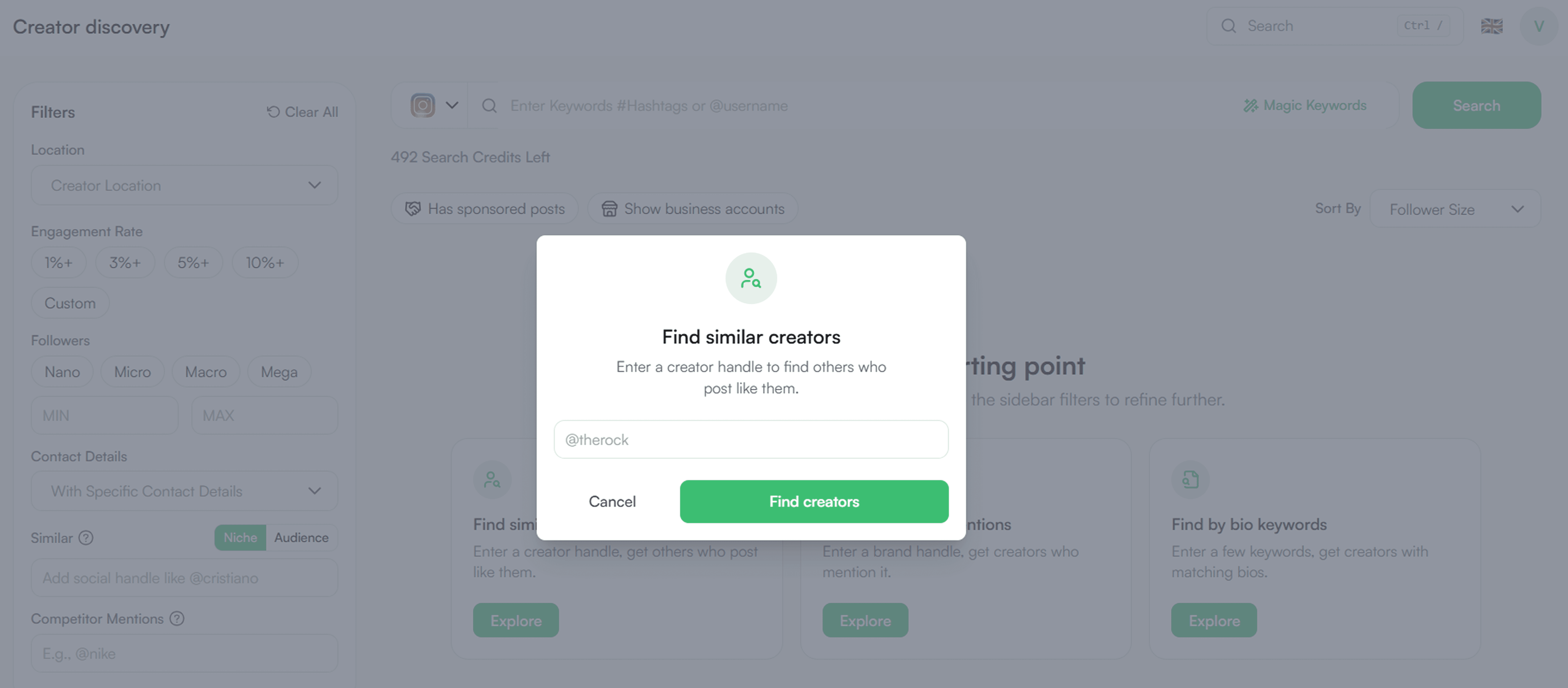
Step 2. Open Creator Discovery. On the "Find similar creators" card, click Explore.
Step 3. Paste the handle into the Similar field in the left filter panel. Toggle to Audience (not Niche) for performance use cases.
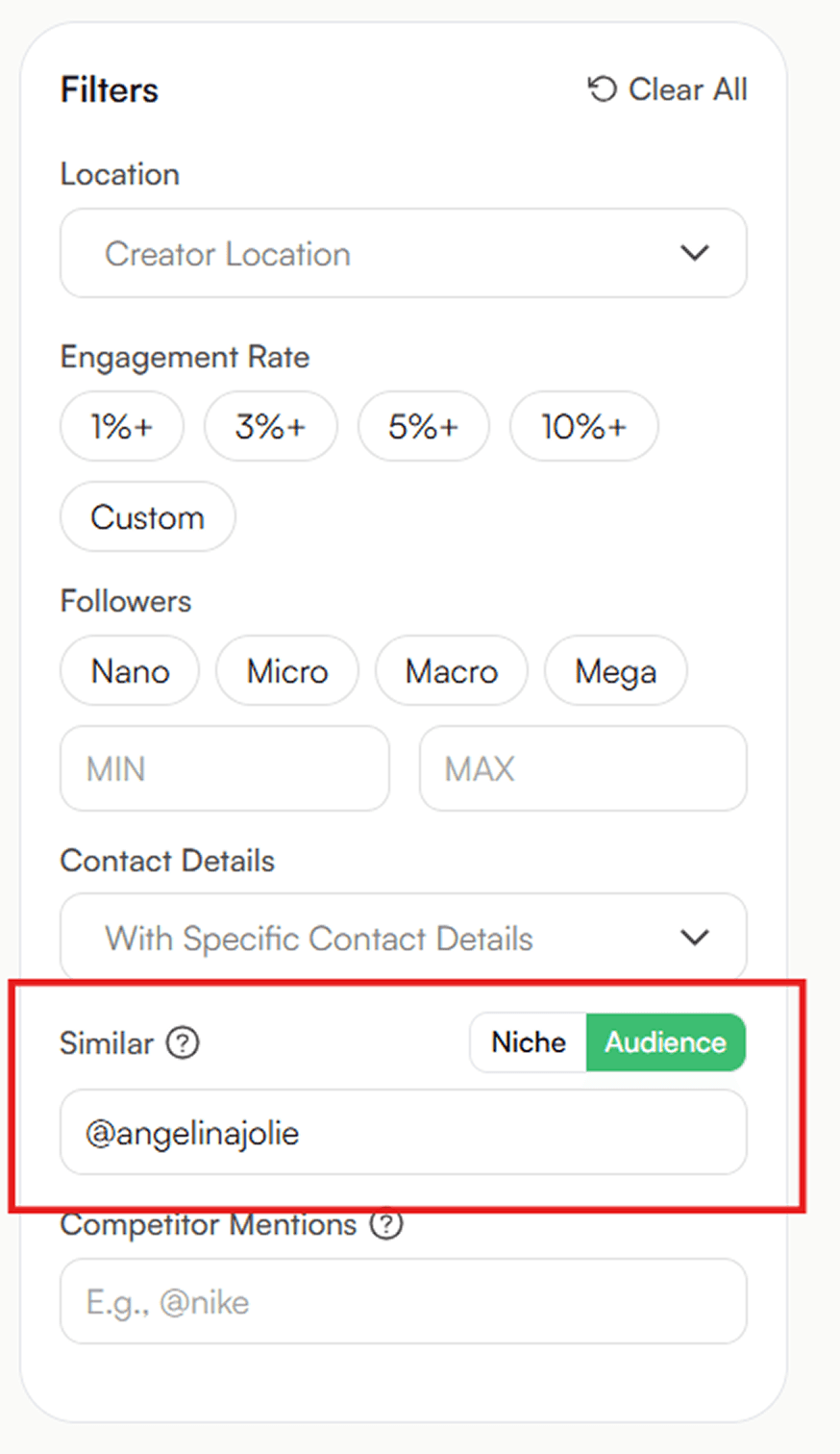
Step 4. Apply hard filters: Audience Locations, Engagement Rate floor, Audience Credibility minimum. Don't filter follower count yet — you want to see the full distribution.
Step 5. Click Search.
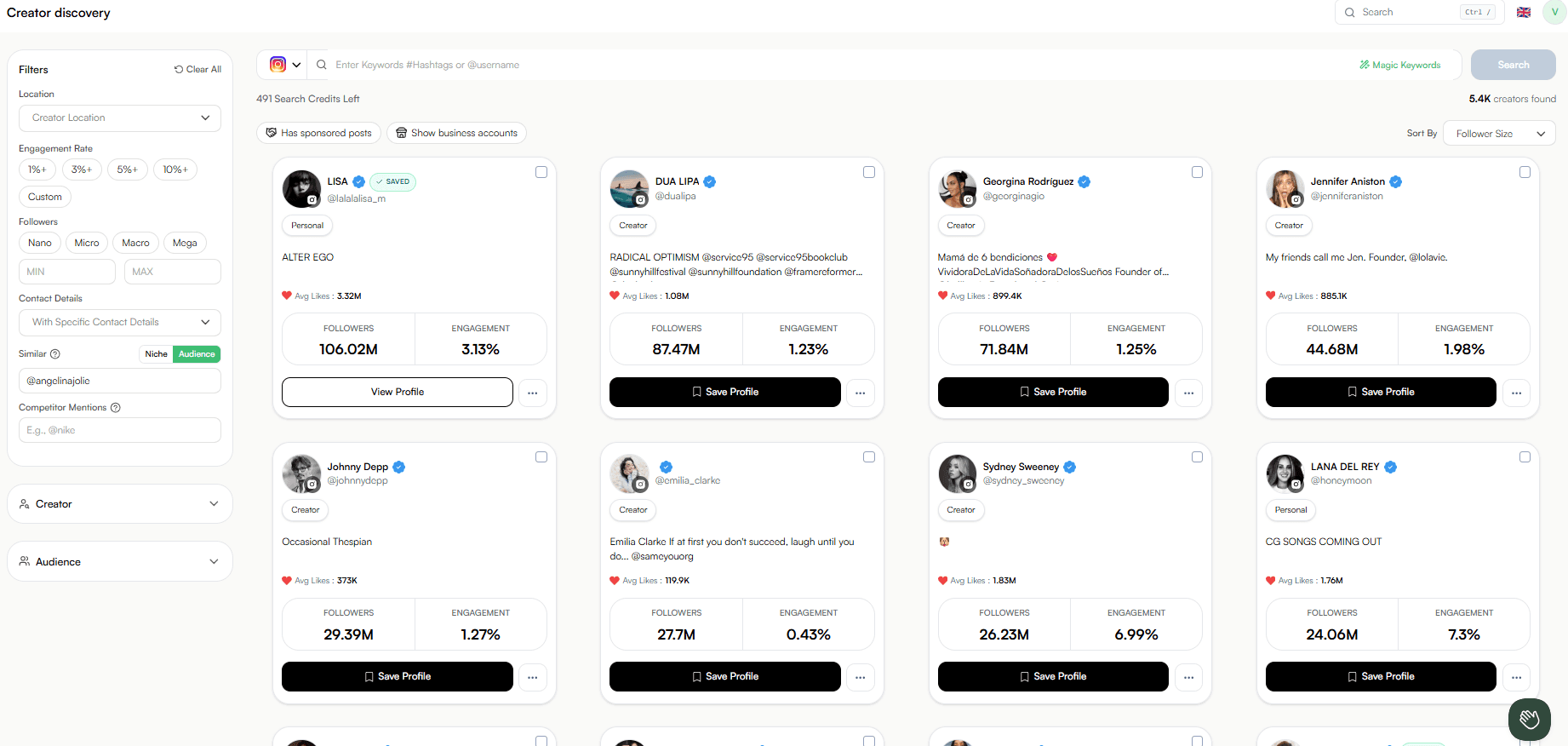
Step 6. Stack secondary filters from the Creator section (Content Count, Last Posted) or the Audience section (Audience Age, Gender, Interest) to narrow the format/profile match.
Step 7. Open the top 5 in an Influencer Report. Inside each report, scroll to the Lookalikes section — Impulze automatically surfaces another 10 similar creators per report. That's how one becomes 50, then 500.
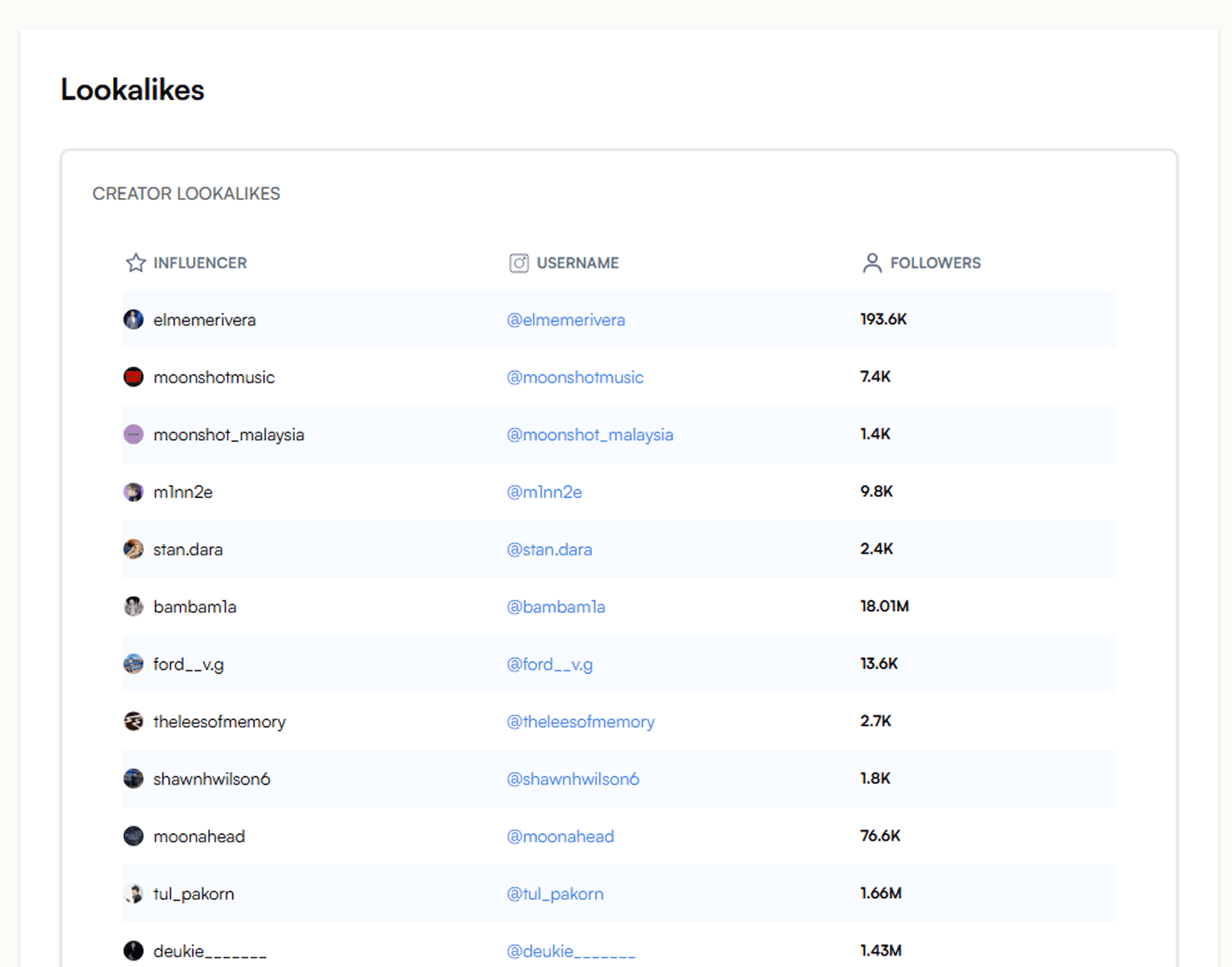
Most teams skip steps 5–7 and wonder why their lookalike searches feel random.
Also read: How to Stack Influencer Search Filters: The 5-Minute Shortlist Method
Where this workflow breaks (and how to fix it)
Your source creator was a one-off. If the creator only did one campaign and the win was driven by a launch moment, the pattern isn't real yet. Run them on a second campaign before treating them as the seed.
Your audience is too niche. If you're selling to female fly-fishing guides in the Pacific Northwest, even a strong engine will return short lists. Loosen filters or accept the smaller pool.
You filter too aggressively. People stack 6 filters on the first pass and end up with 4 results. Start loose, sort by overlap or Credibility, then narrow.
Two situations in which this method changes everything
Scaling a winning campaign. Your first creator drove 200 signups. Your CMO wants 2,000. You need 9 more creators who behave like the one who worked. Lookalike discovery turns that ask from "two weeks of scrolling" into "an afternoon vetting a pre-ranked shortlist."
Replacing a creator who's no longer available. Your best partner raised their rate, signed an exclusive with a competitor, or didn't renew. Feed their handle into the engine, and the next-best matches by audience overlap appear in seconds. Multi-week project → 30-minute task.
Run your first lookalike search in 90 seconds
You already have the seed. Paste the handle, set the toggle to Audience, and hit search.
Inside Impulze, you'll get:
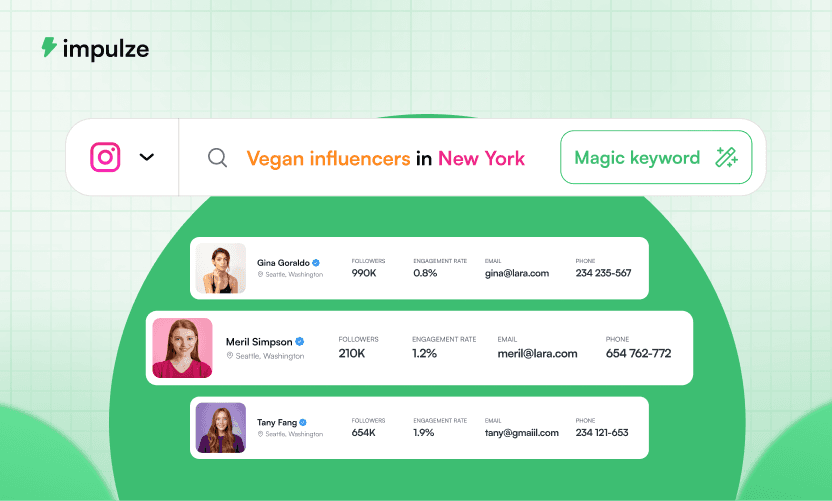
Similar field in Creator Discovery — paste any Instagram, TikTok, or YouTube handle, toggle Niche/Audience, search across 440M+ profiles
Filter stacking in the same view — Location, ER, Followers, plus the Creator and Audience sections for secondary narrowing
Influencer Report → Lookalikes section — every report surfaces 10+ similar creators automatically, so deep-vetting one gives you the next ring for free
Credibility Score on every result — rank lookalikes by who's actually real
Sponsored Performance % inside each Influencer Report — so you know who actually performs on paid posts before reaching out
One seed. 500 ranked lookalikes. Ninety seconds.
Open Impulze and run your first similar-creator search — free →
Your first creator drove 200 signups off a single Reel. Your CMO opens Slack: "Can we hit 2,000 next month? Find 10 more like her."
You stare at the screen. Your last 90 minutes were spent scrolling hashtags by hand to find that first creator. Multiplying that by 10 means a full week of searching, screenshotting, and DMing — and most of the candidates will be wrong.
There's a faster move. The creator who already converted is the single best clue you have about who to partner with next. Their audience matches your customer. Their format matches your funnel. Their voice matches your brand. You don't need to start over — you need to extract the pattern and run it 500 more times.
This guide shows you exactly how to do that inside Impulze. Total time per source creator: about 90 seconds.
Open Impulze and run your first similar-creator search →
Why "find more like this one" is the most underused workflow in influencer marketing
Most small teams treat every campaign like a cold start. They forget that the winning creator from their last campaign is a signal — and a powerful one.
Lookalike discovery flips that. You take one creator that converted, paste their handle into a similar-creator engine, and let the data find the rest. The output isn't 20 maybe-matches. It's a ranked list of creators whose audiences, formats, engagement profiles, and collaboration histories most closely match the one you already trust.
What a lookalike actually is (and what most tools get wrong)
The phrase "find me 500 creators like Emma Chamberlain" sounds like it means "find me 500 creators who look like Emma." Most cheap tools interpret it that way — they match on niche, follower band, and aesthetic. Their output is full of generic Gen Z lifestyle accounts that have nothing to do with your customer.
A proper lookalike match isn't about how the creator looks. It's about who's watching.
The signal that matters is audience overlap. Two creators with completely different aesthetics can have nearly identical audiences — same age range, same income band, same purchase intent. That's the match worth chasing, because the audience is the asset.
Niche match vs Audience match — the toggle most marketers miss
Inside Impulze's Creator Discovery, the Similar field in the left filter panel lets you toggle how the engine matches:
Similar by Niche — finds creators in the same content category as your seed. Useful when format consistency matters (e.g., you want only Reel-first creators in beauty).
Similar by Audience — finds creators whose audiences overlap with your seed's audience, even if their content category is different. Higher-signal for performance campaigns.
The Niche toggle is what most "Find similar creators" tools default to. The Audience toggle returns lookalikes who actually convert for your category. Default to Audience first; switch to Niche only if you need format alignment.
The 5 signals a good lookalike engine compares
When a similar-creator search is doing its job, it's weighing these five signals together — not just one.
1. Audience overlap, not aesthetic match
The engine compares the source creator's audience demographics (age, gender, geography, interests, income tier) against every other creator in the database and ranks by overlap percentage. Two creators in completely different categories can still hit 80%+ overlap if their followers are the same humans.
2. Posting cadence and format mix
If your source wins because she posts 3 Reels a week with product integrations, you don't want lookalikes who only post static carousels twice a month. A good engine weights format match so the top results aren't just audience-similar — they can actually run the same campaign structure.
3. Engagement quality (and Credibility Score)
Most lookalike searches rank by average ER, which is easy to fake. Inside Impulze, every creator in the Discovery results — and every result inside an Influencer Report's Lookalikes section — comes with the Credibility Score baked in. Filter on it to keep only the lookalikes whose numbers are real.
4. Geography and language
Surface-level filters are easy to forget. If your source creator's audience is 70% US and you greenlight a lookalike whose audience is 60% Brazil, you've matched the vibe and missed the customer. Lock geography and language as hard filters in the Audience panel.
5. Brand collaboration history
The smart-matches signal. Look at what your source creator has worked with, then look at what your lookalike candidates have worked with. If three of your top matches have collaborated with brands in your competitor set, that's a strong signal they convert for your category.
The "One Creator = 500 More" workflow
Here's how the full loop runs inside Impulze. Total time: about 90 seconds per source creator.
Step 1. Copy the handle of the creator who already converted on a campaign you ran.
Step 2. Open Creator Discovery. On the "Find similar creators" card, click Explore.
Step 3. Paste the handle into the Similar field in the left filter panel. Toggle to Audience (not Niche) for performance use cases.
Step 4. Apply hard filters: Audience Locations, Engagement Rate floor, Audience Credibility minimum. Don't filter follower count yet — you want to see the full distribution.
Step 5. Click Search.
Step 6. Stack secondary filters from the Creator section (Content Count, Last Posted) or the Audience section (Audience Age, Gender, Interest) to narrow the format/profile match.
Step 7. Open the top 5 in an Influencer Report. Inside each report, scroll to the Lookalikes section — Impulze automatically surfaces another 10 similar creators per report. That's how one becomes 50, then 500.
Most teams skip steps 5–7 and wonder why their lookalike searches feel random.
Also read: How to Stack Influencer Search Filters: The 5-Minute Shortlist Method
Where this workflow breaks (and how to fix it)
Your source creator was a one-off. If the creator only did one campaign and the win was driven by a launch moment, the pattern isn't real yet. Run them on a second campaign before treating them as the seed.
Your audience is too niche. If you're selling to female fly-fishing guides in the Pacific Northwest, even a strong engine will return short lists. Loosen filters or accept the smaller pool.
You filter too aggressively. People stack 6 filters on the first pass and end up with 4 results. Start loose, sort by overlap or Credibility, then narrow.
Two situations in which this method changes everything
Scaling a winning campaign. Your first creator drove 200 signups. Your CMO wants 2,000. You need 9 more creators who behave like the one who worked. Lookalike discovery turns that ask from "two weeks of scrolling" into "an afternoon vetting a pre-ranked shortlist."
Replacing a creator who's no longer available. Your best partner raised their rate, signed an exclusive with a competitor, or didn't renew. Feed their handle into the engine, and the next-best matches by audience overlap appear in seconds. Multi-week project → 30-minute task.
Run your first lookalike search in 90 seconds
You already have the seed. Paste the handle, set the toggle to Audience, and hit search.
Inside Impulze, you'll get:
Similar field in Creator Discovery — paste any Instagram, TikTok, or YouTube handle, toggle Niche/Audience, search across 440M+ profiles
Filter stacking in the same view — Location, ER, Followers, plus the Creator and Audience sections for secondary narrowing
Influencer Report → Lookalikes section — every report surfaces 10+ similar creators automatically, so deep-vetting one gives you the next ring for free
Credibility Score on every result — rank lookalikes by who's actually real
Sponsored Performance % inside each Influencer Report — so you know who actually performs on paid posts before reaching out
One seed. 500 ranked lookalikes. Ninety seconds.
Open Impulze and run your first similar-creator search — free →
Frequently Asked Questions
What's the difference between a Niche match and an Audience match inside Impulze?

What's the difference between a Niche match and an Audience match inside Impulze?
How many lookalikes is a "good" result?
How many lookalikes is a "good" result?
Can I run lookalike search on a TikTok creator and find Instagram lookalikes?
Can I run lookalike search on a TikTok creator and find Instagram lookalikes?
What if my best creator has a small following?
What if my best creator has a small following?
How often should I rerun the lookalike search?
How often should I rerun the lookalike search?
We Also Recommend To Read