🥳 Skip the subscription. Pay $299 once for lifetime access— See lifetime plans
🥳 Skip the subscription. Pay $299 once for lifetime access—

10 MIN READ
Ideas & Examples
Ideas & Examples
Classic Brand Ambassador Program Examples And What You Can Steal From Each
Classic Brand Ambassador Program Examples And What You Can Steal From Each
Classic Brand Ambassador Program Examples And What You Can Steal From Each

Sections
Build your first creator list on Solo, $29 a month.

Blog in Short ⏱️
Blog in Short ⏱️
A quick glance at the highlights—perfect for when you're short on time.
A quick glance at the highlights—perfect for when you're short on time.
This article breaks down 10 real brand ambassador program examples and the lessons brands can apply when building their own program.
• Gymshark built a billion-dollar brand by forming long-term relationships with fitness creators instead of relying on paid ads.
• OLIPOP generated 982% ROI by combining product gifting with performance-based commissions.
• Glossier turned loyal customers into ambassadors and credited them for nearly 90% of early growth.
• Lululemon built community-driven ambassador programs through local fitness instructors and events.
• Red Bull positioned its student ambassador program as a career opportunity rather than a promotional role.
Each example reveals how successful brands structure incentives, recruit ambassadors, and build communities that drive real growth.
Most brand ambassador programs die quietly. They launch with a landing page, sign up some enthusiastic customers, send a welcome kit, and then… nothing.
The programs that actually work look different from the start. They're built around a clear purpose, structured incentives, and relationships that feel worth showing up for — not just a discount code and a ghost.
According to Forbes, 66% of brand community members report feeling loyal to the company, while 27% of customers say being part of a community directly influences their decision to purchase. And 66% of companies say their customer community contributes to higher retention. Those aren't vanity numbers — that's the business case for building ambassador programs the right way.
So here are 10 real brand ambassador program examples that got it right, with the specific lessons you can take into your own program.
1. Gymshark: The DTC Origin Story That Made the Playbook
Ben Francis was 19, working out of his mum's garage in Birmingham, and watching YouTube fitness videos instead of running paid ads. That decision — to treat fitness creators as people worth building relationships with rather than channels worth buying — is the entire reason Gymshark exists as a billion-dollar company today.
The Program
Gymshark calls their ambassadors "Gymshark Athletes." It's invite-only, there's no public application form, and there's no minimum follower count to qualify.

The only way in is for Gymshark to find you, usually because you're already posting content in their space, wearing their gear, and building a community of your own. They currently have somewhere between 80–100 core athletes on the books, including names like Francis Ngannou and Katie Taylor, but the program was built on micro-level fitness creators long before any of them were involved.
The Numbers
Founded in 2012, Gymshark reached a £1 billion valuation within eight years, almost entirely without traditional advertising.
Early Instagram campaigns generated a 6.6x ROI, with specific influencer collaborations boosting sales over 200%.
Today they have over 10 million customers across 131 countries.
Their TikTok account alone generates nearly 350 million video views per year.
What Made It Work
Francis didn't start by looking for people with large audiences. He started by making a list of fitness creators he personally watched and enjoyed and people whose communities already trusted their recommendations. He sent them gear. Some wore it. Their audiences noticed.
As Francis put it in an interview: "At the time, no one else was doing this. Now it's called 'influencer marketing.' But at the time, it just came totally naturally to us because we were just fans of the guys."
What followed wasn't a marketing strategy so much as a series of real relationships that happened to scale. Gymshark gave their athletes creative freedom, brought them to events, involved them in product development, and treated them as extensions of the brand rather than hired promoters.
The results showed up fast.
When ambassador Nikki Blackketter co-designed a workout line with Gymshark, it sold out online within minutes and the pop-up store in New York had queues running 6–8 hours long. Well-timed campaign can’t get such a massive response. It only comes from an audience that trusts the person recommending the product, built over years of consistent content.
The program also maintains its exclusivity by design.
There's nowhere to apply. Gymshark is always watching who's creating in their space, and they reach out when they see someone worth working with. That dynamic keeps the bar high and the community tight, which is exactly why being a Gymshark Athlete actually means something.
The Lesson
The thing most brands miss when they try to replicate Gymshark is that the program worked because Francis started with genuine admiration. He wasn't optimizing for reach, he was building relationships with people he respected, in a community he was already part of.
Gymshark’s Head of PR Stephanie O’Neill explained to Fashion Monitor: “It’s all about being authentic. The vast majority of Gymshark ambassadors were once fans and consumers of the brand. Who better to represent the brand than those who actually love Gymshark?”
So if you're starting a program today, the equivalent move is to find creators who are:
Already posting in your product category without being paid to
Building communities around the problem your product solves
Creating content that your target audience already engages with
That kind of organic fit is hard to fake and easy to spot. If you're looking in the right places. A tool like Impulze.ai lets you filter creators by niche, engagement quality, and audience demographics, so you can identify who's already operating in your space before you ever send an outreach message.
<Add search dashboard>
Also Read: How to Find Brand Ambassadors: A Step-by-Step Playbook for Brands
2. OLIPOP: The Data-Backed Modern Benchmark
For OLIPOP, applications just started flooding in back in 2021. Sometimes hundreds per week — from people who genuinely loved the product.
The brand had a choice: accept everyone, accept no one, or build a system that could scale without losing quality. What they built became one of the most documented ambassador success stories in DTC.
The Program
OLIPOP runs a hybrid creator community that combines free product gifting with performance-based commissions.
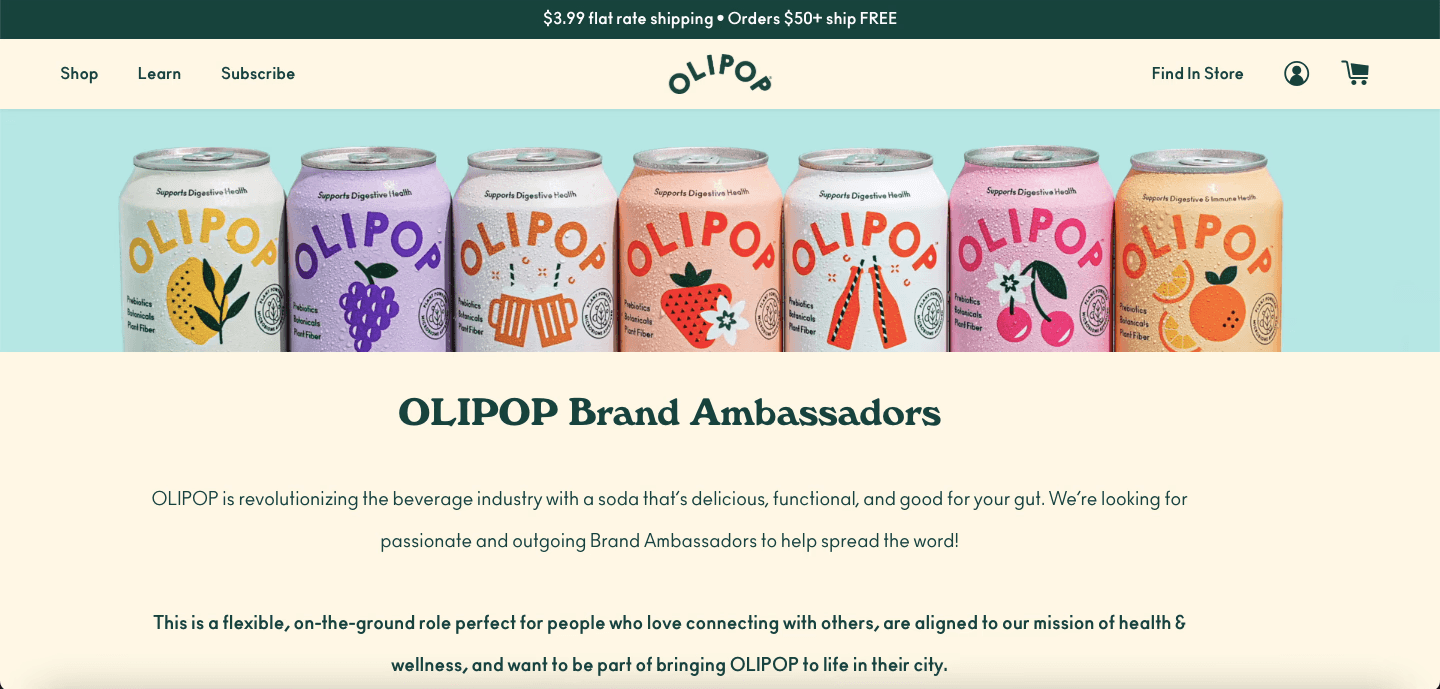
Ambassadors receive $36 worth of product samples to start.
From there, they earn a 10% commission on every sale they drive. The program spans micro-influencers, health-focused creators, registered dietitians, and nutritionists; with a minimum threshold of 10,000 followers on at least one platform, though exceptions are made for credentialed health professionals regardless of audience size.
The Numbers
The creator program has grown from 4% of total sales in 2021 to 12% in 2024, a 3x increase, while retail distribution was also expanding rapidly
The program delivers a 982% ROI, built almost entirely on product gifting and commission payouts
OLIPOP hit $400M+ in annual sales in 2024 and is now valued at $1.85 billion
The brand is now available in over 65,000 retail locations, yet creator-driven DTC sales kept growing proportionally
What Made It Work
The hybrid model is what makes OLIPOP worth studying. Most ambassador programs choose between gifting (relationship-first, low cost, harder to track) and commissions (performance-first, higher cost, easier to track). OLIPOP combined both in a deliberate sequence: gift first to build genuine buy-in, then add commissions for people who actually convert.
This structure self-selects for quality. Creators who genuinely like the product generate sales. Creators who don't, don't stick around. The program naturally filters out people who are there for free product and surfaces the ones whose audiences actually care about what they're saying.
OLIPOP also leaned into creator diversity rather than chasing a single archetype. Their ambassador roster runs from nano fitness influencers to registered dietitians to larger health accounts, which creates redundancy, reduces dependence on any single relationship, and allows them to reach different audience segments simultaneously. If one ambassador relationship ends, the program doesn't feel it.
The offline-online crossover mattered too.
OLIPOP distributed ambassador discount codes at in-person events and sampling activations — so the same codes being shared online were also being passed around in the real world, creating a layer of word-of-mouth that pure digital programs never achieve.
The Lesson
The 982% ROI gets all the attention, but the real insight from OLIPOP is structural.
They built a program where authenticity was the entry requirement. By combining product gifting with performance commissions, they created a system where the people who stayed were the people who actually drove results, without the brand having to manually filter for quality at every stage.
If you're managing ambassador relationships at any meaningful scale, tracking that performance across dozens or hundreds of creators is where most teams hit a wall.
Impulze.ai's campaign monitoring lets you track creator performance, sales attribution, and relationship history in one place so you can make decisions based on data rather than gut feel as your program grows.
<Add campaign dashboad image>
3. Glossier: The Customer-Mining Blueprint
Glossier is a brand that was built entirely from its community and its ambassador program is the most direct expression of that.
Before the term "ambassador marketing" was in common use, founder Emily Weiss was already turning her most loyal customers into commission-earning brand reps.
The Program
Glossier's ambassador program is called Generation Glossier. It's open to any customer who applies through the main website, but the bar is real: Glossier looks for people who are already creating authentic content, engaging consistently, and naturally aligned with the brand's aesthetic.

Selected ambassadors receive a personal discount code, commissions on every sale they drive, early access to new products, exclusive event invitations, and access to a private Slack community where they give product feedback and connect with each other.
The Numbers
79% of Glossier's early sales came from organic and peer-to-peer sources before the brand spent meaningfully on advertising
Emily Weiss has credited her ambassador "fangirls" with 90% of the brand's early growth
8% of ongoing sales are directly attributed to ambassador activity, even as the brand scaled
Glossier grew to a $1.2 billion valuation, with ambassador-driven word-of-mouth as a foundational growth engine throughout
What Made It Work
Glossier didn't go looking for influencers. They monitored their own social channels, identified customers who were already creating high-quality content and tagging the brand organically, and then invited those people in.
The typical Glossier rep had between 300 and 5,000 followers. What mattered was engagement quality and genuine alignment with the brand's look and feel.
The Slack community was a particularly smart retention mechanism. Ambassadors who could give product feedback and see that feedback actually influence what Glossier launched next became invested in the brand's success in a way that a discount code alone never achieves. When the brand used community input to develop the Milky Jelly Cleanser — after customers flagged that jars felt unhygienic — and it became a bestseller, the message was clear: these people's opinions matter here.
Glossier also used its own channels to elevate ambassador content.
Featuring real customers in national ad campaigns, reposting UGC in Instagram Stories, and running weekly "Top 5" highlights of tagged content created a social currency around being recognized by the brand. This alone surfaced more potential ambassadors.
The Lesson
Glossier proved that your best ambassadors are probably already in your customer list, you just haven't identified them yet.
Before you build outward-facing recruitment for your program, it's worth auditing inward: who's tagging you, reviewing you, and talking about you without being asked?
Once you know who those people are, the next step is giving them a reason to go deeper. Early product access, genuine community, and the feeling that their feedback shapes what you build, those things create advocates that no paid campaign can replicate. The commission is almost secondary.
4. Lululemon: The Community-First Model
Lululemon built one of the most recognized ambassador programs in retail without recruiting a single celebrity, without paying ambassadors a fee, and without running a single paid promotion to sign people up.
What they built instead was a network of local fitness instructors who led free yoga classes in Lululemon stores and in doing so, turned their retail locations into community hubs rather than just shops.
The Program
Lululemon runs two ambassador tiers:
Store Ambassadors are local yoga and fitness instructors who teach free classes in-store, lead community events, and provide product feedback.
Global Ambassadors are elite athletes, yogis, and creatives who represent the brand internationally.
Neither group gets paid a flat fee.
Instead, ambassadors receive product to test, tools to grow their own businesses and careers, event access, and a network of like-minded people. In return, they show up at the store, in the community, and on social.
The Numbers
Lululemon works with around 700 ambassadors total, a deliberately small number for a company generating over $9 billion in annual revenue
65% of Lululemon customers feel more connected to the brand specifically because of its community-driven events
When COVID-19 shut studios down in 2020, Lululemon created a $2 million relief fund to support their store ambassadors financially to protect relationships they'd spent years building
The brand is ranked 70 places ahead of Nike on the Forbes World's Best Employers list, partly attributed to the community culture the ambassador program reinforces internally
What Made It Work
Lululemon's recruitment process is one of the most underrated parts of the model.
Rather than posting job listings or running open applications, store managers attend local fitness classes, yoga studios, and community events and identify the instructors who naturally embody what the brand stands for.
The brand reimburses employees for gym and studio memberships specifically so the team stays embedded in the local fitness scene and knows who the best people are before they ever make contact.
The ask-in is deliberate too. When Lululemon invites someone to become an ambassador, they do it creatively — custom cakes, handwritten notes, personal gestures.
The message is: we've been watching you, we respect what you've built, and we want to support it. That approach means ambassadors arrive already feeling valued, not just recruited.
The $2 million COVID relief fund is the single most telling thing about how Lululemon views ambassador relationships. That money wasn't spent because it was required. It was spent because the brand understood that these relationships had taken years to build and would cost far more than $2 million to rebuild. It's the opposite of the transactional mindset that kills most ambassador programs.
As Director of Brand and Community Lindsay Claydon put it: "The ambassador program acts as a living, breathing advertisement for Lululemon."
The Lesson
The Lululemon model is a reminder that program size and program impact are not the same thing. Seven hundred deeply invested ambassadors, whose livelihoods Lululemon actively supports, whose communities trust them completely, who teach classes that bring new customers through the door every week will consistently outperform a database of 7,000 people who signed up for a 20% discount.
The selectivity isn't a limitation of the program. It is the program. Build the bar high from the start, and the people who clear it will do more for your brand than any automated nurture sequence ever could.
5. Red Bull: The Program That Made Itself Worth Wanting
Most ambassador programs ask creators to give something — time, content, promotion — in exchange for free product and a commission.
Red Bull flipped that dynamic.
Their Student Marketeer program was designed to feel like something you'd put on your resume, not something you'd do for the perks. That shift in positioning changed everything about who applied and how hard they worked once they were in.
The Program
The Red Bull Student Marketeer program recruits college-age ambassadors globally to represent the brand on campus.
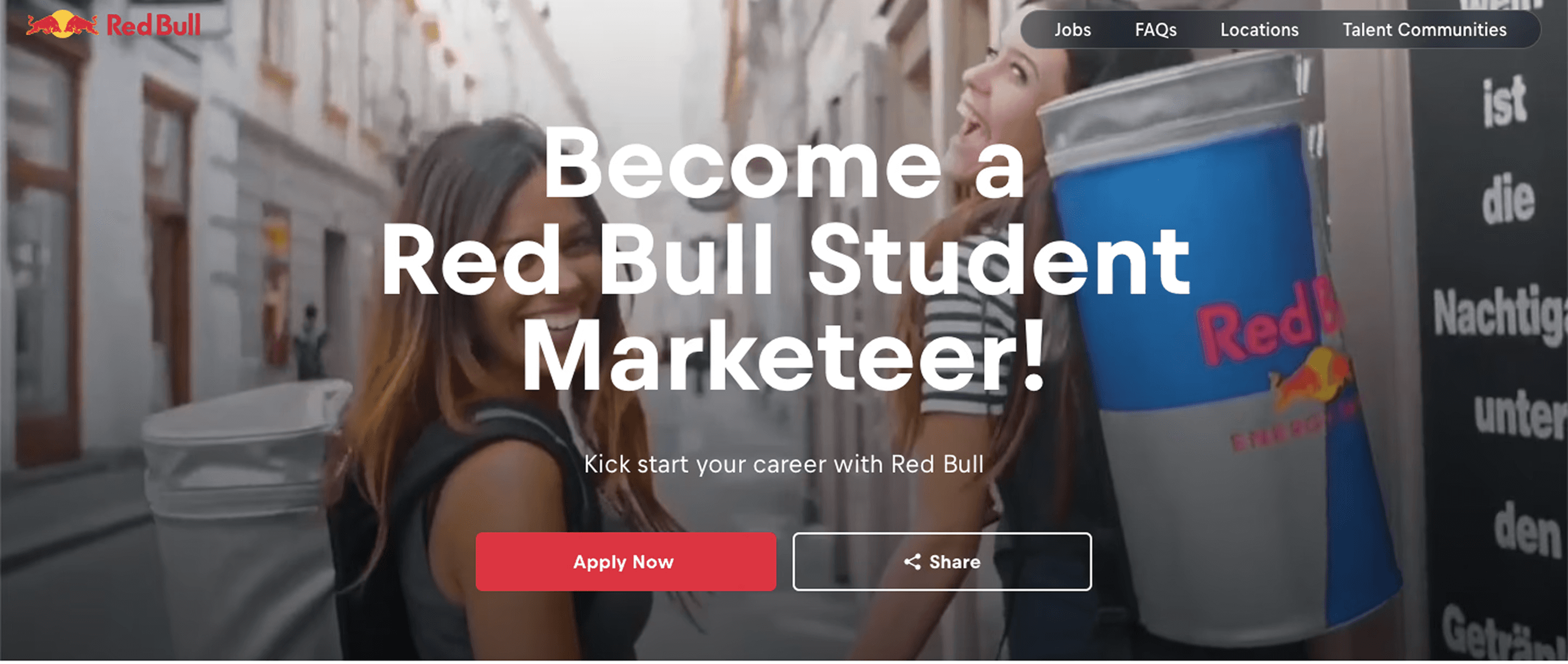
Ambassadors run sampling events, organize activations, build brand presence in their university communities, and report back on market trends.
What sets the program apart structurally is that it gives ambassadors genuine access to Red Bull's business operations — including market analysis frameworks, advance product information, and strategic planning exposure — treating the role as a real marketing apprenticeship rather than a promotional gig.
What Made It Work
The positioning is everything here. Red Bull didn't advertise the program by leading with free cans and event access. They led with career development, business exposure, and the chance to operate like a real marketer inside one of the most recognized brands in the world. That framing attracted business-minded, entrepreneurially oriented students who wanted to learn, not just represent.
The selectivity reinforced the value. Because not everyone got in, getting in meant something. Students who became Student Marketeers had a credential that peers recognized and future employers respected. That external value created internal motivation — ambassadors worked hard because the program was worth working hard for, not because Red Bull was watching.
The brand alignment was equally precise. Red Bull's identity is built around energy, ambition, and pushing limits and the program only recruited students who embodied those qualities naturally. The result was a campus presence that felt authentic to Red Bull's brand rather than like a brand trying to seem relevant to students.
The Lesson
How you frame your ambassador program determines who shows up for it.
If you lead with "free product and commissions," you'll attract people who are primarily interested in free product and commissions. If you lead with community, career development, exclusive access, or a genuine sense of belonging, you'll attract people who are invested before they ever post.
Before you write your ambassador landing page or draft your first outreach message, it's worth asking: why would someone genuinely want to be part of this, beyond the obvious incentives? The brands with the strongest programs always have a real answer to that question.
Also Worth Studying: 5 More Brand Ambassador Program Examples
These brand ambassador program examples highlight different ways companies structure ambassador communities depending on their audience and brand identity.
Poppi:
Their "Poppi University" college program received 7,000+ applications in 2024–25 by making the program feel like a cultural movement rather than a marketing initiative. The brand was acquired by PepsiCo for $1.95 billion in March 2025. The lesson is about program branding: the language, aesthetics, and positioning of your ambassador program are themselves a form of marketing.
Deeper Sonars:
A niche fish finder brand running three simultaneous ambassador program tiers across thousands of ambassadors with a small internal team. It's the strongest counterexample to the idea that ambassador programs only work for lifestyle brands with broad consumer appeal. Passionate niche communities can drive disproportionate ROI when you give them the right structure.
Sephora (Beauty Insider):
Over 5 million community members. The distinguishing factor is representative casting: Sephora's ambassadors genuinely reflect the diversity of their customer base, which builds trust faster than aspirational casting ever could with a broad audience.
Harley-Davidson (HOG):
325,000+ members, no content deliverables required. The Harley Owners Group is a social community first and a marketing program second, which is exactly why it has sustained for decades while most loyalty programs have come and gone.
Maker's Mark:
The most memorable structural innovation on this list: ambassadors are assigned a named barrel of bourbon that matures over 7+ years. The program literally builds time into the incentive structure. Ambassadors have a reason to stay invested for years, and the eventual payoff — receiving your own barrel — is unlike anything a commission structure could manufacture.
What the Best Ambassador Programs Have in Common
If you stack these 10 brand ambassador program examples against each other, four patterns emerge:
They recruit from depth. Gymshark watches organic content. Glossier monitors loyal customers. Lululemon attends local classes. The best ambassadors aren't found in databases, they're found in communities where your product already lives.
They make the exchange feel mutual. Product gifting, commissions, career tools, community access, product input — the strongest programs give ambassadors something real instead of just exposure.
They build for retention, not recruitment. Most brand ambassador program failures happen at month three, after the initial excitement fades and the brand stops showing up. Lululemon's relief fund, Deeper's fly-out fishing tournaments, Red Bull's business mentorship: these are retention mechanics, not recruitment tactics.
They use the data. OLIPOP tracks contribution to total sales. Glossier measures referral conversion. Gymshark tracks engagement over follower count. The programs that survive are the ones that can prove their ROI, which requires the right infrastructure from day one.
If you're building or scaling a program right now, the infrastructure question matters more than most teams expect.
Finding the right ambassadors, managing outreach across dozens or hundreds of relationships, tracking campaign performance, and staying organized as you scale — that's where most brand ambassador programs break down operationally.
Impulze.ai is built specifically for this: a platform that handles creator discovery, outreach, and relationship management in one place, so your program can grow without the chaos.
Try it yourself by creating a free account and don’t hesitate to book a call if any issue arises.
Most brand ambassador programs die quietly. They launch with a landing page, sign up some enthusiastic customers, send a welcome kit, and then… nothing.
The programs that actually work look different from the start. They're built around a clear purpose, structured incentives, and relationships that feel worth showing up for — not just a discount code and a ghost.
According to Forbes, 66% of brand community members report feeling loyal to the company, while 27% of customers say being part of a community directly influences their decision to purchase. And 66% of companies say their customer community contributes to higher retention. Those aren't vanity numbers — that's the business case for building ambassador programs the right way.
So here are 10 real brand ambassador program examples that got it right, with the specific lessons you can take into your own program.
1. Gymshark: The DTC Origin Story That Made the Playbook
Ben Francis was 19, working out of his mum's garage in Birmingham, and watching YouTube fitness videos instead of running paid ads. That decision — to treat fitness creators as people worth building relationships with rather than channels worth buying — is the entire reason Gymshark exists as a billion-dollar company today.
The Program
Gymshark calls their ambassadors "Gymshark Athletes." It's invite-only, there's no public application form, and there's no minimum follower count to qualify.
The only way in is for Gymshark to find you, usually because you're already posting content in their space, wearing their gear, and building a community of your own. They currently have somewhere between 80–100 core athletes on the books, including names like Francis Ngannou and Katie Taylor, but the program was built on micro-level fitness creators long before any of them were involved.
The Numbers
Founded in 2012, Gymshark reached a £1 billion valuation within eight years, almost entirely without traditional advertising.
Early Instagram campaigns generated a 6.6x ROI, with specific influencer collaborations boosting sales over 200%.
Today they have over 10 million customers across 131 countries.
Their TikTok account alone generates nearly 350 million video views per year.
What Made It Work
Francis didn't start by looking for people with large audiences. He started by making a list of fitness creators he personally watched and enjoyed and people whose communities already trusted their recommendations. He sent them gear. Some wore it. Their audiences noticed.
As Francis put it in an interview: "At the time, no one else was doing this. Now it's called 'influencer marketing.' But at the time, it just came totally naturally to us because we were just fans of the guys."
What followed wasn't a marketing strategy so much as a series of real relationships that happened to scale. Gymshark gave their athletes creative freedom, brought them to events, involved them in product development, and treated them as extensions of the brand rather than hired promoters.
The results showed up fast.
When ambassador Nikki Blackketter co-designed a workout line with Gymshark, it sold out online within minutes and the pop-up store in New York had queues running 6–8 hours long. Well-timed campaign can’t get such a massive response. It only comes from an audience that trusts the person recommending the product, built over years of consistent content.
The program also maintains its exclusivity by design.
There's nowhere to apply. Gymshark is always watching who's creating in their space, and they reach out when they see someone worth working with. That dynamic keeps the bar high and the community tight, which is exactly why being a Gymshark Athlete actually means something.
The Lesson
The thing most brands miss when they try to replicate Gymshark is that the program worked because Francis started with genuine admiration. He wasn't optimizing for reach, he was building relationships with people he respected, in a community he was already part of.
Gymshark’s Head of PR Stephanie O’Neill explained to Fashion Monitor: “It’s all about being authentic. The vast majority of Gymshark ambassadors were once fans and consumers of the brand. Who better to represent the brand than those who actually love Gymshark?”
So if you're starting a program today, the equivalent move is to find creators who are:
Already posting in your product category without being paid to
Building communities around the problem your product solves
Creating content that your target audience already engages with
That kind of organic fit is hard to fake and easy to spot. If you're looking in the right places. A tool like Impulze.ai lets you filter creators by niche, engagement quality, and audience demographics, so you can identify who's already operating in your space before you ever send an outreach message.
<Add search dashboard>
Also Read: How to Find Brand Ambassadors: A Step-by-Step Playbook for Brands
2. OLIPOP: The Data-Backed Modern Benchmark
For OLIPOP, applications just started flooding in back in 2021. Sometimes hundreds per week — from people who genuinely loved the product.
The brand had a choice: accept everyone, accept no one, or build a system that could scale without losing quality. What they built became one of the most documented ambassador success stories in DTC.
The Program
OLIPOP runs a hybrid creator community that combines free product gifting with performance-based commissions.
Ambassadors receive $36 worth of product samples to start.
From there, they earn a 10% commission on every sale they drive. The program spans micro-influencers, health-focused creators, registered dietitians, and nutritionists; with a minimum threshold of 10,000 followers on at least one platform, though exceptions are made for credentialed health professionals regardless of audience size.
The Numbers
The creator program has grown from 4% of total sales in 2021 to 12% in 2024, a 3x increase, while retail distribution was also expanding rapidly
The program delivers a 982% ROI, built almost entirely on product gifting and commission payouts
OLIPOP hit $400M+ in annual sales in 2024 and is now valued at $1.85 billion
The brand is now available in over 65,000 retail locations, yet creator-driven DTC sales kept growing proportionally
What Made It Work
The hybrid model is what makes OLIPOP worth studying. Most ambassador programs choose between gifting (relationship-first, low cost, harder to track) and commissions (performance-first, higher cost, easier to track). OLIPOP combined both in a deliberate sequence: gift first to build genuine buy-in, then add commissions for people who actually convert.
This structure self-selects for quality. Creators who genuinely like the product generate sales. Creators who don't, don't stick around. The program naturally filters out people who are there for free product and surfaces the ones whose audiences actually care about what they're saying.
OLIPOP also leaned into creator diversity rather than chasing a single archetype. Their ambassador roster runs from nano fitness influencers to registered dietitians to larger health accounts, which creates redundancy, reduces dependence on any single relationship, and allows them to reach different audience segments simultaneously. If one ambassador relationship ends, the program doesn't feel it.
The offline-online crossover mattered too.
OLIPOP distributed ambassador discount codes at in-person events and sampling activations — so the same codes being shared online were also being passed around in the real world, creating a layer of word-of-mouth that pure digital programs never achieve.
The Lesson
The 982% ROI gets all the attention, but the real insight from OLIPOP is structural.
They built a program where authenticity was the entry requirement. By combining product gifting with performance commissions, they created a system where the people who stayed were the people who actually drove results, without the brand having to manually filter for quality at every stage.
If you're managing ambassador relationships at any meaningful scale, tracking that performance across dozens or hundreds of creators is where most teams hit a wall.
Impulze.ai's campaign monitoring lets you track creator performance, sales attribution, and relationship history in one place so you can make decisions based on data rather than gut feel as your program grows.
<Add campaign dashboad image>
3. Glossier: The Customer-Mining Blueprint
Glossier is a brand that was built entirely from its community and its ambassador program is the most direct expression of that.
Before the term "ambassador marketing" was in common use, founder Emily Weiss was already turning her most loyal customers into commission-earning brand reps.
The Program
Glossier's ambassador program is called Generation Glossier. It's open to any customer who applies through the main website, but the bar is real: Glossier looks for people who are already creating authentic content, engaging consistently, and naturally aligned with the brand's aesthetic.
Selected ambassadors receive a personal discount code, commissions on every sale they drive, early access to new products, exclusive event invitations, and access to a private Slack community where they give product feedback and connect with each other.
The Numbers
79% of Glossier's early sales came from organic and peer-to-peer sources before the brand spent meaningfully on advertising
Emily Weiss has credited her ambassador "fangirls" with 90% of the brand's early growth
8% of ongoing sales are directly attributed to ambassador activity, even as the brand scaled
Glossier grew to a $1.2 billion valuation, with ambassador-driven word-of-mouth as a foundational growth engine throughout
What Made It Work
Glossier didn't go looking for influencers. They monitored their own social channels, identified customers who were already creating high-quality content and tagging the brand organically, and then invited those people in.
The typical Glossier rep had between 300 and 5,000 followers. What mattered was engagement quality and genuine alignment with the brand's look and feel.
The Slack community was a particularly smart retention mechanism. Ambassadors who could give product feedback and see that feedback actually influence what Glossier launched next became invested in the brand's success in a way that a discount code alone never achieves. When the brand used community input to develop the Milky Jelly Cleanser — after customers flagged that jars felt unhygienic — and it became a bestseller, the message was clear: these people's opinions matter here.
Glossier also used its own channels to elevate ambassador content.
Featuring real customers in national ad campaigns, reposting UGC in Instagram Stories, and running weekly "Top 5" highlights of tagged content created a social currency around being recognized by the brand. This alone surfaced more potential ambassadors.
The Lesson
Glossier proved that your best ambassadors are probably already in your customer list, you just haven't identified them yet.
Before you build outward-facing recruitment for your program, it's worth auditing inward: who's tagging you, reviewing you, and talking about you without being asked?
Once you know who those people are, the next step is giving them a reason to go deeper. Early product access, genuine community, and the feeling that their feedback shapes what you build, those things create advocates that no paid campaign can replicate. The commission is almost secondary.
4. Lululemon: The Community-First Model
Lululemon built one of the most recognized ambassador programs in retail without recruiting a single celebrity, without paying ambassadors a fee, and without running a single paid promotion to sign people up.
What they built instead was a network of local fitness instructors who led free yoga classes in Lululemon stores and in doing so, turned their retail locations into community hubs rather than just shops.
The Program
Lululemon runs two ambassador tiers:
Store Ambassadors are local yoga and fitness instructors who teach free classes in-store, lead community events, and provide product feedback.
Global Ambassadors are elite athletes, yogis, and creatives who represent the brand internationally.
Neither group gets paid a flat fee.
Instead, ambassadors receive product to test, tools to grow their own businesses and careers, event access, and a network of like-minded people. In return, they show up at the store, in the community, and on social.
The Numbers
Lululemon works with around 700 ambassadors total, a deliberately small number for a company generating over $9 billion in annual revenue
65% of Lululemon customers feel more connected to the brand specifically because of its community-driven events
When COVID-19 shut studios down in 2020, Lululemon created a $2 million relief fund to support their store ambassadors financially to protect relationships they'd spent years building
The brand is ranked 70 places ahead of Nike on the Forbes World's Best Employers list, partly attributed to the community culture the ambassador program reinforces internally
What Made It Work
Lululemon's recruitment process is one of the most underrated parts of the model.
Rather than posting job listings or running open applications, store managers attend local fitness classes, yoga studios, and community events and identify the instructors who naturally embody what the brand stands for.
The brand reimburses employees for gym and studio memberships specifically so the team stays embedded in the local fitness scene and knows who the best people are before they ever make contact.
The ask-in is deliberate too. When Lululemon invites someone to become an ambassador, they do it creatively — custom cakes, handwritten notes, personal gestures.
The message is: we've been watching you, we respect what you've built, and we want to support it. That approach means ambassadors arrive already feeling valued, not just recruited.
The $2 million COVID relief fund is the single most telling thing about how Lululemon views ambassador relationships. That money wasn't spent because it was required. It was spent because the brand understood that these relationships had taken years to build and would cost far more than $2 million to rebuild. It's the opposite of the transactional mindset that kills most ambassador programs.
As Director of Brand and Community Lindsay Claydon put it: "The ambassador program acts as a living, breathing advertisement for Lululemon."
The Lesson
The Lululemon model is a reminder that program size and program impact are not the same thing. Seven hundred deeply invested ambassadors, whose livelihoods Lululemon actively supports, whose communities trust them completely, who teach classes that bring new customers through the door every week will consistently outperform a database of 7,000 people who signed up for a 20% discount.
The selectivity isn't a limitation of the program. It is the program. Build the bar high from the start, and the people who clear it will do more for your brand than any automated nurture sequence ever could.
5. Red Bull: The Program That Made Itself Worth Wanting
Most ambassador programs ask creators to give something — time, content, promotion — in exchange for free product and a commission.
Red Bull flipped that dynamic.
Their Student Marketeer program was designed to feel like something you'd put on your resume, not something you'd do for the perks. That shift in positioning changed everything about who applied and how hard they worked once they were in.
The Program
The Red Bull Student Marketeer program recruits college-age ambassadors globally to represent the brand on campus.
Ambassadors run sampling events, organize activations, build brand presence in their university communities, and report back on market trends.
What sets the program apart structurally is that it gives ambassadors genuine access to Red Bull's business operations — including market analysis frameworks, advance product information, and strategic planning exposure — treating the role as a real marketing apprenticeship rather than a promotional gig.
What Made It Work
The positioning is everything here. Red Bull didn't advertise the program by leading with free cans and event access. They led with career development, business exposure, and the chance to operate like a real marketer inside one of the most recognized brands in the world. That framing attracted business-minded, entrepreneurially oriented students who wanted to learn, not just represent.
The selectivity reinforced the value. Because not everyone got in, getting in meant something. Students who became Student Marketeers had a credential that peers recognized and future employers respected. That external value created internal motivation — ambassadors worked hard because the program was worth working hard for, not because Red Bull was watching.
The brand alignment was equally precise. Red Bull's identity is built around energy, ambition, and pushing limits and the program only recruited students who embodied those qualities naturally. The result was a campus presence that felt authentic to Red Bull's brand rather than like a brand trying to seem relevant to students.
The Lesson
How you frame your ambassador program determines who shows up for it.
If you lead with "free product and commissions," you'll attract people who are primarily interested in free product and commissions. If you lead with community, career development, exclusive access, or a genuine sense of belonging, you'll attract people who are invested before they ever post.
Before you write your ambassador landing page or draft your first outreach message, it's worth asking: why would someone genuinely want to be part of this, beyond the obvious incentives? The brands with the strongest programs always have a real answer to that question.
Also Worth Studying: 5 More Brand Ambassador Program Examples
These brand ambassador program examples highlight different ways companies structure ambassador communities depending on their audience and brand identity.
Poppi:
Their "Poppi University" college program received 7,000+ applications in 2024–25 by making the program feel like a cultural movement rather than a marketing initiative. The brand was acquired by PepsiCo for $1.95 billion in March 2025. The lesson is about program branding: the language, aesthetics, and positioning of your ambassador program are themselves a form of marketing.
Deeper Sonars:
A niche fish finder brand running three simultaneous ambassador program tiers across thousands of ambassadors with a small internal team. It's the strongest counterexample to the idea that ambassador programs only work for lifestyle brands with broad consumer appeal. Passionate niche communities can drive disproportionate ROI when you give them the right structure.
Sephora (Beauty Insider):
Over 5 million community members. The distinguishing factor is representative casting: Sephora's ambassadors genuinely reflect the diversity of their customer base, which builds trust faster than aspirational casting ever could with a broad audience.
Harley-Davidson (HOG):
325,000+ members, no content deliverables required. The Harley Owners Group is a social community first and a marketing program second, which is exactly why it has sustained for decades while most loyalty programs have come and gone.
Maker's Mark:
The most memorable structural innovation on this list: ambassadors are assigned a named barrel of bourbon that matures over 7+ years. The program literally builds time into the incentive structure. Ambassadors have a reason to stay invested for years, and the eventual payoff — receiving your own barrel — is unlike anything a commission structure could manufacture.
What the Best Ambassador Programs Have in Common
If you stack these 10 brand ambassador program examples against each other, four patterns emerge:
They recruit from depth. Gymshark watches organic content. Glossier monitors loyal customers. Lululemon attends local classes. The best ambassadors aren't found in databases, they're found in communities where your product already lives.
They make the exchange feel mutual. Product gifting, commissions, career tools, community access, product input — the strongest programs give ambassadors something real instead of just exposure.
They build for retention, not recruitment. Most brand ambassador program failures happen at month three, after the initial excitement fades and the brand stops showing up. Lululemon's relief fund, Deeper's fly-out fishing tournaments, Red Bull's business mentorship: these are retention mechanics, not recruitment tactics.
They use the data. OLIPOP tracks contribution to total sales. Glossier measures referral conversion. Gymshark tracks engagement over follower count. The programs that survive are the ones that can prove their ROI, which requires the right infrastructure from day one.
If you're building or scaling a program right now, the infrastructure question matters more than most teams expect.
Finding the right ambassadors, managing outreach across dozens or hundreds of relationships, tracking campaign performance, and staying organized as you scale — that's where most brand ambassador programs break down operationally.
Impulze.ai is built specifically for this: a platform that handles creator discovery, outreach, and relationship management in one place, so your program can grow without the chaos.
Try it yourself by creating a free account and don’t hesitate to book a call if any issue arises.
Frequently Asked Questions
What is a brand ambassador program?

What is a brand ambassador program?
How do you find brand ambassadors?
How do you find brand ambassadors?
What should a brand ambassador program include?
What should a brand ambassador program include?
How many ambassadors should I start with?
How many ambassadors should I start with?
What's the difference between a brand ambassador and an influencer?
What's the difference between a brand ambassador and an influencer?
We Also Recommend To Read