🥳 Skip the subscription. Pay $299 once for lifetime access— See lifetime plans
🥳 Skip the subscription. Pay $299 once for lifetime access—

Mar 11, 2026
7 MIN READ
Data & Insights
Data & Insights
Virtual Influencers vs. Human Creators: The Ultimate Brand Guide
Virtual Influencers vs. Human Creators: The Ultimate Brand Guide
Virtual Influencers vs. Human Creators: The Ultimate Brand Guide

Rashmi Singh
Rashmi Singh
Rashmi Singh
Content Marketer @impulze.ai
Sections
Blog in Short ⏱️
Blog in Short ⏱️
A quick glance at the highlights—perfect for when you're short on time.
A quick glance at the highlights—perfect for when you're short on time.
Virtual influencers are no longer a novelty. The market crossed $6 billion in 2024 and is expected to reach $45 billion by 2030. But growth does not always mean better results for brands.
• Virtual influencers often generate higher overall engagement because they attract curiosity and storytelling-driven interactions.
• Human creators still drive 2.7x more engagement on sponsored posts, which matters most for brand campaigns.
• Virtual influencers offer complete brand control and zero scandal risk.
• Human creators bring trust, lived experience, and stronger purchase influence.
• Many successful campaigns now combine both approaches, using virtual influencers for awareness and human creators for credibility and conversion.
The right choice depends on your audience, product category, and campaign goals.
There's a 19-year-old Brazilian-American living in Los Angeles. She's been featured in Vogue, kissed Bella Hadid in a Calvin Klein ad, performed at Coachella, and was named one of TIME magazine's 25 Most Influential People on the Internet, alongside BTS and Rihanna.
She has never drawn a breath in her life. Lil Miquela is entirely computer-generated.
If you find that unsettling, you're not alone. If you find it commercially interesting, you're paying attention to the right thing.
The virtual influencer market hit $6 billion in 2024 and is projected to reach $45 billion by 2030, which is a 40.8% compound annual growth rate. Meanwhile, 58% of people already follow at least one virtual influencer, and 75% of Gen Z consumers are reportedly doing the same. These are not niche numbers. Something real is happening here, even if the influencers themselves aren't.
The question for brands isn't whether virtual influencers are interesting. It's whether they're useful and compared to what, under what conditions, and at what cost.
Here's an honest look at both sides.
What Virtual Influencers Actually Are (And What They're Not)
The term gets used loosely, so let's be precise.
A virtual influencer is a computer-generated persona — built using CGI, AI, motion capture, or some combination — that operates on social media with a defined personality, backstory, and content strategy. They look like people, post like people, and respond to comments like people. They are not people.
The best-known examples are worth knowing because they illustrate how different this category can be internally:
Lil Miquela (@lilmiquela) was created by Los Angeles startup Brud in 2016. She has 2.3 million Instagram followers and 3.5 million on TikTok, has collaborated with Prada, Calvin Klein, BMW, and Samsung, and is estimated to earn around $10–11 million annually.
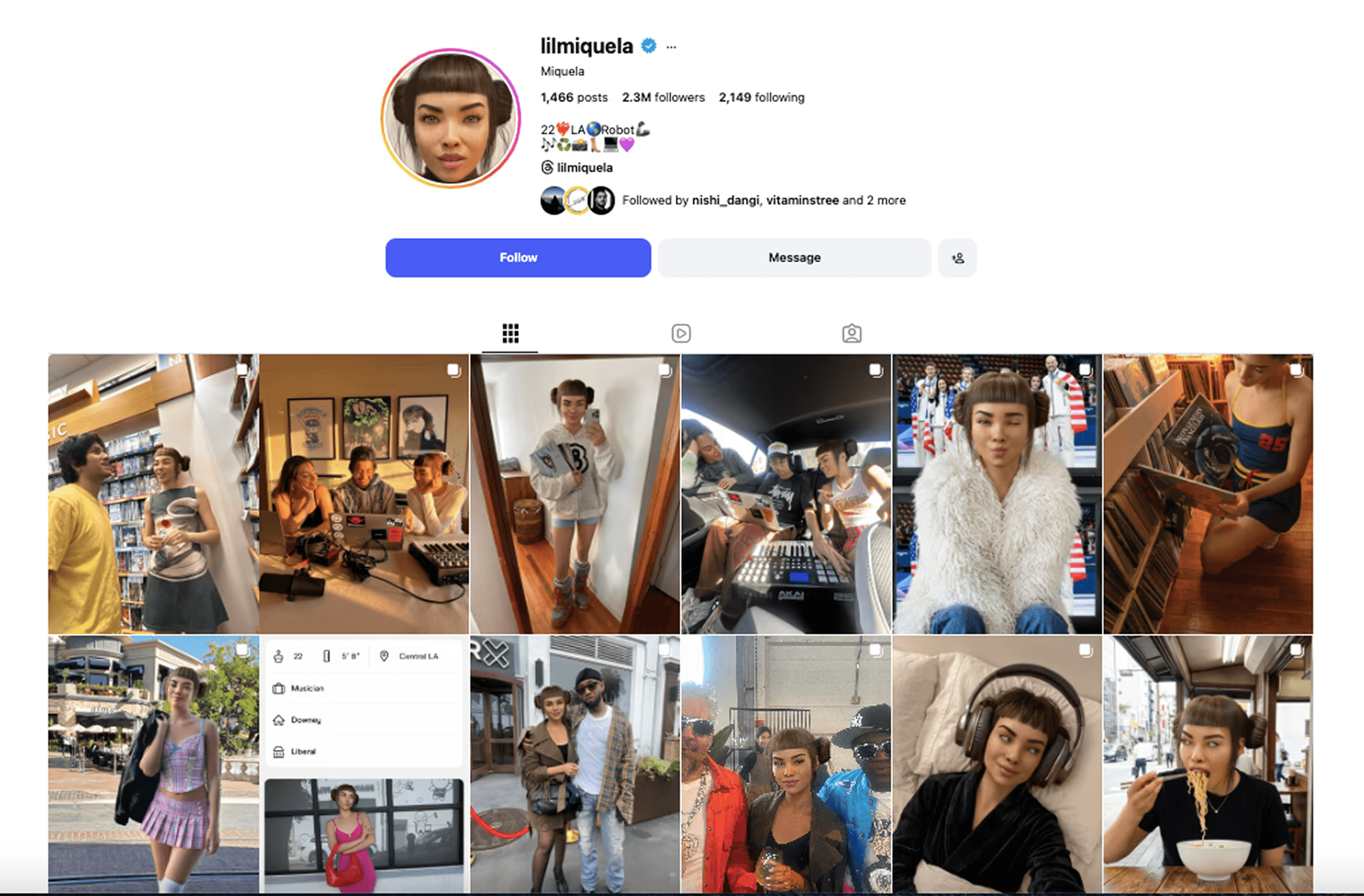
Her content blends fashion, progressive politics, and an evolving narrative about being a digital entity in a human world. The storytelling is deliberate. She was once "hacked" by a Trump-supporting CGI character in a staged drama that generated enormous press coverage.
Lu do Magalu is a virtual influencer created by Brazilian retail giant Magazine Luiza. She has more than 8.6 million followers and earns an estimated $16.2 million annually from brand partnerships.
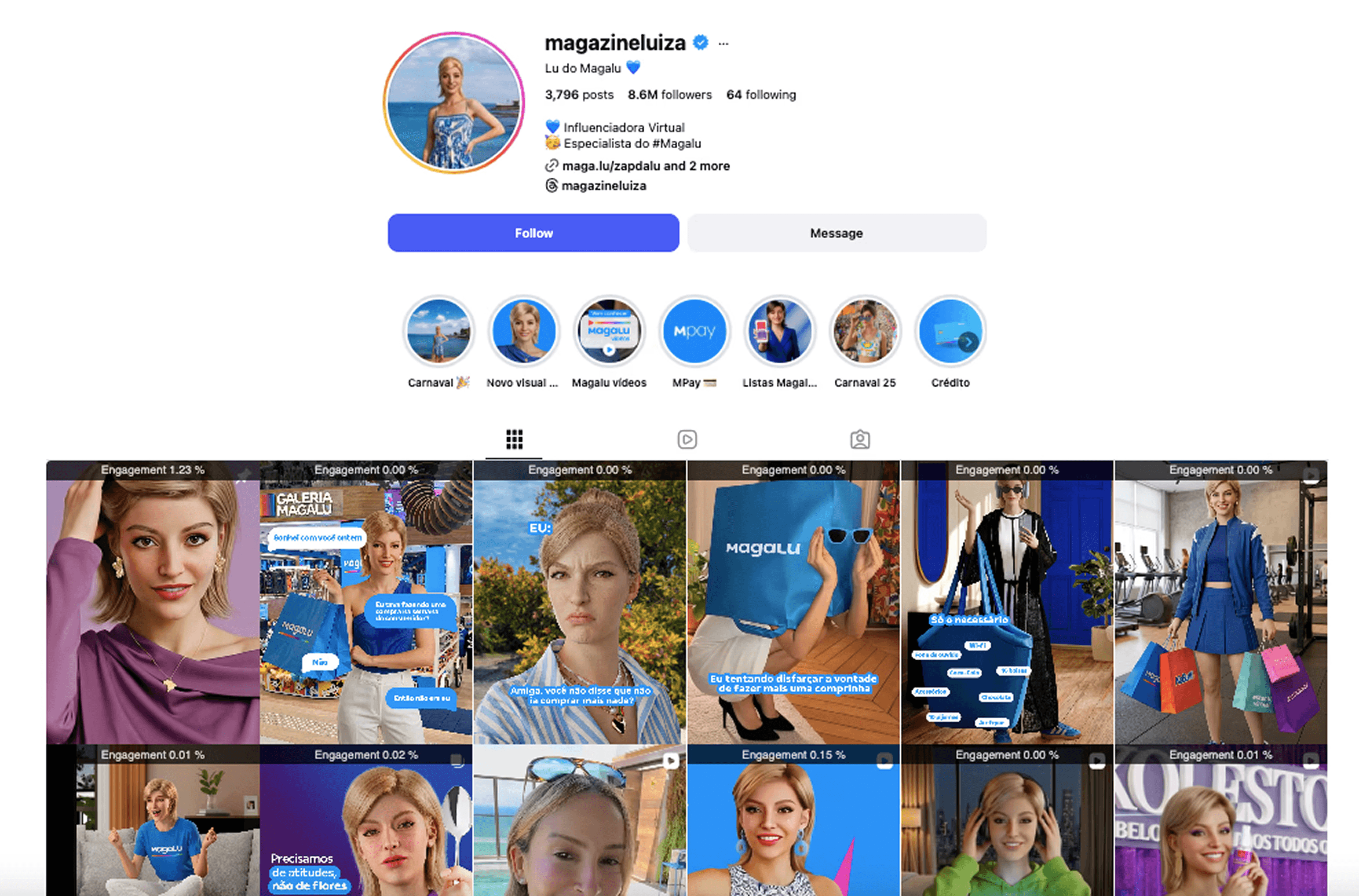
She reviews products, announces deals, and engages directly with customer service questions. She is, essentially, a brand mascot who went viral.
Imma is a Tokyo-based virtual influencer created by Japanese company Aww Inc., recognizable by her bubblegum-pink bob. She has worked with IKEA, Nike, Dior, Coach, SK-II, and Unilever's Magnum.
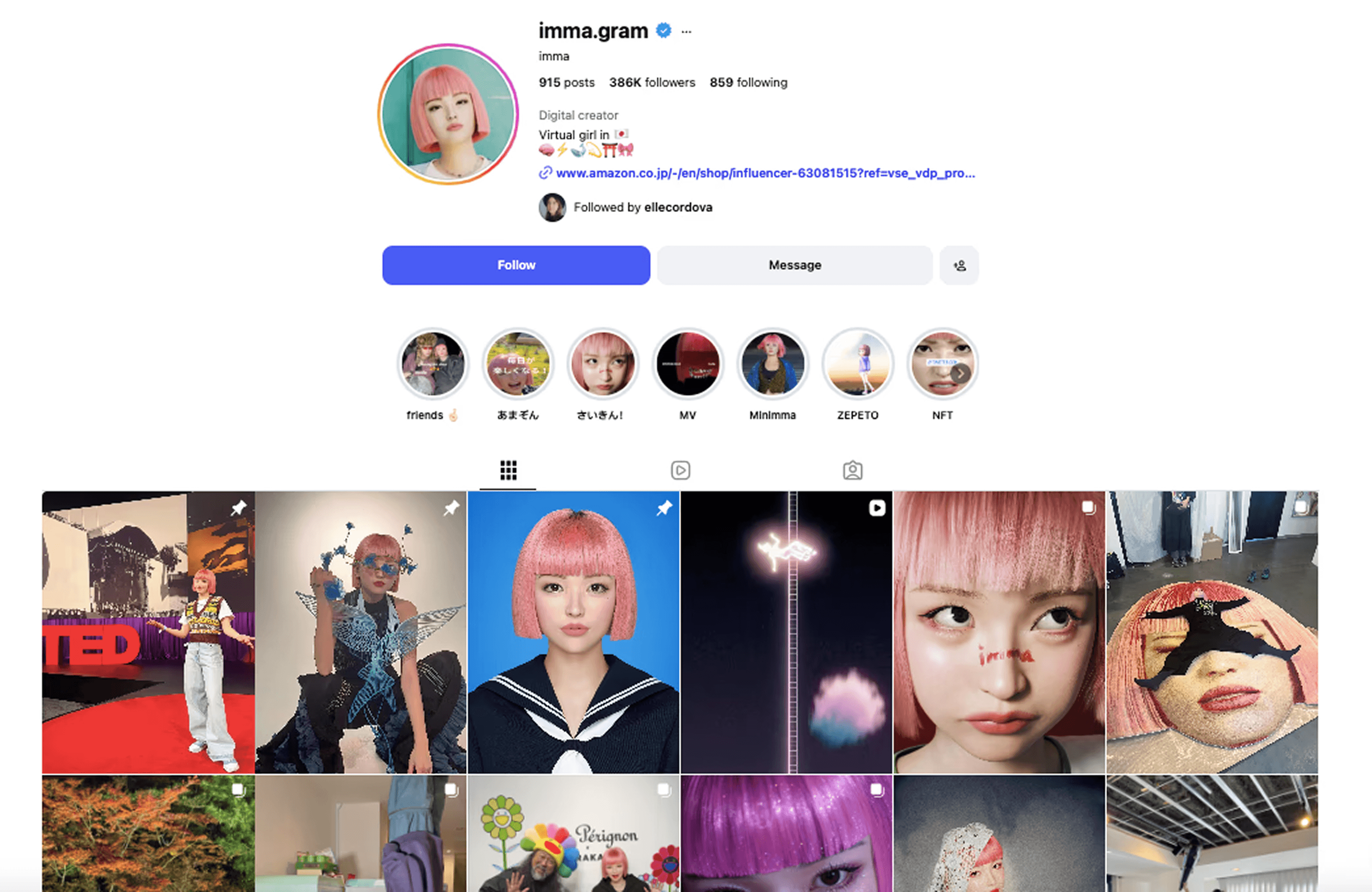
In 2024, Coach paired her with Lil Nas X and Camila Mendes for their "Find Your Courage" spring campaign.
These three operate very differently, serve very different brand purposes, and draw very different audiences. The category is not monolithic which matters a lot for how you think about deploying any of them.
Also Read: Meet the Top 15 AI Influencers and Learn How to Build One
The Engagement Data And Why It's More Complicated Than It Looks
The headline statistic you'll see quoted most often is that virtual influencers generate engagement rates of around 2.84% on Instagram vs. 1.72% for human influencers — a meaningful gap in a metric that most brands care about.
So case closed — virtual influencers win on engagement?
Not quite.
When you look at sponsored content specifically — which is the context most relevant to brands — the picture flips.
Sponsored posts by human influencers achieve 2.7 times more engagement than those by AI influencers.
The BMW campaign featuring Lil Miquela is illustrative: she achieved a 0.6% engagement rate while human creators generated 3.6% for the same brand. The general engagement advantage of virtual influencers appears to erode significantly when the content is explicitly commercial.
There's a logic to this. Part of what drives high general engagement with virtual influencers is novelty — people interact because they're curious, because the character is compelling, or because the narrative hooks them. That curiosity doesn't necessarily translate to purchase intent when someone is asking you to buy something from a brand they don't fully trust yet.
On raw reach and likes, the gap is stark: human influencers receive an average of 414,754 likes per post vs. 71,491 for AI influencers — a 5.8x difference. And human influencers earn $78,777 per post on average vs. $1,694 for virtual influencers — a 46x gap — which means cost-adjusted, they're capturing far more value.
This doesn't mean virtual influencers underperform. It means the engagement metrics require context, and the context often favors human creators when commercial conversion is the goal.
The Trust Paradox
Here's where things get genuinely interesting from a research perspective:
The intuitive assumption is that consumers trust human influencers more because they're real. That's partially borne out by the data: studies consistently show that consumers perceive human influencers as more sincere, genuine, and trustworthy, particularly for products that require credibility through lived experience, like health supplements, skincare, or food.
But a 2024 experimental study published in the International Journal of Human-Computer Interaction found the opposite: virtual influencers were unexpectedly perceived as more authentic than human influencers in certain conditions.
The explanation?
What researchers call "machine heuristic" which is the belief that machines are more objective, precise, and less motivated by self-interest than humans.
When consumers apply this logic, a virtual influencer can't be accused of faking enthusiasm for money, because they're not capable of genuine enthusiasm at all. The fakeness becomes, paradoxically, a kind of honesty.
This holds especially for younger consumers.
One study captured the generational divide cleanly: an 18–24-year-old participant said, "We're used to AI, most content is filtered anyway." A 35–44-year-old said, "I would rather have an actual human being. It feels more honest."
These aren't just opinions. they reflect genuinely different cognitive relationships with digitally-mediated content. For Gen Z, the line between edited reality and constructed reality is already blurred enough that a virtual influencer doesn't feel categorically different from a heavily filtered human one.
The trust picture, then, depends heavily on your audience segment, your product category, and whether consumers even know they're engaging with a virtual influencer, which is increasingly not guaranteed as the technology improves.
What Virtual Influencers Actually Solve For Brands
The most honest framing is this: virtual influencers don't primarily win on performance metrics. They win on control.
Total brand control
With a human creator, you have a real person with a real history, real opinions, and real capacity for public mistakes. The brand safety risk is constant and occasionally catastrophic.
Brand safety
A virtual influencer can't get arrested, can't post something offensive at 2am, can't develop personal views that conflict with your campaign, and can't decide they don't like your product three months into a contract.
This is not a minor consideration.
Any brand that has navigated a talent-driven crisis mid-campaign understands exactly what it costs, in money, time, and reputation management. Virtual influencers make that risk essentially zero. The scandal budget goes to zero.
Consistent content production
They also solve for consistency at scale. A virtual influencer can post every day, in multiple time zones, across multiple platforms, adapted to different languages and cultural contexts, without fatigue, scheduling conflicts, or rate increases. For brands running always-on content programs across global markets, that operational reliability has real dollar value.
And for product categories where the influencer is meant to serve more as a visual vehicle than a trusted personal endorser — luxury fashion, automotive, gaming, technology — the creative control advantage is significant. You can show anything in any way, with any aesthetic, adapted to any campaign brief, with no negotiation over how the creator wants to show up.
That's a different kind of creative latitude than most brand-human influencer relationships allow.
What Human Creators Still Do That Virtual Influencers Can't
The word that comes up in virtually every piece of academic research on this topic is "parasocial."
The parasocial relationship (the one-sided emotional bond an audience forms with an influencer) is the engine of influencer marketing's commercial effectiveness. It's what turns a recommendation from a person you've never met into something that feels like advice from a friend.
Virtual influencers can simulate parasocial connection. They can't fully replicate it, because the foundation of that bond is the belief that someone has genuinely lived through something and is sharing it from experience.
Virtual influencers face a fundamental limitation in content quality because they cannot experience the products they promote. They can't try the moisturizer and report what it actually feels like, can't genuinely be moved by a piece of music, can't describe what it's like to run in a pair of shoes for 10 miles.
For product categories where credibility requires lived experience. For instance, anything health-related, anything functional, anything that requires a real person to say "this genuinely helped me" is where human creators remain the superior choice.
A study of 120 campaigns found that avatars fail to perform as well as human influencers in driving interaction, conversion, and credibility, with qualitative respondents describing virtual influencers as "non-authentic, artificial, and emotionless" in a way that blocked persuasion specifically for products where emotion and trust are prerequisites to purchase.
Human creators also bring something virtual influencers categorically cannot: an existing audience that chose to follow them because of a specific point of view, a personality, a niche, a voice.
When a micro-influencer with 40,000 followers who exclusively covers sustainable fashion recommends a product to her audience, she's delivering a targeted endorsement to people who care about that exact thing.
The creator's credibility is the instrument. That instrument doesn't exist in a virtual influencer unless you've spent years building genuine audience loyalty around the character, which few brands have the patience or resources to do.
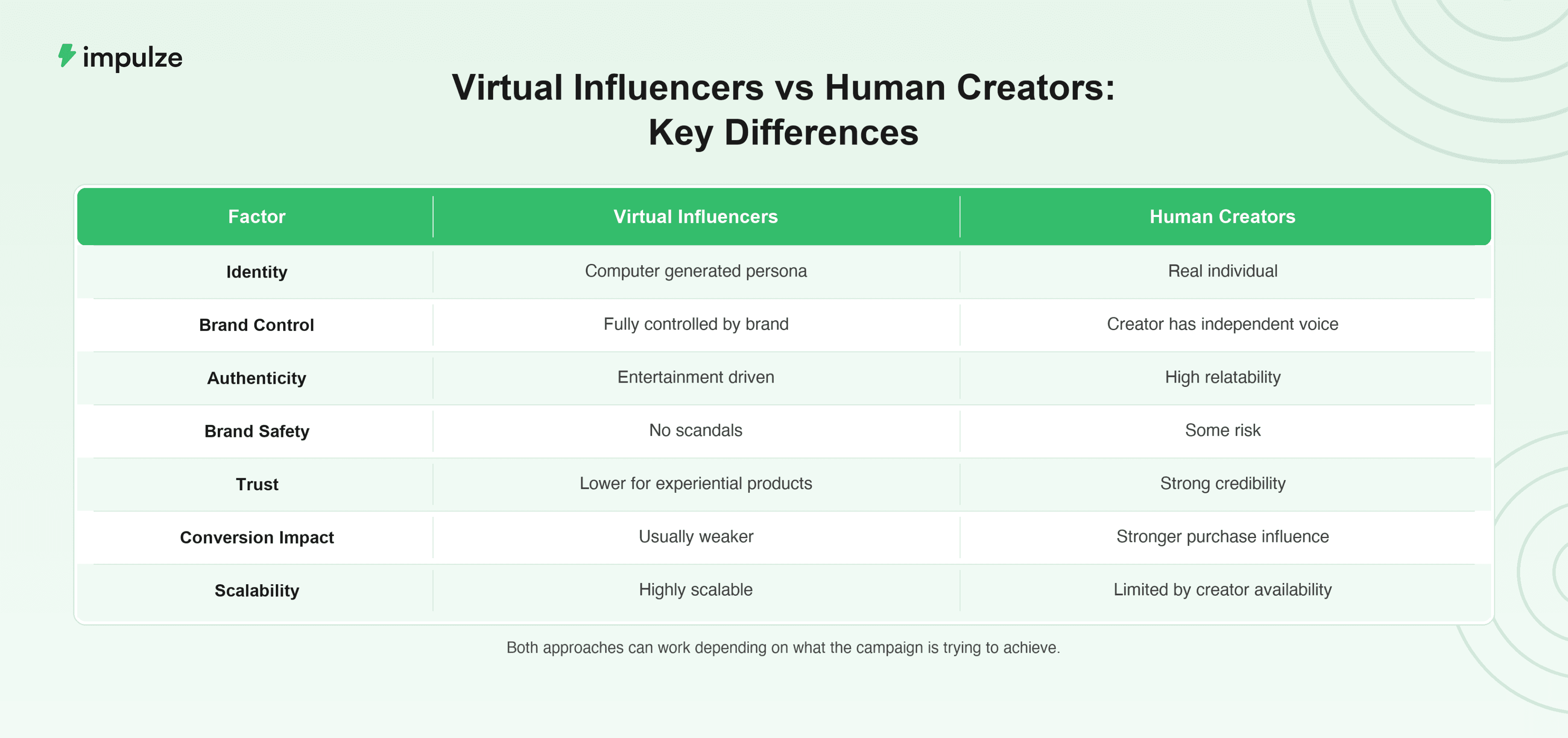
The Practical Decision Framework
This isn't a competition with a winner. It's a question of fit. Here's how to think about it:
Use virtual influencers when:
• brand safety is critical
• campaigns focus on visual storytelling and awareness
• the target audience is Gen Z or gaming communities
• brands need consistent global content production
• the campaign requires full creative control
Luxury, fashion, gaming, and entertainment brands often benefit from this approach.
Use human creators when:
products require trust and lived experience
the campaign is performance driven
brands want authentic reviews and demonstrations
the audience follows specific niche communities
the goal is driving sales or conversions
Most e-commerce and consumer product campaigns still rely heavily on human creators for this reason.
Consider both simultaneously when:
You're running a large-scale campaign that needs celebrity-tier visibility AND grassroots trust
You can use a virtual influencer for top-of-funnel awareness while human micro-influencers handle conversion
SKIMS-style layering: the virtual or celebrity layer creates the cultural moment; the human layer makes it credible
Also Read: The Future of AI Influencer Marketing: Meet SocialiQ 2.0
What's Coming Next
The more interesting question isn't virtual vs. human. It's what happens when the line between them becomes functionally invisible.
We're already seeing brands like MANGO launch entire teen sportswear collections without a single human model. Virtual influencer technology is advancing fast enough that in controlled conditions, audiences can't reliably distinguish CGI personas from real people.
And as AI-generated content becomes normalized, the credibility advantage that human creators currently enjoy may erode, particularly for younger consumers who already treat heavy editing and AI-assistance as baseline assumptions about any content they consume.
The brands that will navigate this best aren't the ones picking a side. They're the ones building creator programs that are clear-eyed about what each type of creator does well, structuring campaigns accordingly, and measuring both in terms of what they're actually being asked to accomplish, not comparing a brand awareness play to a conversion play and wondering why the numbers look different.
Virtual influencers are a real and growing tool. Human creators remain the most effective instrument for trust-based, conversion-focused influencer marketing. Both are true at once.
There's a 19-year-old Brazilian-American living in Los Angeles. She's been featured in Vogue, kissed Bella Hadid in a Calvin Klein ad, performed at Coachella, and was named one of TIME magazine's 25 Most Influential People on the Internet, alongside BTS and Rihanna.
She has never drawn a breath in her life. Lil Miquela is entirely computer-generated.
If you find that unsettling, you're not alone. If you find it commercially interesting, you're paying attention to the right thing.
The virtual influencer market hit $6 billion in 2024 and is projected to reach $45 billion by 2030, which is a 40.8% compound annual growth rate. Meanwhile, 58% of people already follow at least one virtual influencer, and 75% of Gen Z consumers are reportedly doing the same. These are not niche numbers. Something real is happening here, even if the influencers themselves aren't.
The question for brands isn't whether virtual influencers are interesting. It's whether they're useful and compared to what, under what conditions, and at what cost.
Here's an honest look at both sides.
What Virtual Influencers Actually Are (And What They're Not)
The term gets used loosely, so let's be precise.
A virtual influencer is a computer-generated persona — built using CGI, AI, motion capture, or some combination — that operates on social media with a defined personality, backstory, and content strategy. They look like people, post like people, and respond to comments like people. They are not people.
The best-known examples are worth knowing because they illustrate how different this category can be internally:
Lil Miquela (@lilmiquela) was created by Los Angeles startup Brud in 2016. She has 2.3 million Instagram followers and 3.5 million on TikTok, has collaborated with Prada, Calvin Klein, BMW, and Samsung, and is estimated to earn around $10–11 million annually.
Her content blends fashion, progressive politics, and an evolving narrative about being a digital entity in a human world. The storytelling is deliberate. She was once "hacked" by a Trump-supporting CGI character in a staged drama that generated enormous press coverage.
Lu do Magalu is a virtual influencer created by Brazilian retail giant Magazine Luiza. She has more than 8.6 million followers and earns an estimated $16.2 million annually from brand partnerships.
She reviews products, announces deals, and engages directly with customer service questions. She is, essentially, a brand mascot who went viral.
Imma is a Tokyo-based virtual influencer created by Japanese company Aww Inc., recognizable by her bubblegum-pink bob. She has worked with IKEA, Nike, Dior, Coach, SK-II, and Unilever's Magnum.
In 2024, Coach paired her with Lil Nas X and Camila Mendes for their "Find Your Courage" spring campaign.
These three operate very differently, serve very different brand purposes, and draw very different audiences. The category is not monolithic which matters a lot for how you think about deploying any of them.
Also Read: Meet the Top 15 AI Influencers and Learn How to Build One
The Engagement Data And Why It's More Complicated Than It Looks
The headline statistic you'll see quoted most often is that virtual influencers generate engagement rates of around 2.84% on Instagram vs. 1.72% for human influencers — a meaningful gap in a metric that most brands care about.
So case closed — virtual influencers win on engagement?
Not quite.
When you look at sponsored content specifically — which is the context most relevant to brands — the picture flips.
Sponsored posts by human influencers achieve 2.7 times more engagement than those by AI influencers.
The BMW campaign featuring Lil Miquela is illustrative: she achieved a 0.6% engagement rate while human creators generated 3.6% for the same brand. The general engagement advantage of virtual influencers appears to erode significantly when the content is explicitly commercial.
There's a logic to this. Part of what drives high general engagement with virtual influencers is novelty — people interact because they're curious, because the character is compelling, or because the narrative hooks them. That curiosity doesn't necessarily translate to purchase intent when someone is asking you to buy something from a brand they don't fully trust yet.
On raw reach and likes, the gap is stark: human influencers receive an average of 414,754 likes per post vs. 71,491 for AI influencers — a 5.8x difference. And human influencers earn $78,777 per post on average vs. $1,694 for virtual influencers — a 46x gap — which means cost-adjusted, they're capturing far more value.
This doesn't mean virtual influencers underperform. It means the engagement metrics require context, and the context often favors human creators when commercial conversion is the goal.
The Trust Paradox
Here's where things get genuinely interesting from a research perspective:
The intuitive assumption is that consumers trust human influencers more because they're real. That's partially borne out by the data: studies consistently show that consumers perceive human influencers as more sincere, genuine, and trustworthy, particularly for products that require credibility through lived experience, like health supplements, skincare, or food.
But a 2024 experimental study published in the International Journal of Human-Computer Interaction found the opposite: virtual influencers were unexpectedly perceived as more authentic than human influencers in certain conditions.
The explanation?
What researchers call "machine heuristic" which is the belief that machines are more objective, precise, and less motivated by self-interest than humans.
When consumers apply this logic, a virtual influencer can't be accused of faking enthusiasm for money, because they're not capable of genuine enthusiasm at all. The fakeness becomes, paradoxically, a kind of honesty.
This holds especially for younger consumers.
One study captured the generational divide cleanly: an 18–24-year-old participant said, "We're used to AI, most content is filtered anyway." A 35–44-year-old said, "I would rather have an actual human being. It feels more honest."
These aren't just opinions. they reflect genuinely different cognitive relationships with digitally-mediated content. For Gen Z, the line between edited reality and constructed reality is already blurred enough that a virtual influencer doesn't feel categorically different from a heavily filtered human one.
The trust picture, then, depends heavily on your audience segment, your product category, and whether consumers even know they're engaging with a virtual influencer, which is increasingly not guaranteed as the technology improves.
What Virtual Influencers Actually Solve For Brands
The most honest framing is this: virtual influencers don't primarily win on performance metrics. They win on control.
Total brand control
With a human creator, you have a real person with a real history, real opinions, and real capacity for public mistakes. The brand safety risk is constant and occasionally catastrophic.
Brand safety
A virtual influencer can't get arrested, can't post something offensive at 2am, can't develop personal views that conflict with your campaign, and can't decide they don't like your product three months into a contract.
This is not a minor consideration.
Any brand that has navigated a talent-driven crisis mid-campaign understands exactly what it costs, in money, time, and reputation management. Virtual influencers make that risk essentially zero. The scandal budget goes to zero.
Consistent content production
They also solve for consistency at scale. A virtual influencer can post every day, in multiple time zones, across multiple platforms, adapted to different languages and cultural contexts, without fatigue, scheduling conflicts, or rate increases. For brands running always-on content programs across global markets, that operational reliability has real dollar value.
And for product categories where the influencer is meant to serve more as a visual vehicle than a trusted personal endorser — luxury fashion, automotive, gaming, technology — the creative control advantage is significant. You can show anything in any way, with any aesthetic, adapted to any campaign brief, with no negotiation over how the creator wants to show up.
That's a different kind of creative latitude than most brand-human influencer relationships allow.
What Human Creators Still Do That Virtual Influencers Can't
The word that comes up in virtually every piece of academic research on this topic is "parasocial."
The parasocial relationship (the one-sided emotional bond an audience forms with an influencer) is the engine of influencer marketing's commercial effectiveness. It's what turns a recommendation from a person you've never met into something that feels like advice from a friend.
Virtual influencers can simulate parasocial connection. They can't fully replicate it, because the foundation of that bond is the belief that someone has genuinely lived through something and is sharing it from experience.
Virtual influencers face a fundamental limitation in content quality because they cannot experience the products they promote. They can't try the moisturizer and report what it actually feels like, can't genuinely be moved by a piece of music, can't describe what it's like to run in a pair of shoes for 10 miles.
For product categories where credibility requires lived experience. For instance, anything health-related, anything functional, anything that requires a real person to say "this genuinely helped me" is where human creators remain the superior choice.
A study of 120 campaigns found that avatars fail to perform as well as human influencers in driving interaction, conversion, and credibility, with qualitative respondents describing virtual influencers as "non-authentic, artificial, and emotionless" in a way that blocked persuasion specifically for products where emotion and trust are prerequisites to purchase.
Human creators also bring something virtual influencers categorically cannot: an existing audience that chose to follow them because of a specific point of view, a personality, a niche, a voice.
When a micro-influencer with 40,000 followers who exclusively covers sustainable fashion recommends a product to her audience, she's delivering a targeted endorsement to people who care about that exact thing.
The creator's credibility is the instrument. That instrument doesn't exist in a virtual influencer unless you've spent years building genuine audience loyalty around the character, which few brands have the patience or resources to do.
The Practical Decision Framework
This isn't a competition with a winner. It's a question of fit. Here's how to think about it:
Use virtual influencers when:
• brand safety is critical
• campaigns focus on visual storytelling and awareness
• the target audience is Gen Z or gaming communities
• brands need consistent global content production
• the campaign requires full creative control
Luxury, fashion, gaming, and entertainment brands often benefit from this approach.
Use human creators when:
products require trust and lived experience
the campaign is performance driven
brands want authentic reviews and demonstrations
the audience follows specific niche communities
the goal is driving sales or conversions
Most e-commerce and consumer product campaigns still rely heavily on human creators for this reason.
Consider both simultaneously when:
You're running a large-scale campaign that needs celebrity-tier visibility AND grassroots trust
You can use a virtual influencer for top-of-funnel awareness while human micro-influencers handle conversion
SKIMS-style layering: the virtual or celebrity layer creates the cultural moment; the human layer makes it credible
Also Read: The Future of AI Influencer Marketing: Meet SocialiQ 2.0
What's Coming Next
The more interesting question isn't virtual vs. human. It's what happens when the line between them becomes functionally invisible.
We're already seeing brands like MANGO launch entire teen sportswear collections without a single human model. Virtual influencer technology is advancing fast enough that in controlled conditions, audiences can't reliably distinguish CGI personas from real people.
And as AI-generated content becomes normalized, the credibility advantage that human creators currently enjoy may erode, particularly for younger consumers who already treat heavy editing and AI-assistance as baseline assumptions about any content they consume.
The brands that will navigate this best aren't the ones picking a side. They're the ones building creator programs that are clear-eyed about what each type of creator does well, structuring campaigns accordingly, and measuring both in terms of what they're actually being asked to accomplish, not comparing a brand awareness play to a conversion play and wondering why the numbers look different.
Virtual influencers are a real and growing tool. Human creators remain the most effective instrument for trust-based, conversion-focused influencer marketing. Both are true at once.
Frequently Asked Questions
Are virtual influencers more cost-effective than human influencers?

Are virtual influencers more cost-effective than human influencers?
Do audiences know when an influencer is virtual?
Do audiences know when an influencer is virtual?
Which type of influencer drives more sales?
Which type of influencer drives more sales?
Can small brands afford virtual influencers?
Can small brands afford virtual influencers?
Is the virtual influencer trend specific to certain markets?
Is the virtual influencer trend specific to certain markets?
Author Bio
Author Bio
Rashmi Singh
Rashmi Singh
Rashmi Singh is a writer and strategist with more than 7 years of experience. When not writing, she is either spending time with her friends or planning her next trip. You can learn more about her here.
Rashmi Singh is a writer and strategist with more than 7 years of experience. When not writing, she is either spending time with her friends or planning her next trip. You can learn more about her here.
We Also Recommend To Read