🥳 Skip the subscription. Pay $299 once for lifetime access— See lifetime plans
🥳 Skip the subscription. Pay $299 once for lifetime access—

5 MIN READ
Data & Insights
Data & Insights
FTC Influencer Marketing Guidelines in 2026: A Compliance Checklist Every Brand Needs
FTC Influencer Marketing Guidelines in 2026: A Compliance Checklist Every Brand Needs
FTC Influencer Marketing Guidelines in 2026: A Compliance Checklist Every Brand Needs
Sections
Try Influencer marketing tools for free

Blog in Short ⏱️
Blog in Short ⏱️
A quick glance at the highlights—perfect for when you're short on time.
A quick glance at the highlights—perfect for when you're short on time.
FTC compliance in influencer marketing is no longer optional. It is a serious legal and financial responsibility for brands. With penalties crossing $50,000 per violation and lawsuits targeting brands directly, companies are now accountable for how influencers disclose partnerships.
Here is what brands need to understand:
Brands share liability when influencers fail to disclose partnerships properly
Clear and visible disclosures are mandatory, not optional hashtags
Material connections include everything from payments to gifted products and affiliate links
Platform tools alone are not enough, written disclosures are still required
Monitoring content after publishing is critical to avoid compliance risks
Most brands think FTC compliance is the influencer's problem. Brief them, pay them, post, done. If anything goes wrong, that's on the creator.
That's not how it works.
When an influencer promotes your product without proper disclosure, you're on the hook too. The FTC has been explicit about this for years, and the courts are now catching up. In early 2025, consumers filed a $500 million class action lawsuit against Shein — not just the influencers, but the brand itself — for running campaigns that looked like genuine recommendations but were paid promotions in disguise.
Revolve faced a $50 million suit the same year for the same reason. Celsius was named in a class action alongside three influencers who made health claims without disclosing they were paid.
This is no longer about hashtag etiquette. It's a real legal and financial risk, and four out of five influencers still aren't disclosing properly.
So let's break down exactly what the rules are, what changed recently, and what your brand needs to do before the next campaign goes live.
First, What Did the FTC Actually Change?
The FTC's influencer marketing rules haven't always been this detailed. The original guidelines were written in 2009 — before Instagram existed, before TikTok, before the entire creator economy as we know it. They finally updated them in 2023, then added more teeth in 2024.
Here's what's new and relevant:
The 2023 Endorsement Guide update is the big one. It clarified a lot of grey areas that brands had been exploiting. Social media tags are now explicitly endorsements. So if an influencer tags your brand in a post they were paid to create, that tag needs a disclosure. The definition of "material connection" — meaning any relationship that might affect how someone views a recommendation — was expanded to include things like receiving early access to a product, the possibility of appearing in your brand's ads, and even family or personal relationships with people at your company.
The August 2024 Fake Reviews Rule banned AI-generated fake reviews and buying fake followers or engagement. If you knowingly work with an influencer who has purchased followers, you share liability. Violations carry fines of up to $51,744 per incident. This rule went live on October 21, 2024.
The 2025 class action wave is the development nobody saw coming. Private consumers — not just the FTC — are now suing brands directly for undisclosed influencer marketing. This matters because even if the FTC deprioritizes enforcement in a given period, plaintiffs' attorneys are actively filing these cases. Your brand can face a lawsuit regardless of what the FTC is doing.
The One Rule Everything Else Flows From
Before we get into the checklist, there's one principle that makes sense of all the specific requirements: disclosures must be clear and conspicuous.
What does that actually mean?
The FTC's test is simple.
Imagine a consumer who sees only the disclosure — nothing else about the post. Would they immediately understand that what they're looking at is a paid promotion? If they'd have to guess, scroll down, or already know that the influencer works with brands — the disclosure isn't good enough.
In practice:
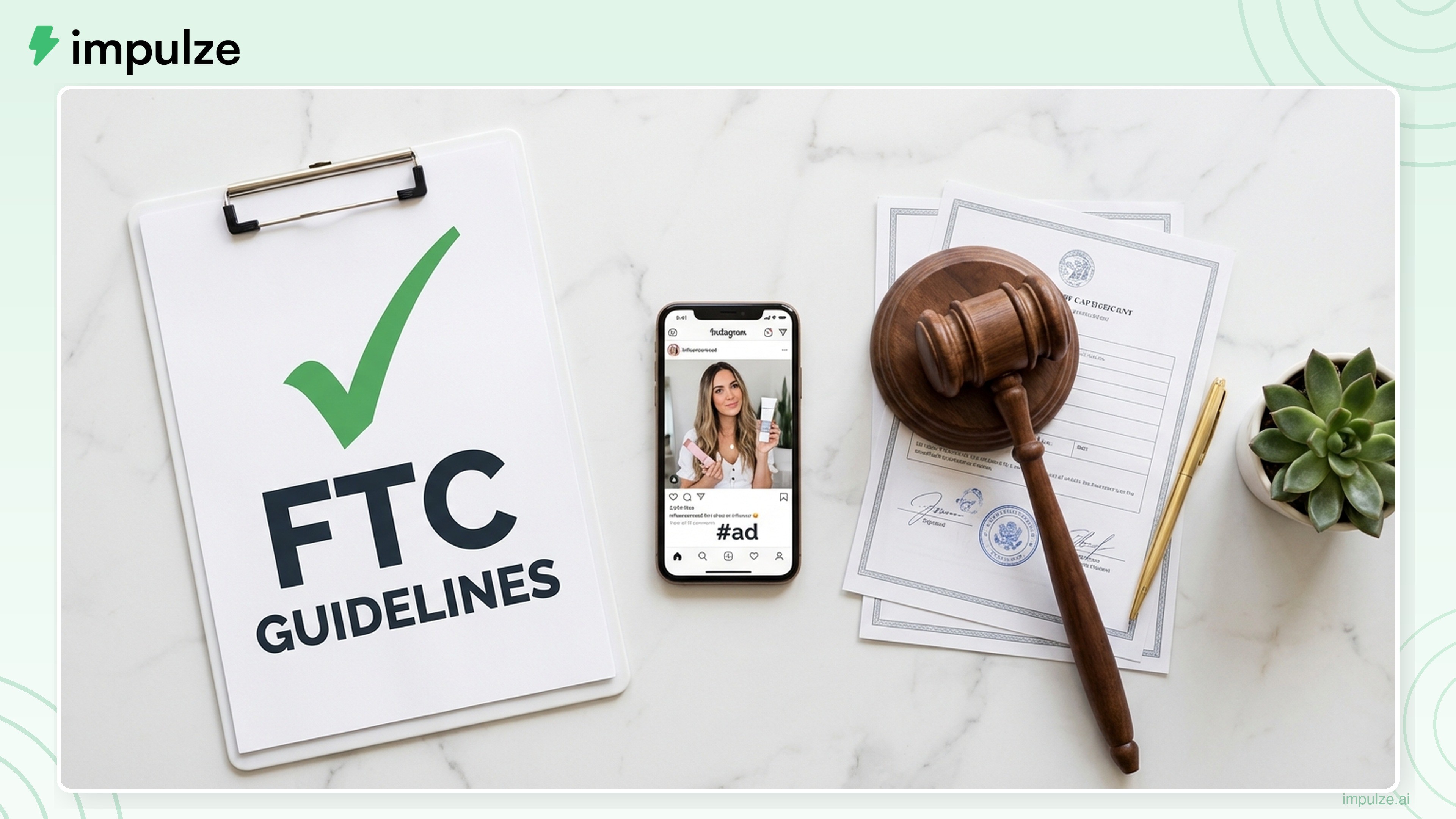
These work: #ad, #sponsored, "Sponsored by [Brand]", "Paid partnership with [Brand]", "[Brand] gifted me this"
These don't: #sp, #collab, #partner, #ambassador, "Thanks [Brand]", a tiny tag buried after twenty other hashtags
And here's the one that surprises most brands: Instagram's "Paid Partnership" label isn't enough on its own. The FTC requires a written disclosure in the actual caption — the built-in tool supplements it, it doesn't replace it. Same goes for TikTok's Branded Content toggle. Platform tools help, but they don't get you off the hook.
The Compliance Checklist
✅ Before the Campaign Launches
Get a written agreement in place for every partnership — paid, gifted, or affiliate. Not because you need a fancy contract, but because it's your evidence that you gave the influencer clear instructions. If a complaint is ever filed, "we briefed them" without documentation means nothing.
Give them the exact words to use. Don't just say "disclose the partnership." Write it out: "Please include 'This post is sponsored by [Brand]' at the start of your caption." Vague instructions produce vague disclosures.
Cover gifted product separately. A lot of brands think disclosure only applies when you pay a fee. It doesn't. Sending free product — even without asking for a post — still requires disclosure if the influencer chooses to post about it. Your gifting email should include a line like: "If you do post about this, please disclose that it was gifted using #gifted or 'gifted by [Brand]'."
Cover affiliate links and discount codes. Every post where a unique link or code appears needs a disclosure — because that's a financial relationship, and the audience doesn't know it exists unless you tell them.
Check the creator's audience quality. Under the 2024 Fake Reviews Rule, working with someone who has bought followers can implicate your brand. It's worth auditing engagement quality before you confirm a partnership.
✅ The Platform-by-Platform Rules
This is where most brands get it wrong because the specifics differ by platform.
Disclosure at the very start of the caption before the "more" cut-off, not after it
Instagram's "Paid Partnership" label switched on plus a written disclosure in the caption
Stories: disclosure on every single Story in a sponsored sequence. One disclosure on the first story does not carry over to the rest
Reels: disclosure in the caption and verbally if the creator mentions the brand in the video
TikTok
#ador#sponsoredin the captionOn-screen text disclosure during the video, not just at the very end when most people have already stopped watching
TikTok's Branded Content toggle activated. It adds a visible label, but written disclosure is still required on top of it
YouTube
Creator says it out loud in the first 30 seconds. Don't bury it at the end
Written disclosure in the video description above the "show more" fold
For integrated sponsorships woven into the video (not just a pre-roll mention), the verbal disclosure should be repeated near the sponsored segment
Podcasts
Verbal disclosure at the start of the episode and again right before the sponsored segment
Written disclosure in show notes if there's a companion page
Livestreams
Disclosure repeated throughout the stream. Someone joining 20 minutes in has no idea it's sponsored unless you say it again. The FTC evaluates what a late-joining viewer would experience.
✅ What Counts as a "Material Connection"
This is the legal term for "any relationship that might affect how someone views a recommendation." If it exists, it needs to be disclosed. The updated 2023 Guides expanded this significantly. It now includes:
Payment or fee of any kind
Free or gifted products — including ones sent without asking for a post
Discount codes or early product access
Affiliate commissions or revenue share
Sponsored travel, event invites, or experiences
Being employed by or having a business relationship with the brand
Having a family or personal relationship with someone at the brand
The possibility of being featured in the brand's own ads or content
Contest entries or prizes from the brand
If any of these exist, and the influencer posts about your product, disclosure is required. No exceptions.
✅ The Claims Need to Be True, Too
Disclosure is only half the equation. The other half is that whatever the influencer says about your product has to be accurate and substantiated.
The influencer has actually used the product they're recommending. The updated guides make clear that endorsers can be personally liable for falsely claiming they used something they didn't and brand liability follows
Health claims are backed by evidence and reviewed before the content goes live. "This cleared my skin in three days" needs to be something you can actually substantiate
Weight loss, medical, or supplement claims follow both FTC and FDA requirements
Financial or income claims accurately reflect typical results, not best-case outliers
The Celsius case is worth remembering here: influencers claimed the drink had "fewer calories than an apple." That claim was central to the lawsuit and Celsius was named alongside the creators
✅ If Your Campaign Reaches Kids
If you're running campaigns in categories like toys, snacks, games, or family content, the bar is higher.
The FTC applies stricter scrutiny to content directed at children, who don't process commercial intent the same way adults do
Disclosures need to be more prominent, persistent, and plain-language than standard adult-directed content
Family and kids' YouTube channels have been under heightened FTC scrutiny since 2024. If this is your channel type, treat compliance as a higher priority
✅ After the Content Goes Live
This is the step most brands skip entirely, and it's where a lot of liability accumulates.
Review the post before or immediately after it goes live. Does the disclosure actually appear where it should? Is it visible without scrolling? This takes two minutes and prevents a lot of problems.
If the disclosure is missing or wrong, ask for a correction and document it. Letting a non-compliant post sit after you've seen it significantly increases your exposure. A paper trail showing you caught the issue and requested a fix matters if a complaint is ever filed.
Keep records. Briefs, contracts, disclosure instructions, any corrections you requested — hold onto all of it. If the FTC investigates, your ability to show you ran a reasonable compliance program is your main defense. The FTC has explicitly said that brands with documented compliance programs face lower enforcement risk.
A Note on International Campaigns
If your influencer's audience is outside the US, you're dealing with additional rules based on where the audience is, not where the creator is.
UK: The Advertising Standards Authority requires "Ad" or "Advert" at the very beginning of posts — more prominent placement than the FTC demands. UK enforcement has accelerated significantly since 2023.
EU: The Digital Services Act, which came into force across the EU in 2024–2025, adds new transparency requirements for commercial content on large platforms.
Canada: The Competition Bureau enforces disclosure under the Competition Act, similar standard to the FTC.
The Quick-Reference Summary
Before the campaign:
Written agreement with explicit disclosure language for every partnership
Brief specifies exact words and placement by platform
Gifted product and affiliate link disclosures covered
Creator's audience quality verified — no fake followers or bought engagement
In the content:
Disclosure appears before any "see more" break
Platform's built-in tool activated AND manual written disclosure included
Health, financial, or performance claims are reviewed and substantiated
Creator has genuinely experienced the product they're endorsing
After publishing:
Post reviewed for compliance immediately after going live
Non-compliant posts flagged, correction requested, and documented
Campaign records kept — contracts, briefs, communications, published content
Compliance starts before the campaign brief. It starts with knowing who you're working with and an influencer with a history of undisclosed partnerships or inflated engagement numbers is a problem before a single post goes live.
Impulze.ai helps you vet creators before you commit:
Fake follower detection flags creators with bought engagement, so you're not paying for reach that doesn't exist or inheriting their compliance risk
Collaboration history shows what brands a creator has worked with and how they've handled past partnerships
Search 4000M+ creator profiles by niche, engagement rate, and audience demographics to find the right fit from the start
Campaign tracking in one place — from outreach to live content, with everything documented
Start for free — no credit card, no demo call required.
Most brands think FTC compliance is the influencer's problem. Brief them, pay them, post, done. If anything goes wrong, that's on the creator.
That's not how it works.
When an influencer promotes your product without proper disclosure, you're on the hook too. The FTC has been explicit about this for years, and the courts are now catching up. In early 2025, consumers filed a $500 million class action lawsuit against Shein — not just the influencers, but the brand itself — for running campaigns that looked like genuine recommendations but were paid promotions in disguise.
Revolve faced a $50 million suit the same year for the same reason. Celsius was named in a class action alongside three influencers who made health claims without disclosing they were paid.
This is no longer about hashtag etiquette. It's a real legal and financial risk, and four out of five influencers still aren't disclosing properly.
So let's break down exactly what the rules are, what changed recently, and what your brand needs to do before the next campaign goes live.
First, What Did the FTC Actually Change?
The FTC's influencer marketing rules haven't always been this detailed. The original guidelines were written in 2009 — before Instagram existed, before TikTok, before the entire creator economy as we know it. They finally updated them in 2023, then added more teeth in 2024.
Here's what's new and relevant:
The 2023 Endorsement Guide update is the big one. It clarified a lot of grey areas that brands had been exploiting. Social media tags are now explicitly endorsements. So if an influencer tags your brand in a post they were paid to create, that tag needs a disclosure. The definition of "material connection" — meaning any relationship that might affect how someone views a recommendation — was expanded to include things like receiving early access to a product, the possibility of appearing in your brand's ads, and even family or personal relationships with people at your company.
The August 2024 Fake Reviews Rule banned AI-generated fake reviews and buying fake followers or engagement. If you knowingly work with an influencer who has purchased followers, you share liability. Violations carry fines of up to $51,744 per incident. This rule went live on October 21, 2024.
The 2025 class action wave is the development nobody saw coming. Private consumers — not just the FTC — are now suing brands directly for undisclosed influencer marketing. This matters because even if the FTC deprioritizes enforcement in a given period, plaintiffs' attorneys are actively filing these cases. Your brand can face a lawsuit regardless of what the FTC is doing.
The One Rule Everything Else Flows From
Before we get into the checklist, there's one principle that makes sense of all the specific requirements: disclosures must be clear and conspicuous.
What does that actually mean?
The FTC's test is simple.
Imagine a consumer who sees only the disclosure — nothing else about the post. Would they immediately understand that what they're looking at is a paid promotion? If they'd have to guess, scroll down, or already know that the influencer works with brands — the disclosure isn't good enough.
In practice:
These work: #ad, #sponsored, "Sponsored by [Brand]", "Paid partnership with [Brand]", "[Brand] gifted me this"
These don't: #sp, #collab, #partner, #ambassador, "Thanks [Brand]", a tiny tag buried after twenty other hashtags
And here's the one that surprises most brands: Instagram's "Paid Partnership" label isn't enough on its own. The FTC requires a written disclosure in the actual caption — the built-in tool supplements it, it doesn't replace it. Same goes for TikTok's Branded Content toggle. Platform tools help, but they don't get you off the hook.
The Compliance Checklist
✅ Before the Campaign Launches
Get a written agreement in place for every partnership — paid, gifted, or affiliate. Not because you need a fancy contract, but because it's your evidence that you gave the influencer clear instructions. If a complaint is ever filed, "we briefed them" without documentation means nothing.
Give them the exact words to use. Don't just say "disclose the partnership." Write it out: "Please include 'This post is sponsored by [Brand]' at the start of your caption." Vague instructions produce vague disclosures.
Cover gifted product separately. A lot of brands think disclosure only applies when you pay a fee. It doesn't. Sending free product — even without asking for a post — still requires disclosure if the influencer chooses to post about it. Your gifting email should include a line like: "If you do post about this, please disclose that it was gifted using #gifted or 'gifted by [Brand]'."
Cover affiliate links and discount codes. Every post where a unique link or code appears needs a disclosure — because that's a financial relationship, and the audience doesn't know it exists unless you tell them.
Check the creator's audience quality. Under the 2024 Fake Reviews Rule, working with someone who has bought followers can implicate your brand. It's worth auditing engagement quality before you confirm a partnership.
✅ The Platform-by-Platform Rules
This is where most brands get it wrong because the specifics differ by platform.
Disclosure at the very start of the caption before the "more" cut-off, not after it
Instagram's "Paid Partnership" label switched on plus a written disclosure in the caption
Stories: disclosure on every single Story in a sponsored sequence. One disclosure on the first story does not carry over to the rest
Reels: disclosure in the caption and verbally if the creator mentions the brand in the video
TikTok
#ador#sponsoredin the captionOn-screen text disclosure during the video, not just at the very end when most people have already stopped watching
TikTok's Branded Content toggle activated. It adds a visible label, but written disclosure is still required on top of it
YouTube
Creator says it out loud in the first 30 seconds. Don't bury it at the end
Written disclosure in the video description above the "show more" fold
For integrated sponsorships woven into the video (not just a pre-roll mention), the verbal disclosure should be repeated near the sponsored segment
Podcasts
Verbal disclosure at the start of the episode and again right before the sponsored segment
Written disclosure in show notes if there's a companion page
Livestreams
Disclosure repeated throughout the stream. Someone joining 20 minutes in has no idea it's sponsored unless you say it again. The FTC evaluates what a late-joining viewer would experience.
✅ What Counts as a "Material Connection"
This is the legal term for "any relationship that might affect how someone views a recommendation." If it exists, it needs to be disclosed. The updated 2023 Guides expanded this significantly. It now includes:
Payment or fee of any kind
Free or gifted products — including ones sent without asking for a post
Discount codes or early product access
Affiliate commissions or revenue share
Sponsored travel, event invites, or experiences
Being employed by or having a business relationship with the brand
Having a family or personal relationship with someone at the brand
The possibility of being featured in the brand's own ads or content
Contest entries or prizes from the brand
If any of these exist, and the influencer posts about your product, disclosure is required. No exceptions.
✅ The Claims Need to Be True, Too
Disclosure is only half the equation. The other half is that whatever the influencer says about your product has to be accurate and substantiated.
The influencer has actually used the product they're recommending. The updated guides make clear that endorsers can be personally liable for falsely claiming they used something they didn't and brand liability follows
Health claims are backed by evidence and reviewed before the content goes live. "This cleared my skin in three days" needs to be something you can actually substantiate
Weight loss, medical, or supplement claims follow both FTC and FDA requirements
Financial or income claims accurately reflect typical results, not best-case outliers
The Celsius case is worth remembering here: influencers claimed the drink had "fewer calories than an apple." That claim was central to the lawsuit and Celsius was named alongside the creators
✅ If Your Campaign Reaches Kids
If you're running campaigns in categories like toys, snacks, games, or family content, the bar is higher.
The FTC applies stricter scrutiny to content directed at children, who don't process commercial intent the same way adults do
Disclosures need to be more prominent, persistent, and plain-language than standard adult-directed content
Family and kids' YouTube channels have been under heightened FTC scrutiny since 2024. If this is your channel type, treat compliance as a higher priority
✅ After the Content Goes Live
This is the step most brands skip entirely, and it's where a lot of liability accumulates.
Review the post before or immediately after it goes live. Does the disclosure actually appear where it should? Is it visible without scrolling? This takes two minutes and prevents a lot of problems.
If the disclosure is missing or wrong, ask for a correction and document it. Letting a non-compliant post sit after you've seen it significantly increases your exposure. A paper trail showing you caught the issue and requested a fix matters if a complaint is ever filed.
Keep records. Briefs, contracts, disclosure instructions, any corrections you requested — hold onto all of it. If the FTC investigates, your ability to show you ran a reasonable compliance program is your main defense. The FTC has explicitly said that brands with documented compliance programs face lower enforcement risk.
A Note on International Campaigns
If your influencer's audience is outside the US, you're dealing with additional rules based on where the audience is, not where the creator is.
UK: The Advertising Standards Authority requires "Ad" or "Advert" at the very beginning of posts — more prominent placement than the FTC demands. UK enforcement has accelerated significantly since 2023.
EU: The Digital Services Act, which came into force across the EU in 2024–2025, adds new transparency requirements for commercial content on large platforms.
Canada: The Competition Bureau enforces disclosure under the Competition Act, similar standard to the FTC.
The Quick-Reference Summary
Before the campaign:
Written agreement with explicit disclosure language for every partnership
Brief specifies exact words and placement by platform
Gifted product and affiliate link disclosures covered
Creator's audience quality verified — no fake followers or bought engagement
In the content:
Disclosure appears before any "see more" break
Platform's built-in tool activated AND manual written disclosure included
Health, financial, or performance claims are reviewed and substantiated
Creator has genuinely experienced the product they're endorsing
After publishing:
Post reviewed for compliance immediately after going live
Non-compliant posts flagged, correction requested, and documented
Campaign records kept — contracts, briefs, communications, published content
Compliance starts before the campaign brief. It starts with knowing who you're working with and an influencer with a history of undisclosed partnerships or inflated engagement numbers is a problem before a single post goes live.
Impulze.ai helps you vet creators before you commit:
Fake follower detection flags creators with bought engagement, so you're not paying for reach that doesn't exist or inheriting their compliance risk
Collaboration history shows what brands a creator has worked with and how they've handled past partnerships
Search 4000M+ creator profiles by niche, engagement rate, and audience demographics to find the right fit from the start
Campaign tracking in one place — from outreach to live content, with everything documented
Start for free — no credit card, no demo call required.
Frequently Asked Questions
Is this really the brand's problem, or the influencer's?

Is this really the brand's problem, or the influencer's?
Does sending free product without asking for a post require disclosure?
Does sending free product without asking for a post require disclosure?
Is Instagram's Paid Partnership label enough?
Is Instagram's Paid Partnership label enough?
What should I do if an influencer posts without disclosing properly?
What should I do if an influencer posts without disclosing properly?
Do these rules apply to micro-influencers too?
Do these rules apply to micro-influencers too?
We Also Recommend To Read