🥳 Skip the subscription. Pay $299 once for lifetime access— See lifetime plans
🥳 Skip the subscription. Pay $299 once for lifetime access—

7 MIN READ
Strategy
Strategy
How to Do a Giveaway on Instagram Using Influencers
How to Do a Giveaway on Instagram Using Influencers
How to Do a Giveaway on Instagram Using Influencers
Sections
Try Influencer marketing tools for free

Blog in Short ⏱️
Blog in Short ⏱️
A quick glance at the highlights—perfect for when you're short on time.
A quick glance at the highlights—perfect for when you're short on time.
Instagram giveaways can drive massive engagement, but most attract the wrong audience and lose followers quickly.
• Giveaway posts generate up to 64x more comments and 3.5x more likes than regular posts.
• Generic prizes like iPhones attract freebie hunters, not customers.
• The right prize should appeal only to your target audience.
• Micro-influencers often outperform large creators due to niche audience alignment.
• Entry mechanics should match your goal, from simple follow-and-tag to UGC contests.
• Track retention, engagement quality, and conversions, not just follower spikes.
A successful giveaway is not about reach. It is about attracting the right audience that stays.
Instagram giveaway posts generate up to 64 times more comments and 3.5 times more likes than standard posts, and 91% of all Instagram posts with over 1,000 comments are giveaway-related. The mechanics work. The problem is that most brands run them wrong.
The typical execution goes like this: pick a flashy prize, find an influencer with a big following, ask people to follow and tag two friends, watch the follower count spike, then watch it drop back to baseline two weeks later.
What you're left with is a list of people who wanted a free iPad, not people who care about your brand.
The brands that actually get value from influencer giveaways structure them differently, from prize selection to influencer fit to entry mechanics.
Here's the full playbook you can also use to run Instagram giveaways with influencers.
Step 1: Get Clear on What You're Actually Trying to Achieve
Before anything else, decide what success looks like, because that decision shapes every choice that follows.
Follower growth is the most common goal, but it's also the most easily gamed by the wrong prize and the wrong audience. If this is the goal, your prize needs to be brand-specific enough to attract people who'd actually buy from you.
Email list growth is underused but highly valuable. You can structure entry mechanics to capture emails alongside Instagram follows, giving you an owned channel that doesn't depend on an algorithm.
UGC generation is a different structure entirely. This is more of a contest-style, where entry requires people to post content featuring your product. Higher friction, lower entry volume, but the content you get is often usable in paid ads.
Awareness around a launch is where influencer giveaways shine most consistently. Timing a giveaway to coincide with a product drop creates urgency and gives the influencer something genuinely newsworthy to post about.
Be honest about which of these you're after. Trying to achieve all four in one campaign usually results in achieving none of them cleanly.
Step 2: Choose the Right Prize
This is where most giveaways fail.
A generic high-value prize — cash, AirPods, an iPhone — attracts everyone, which means it attracts no one useful. The people who enter for an iPhone follow every giveaway account on Instagram. They will not buy your skincare product.
Your prize should be desirable to your customer and undesirable to everyone else. A $300 bundle of your own products passes this test. A $300 Amazon gift card doesn't.
A few prize structures that work:
Product bundles — your full range, presented as a curated "starter kit." High perceived value to an interested buyer, irrelevant to a freebie hunter.
Experience + product — a consultation, a custom option, early access to something unreleased. This is especially effective in beauty, fitness, or fashion where personalization has real value.
Collab bundles — partner with a complementary brand and bundle both products. This expands reach to both audiences while keeping the prize highly targeted.
The prize value doesn't need to be enormous.
Take example of Google's collaboration with micro-influencers The Sorry Girls for a Pixelbook giveaway.
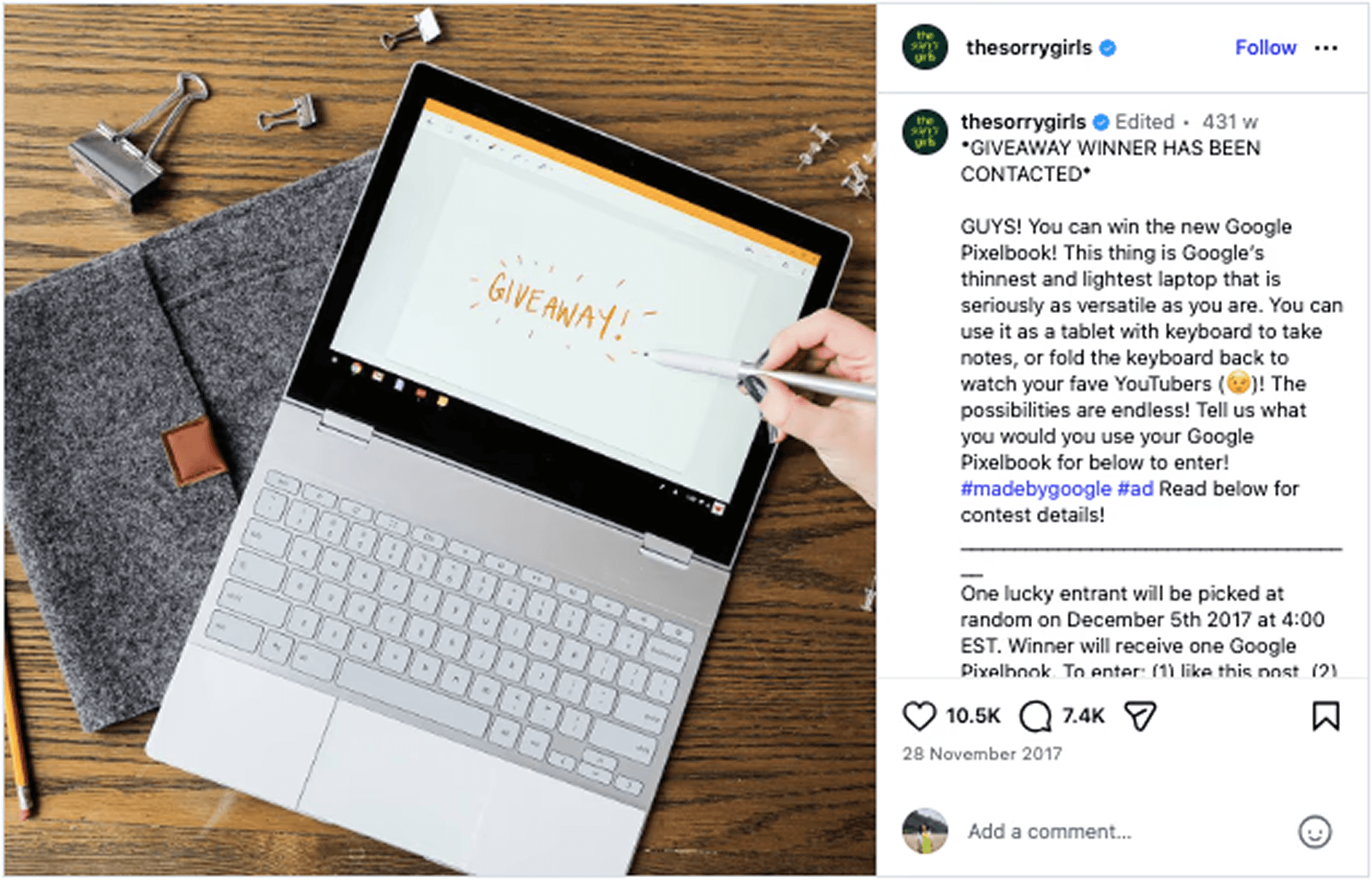
The entry just required liking a post and commenting on how they'd use the laptop and generateda 59.4% engagement rate, outperforming campaigns run by accounts with 100x the followers.
Step 3: Choose the Right Influencer
The instinct is to go with the biggest account you can afford. For giveaways, this is usually the wrong call.
Micro-influencers (10,000–100,000 followers) drive higher engagement rates than macro accounts, and their audiences are more concentrated around a specific interest or community.
When a micro-influencer in the sustainable fashion space runs a giveaway for your sustainable brand, the entrants are people who already care about what you sell. That's a fundamentally different audience than what you get from a lifestyle account with 2 million followers where the audience is wide and shallow.
What to look for in a giveaway partner specifically:
High comment engagement relative to likes (comments signal active community, not passive scrollers)
Audience demographics that match your customer profile
No history of running giveaways constantly. Creators who do monthly giveaways have trained their audience to follow-for-prizes rather than for content, and that behaviour carries over to your campaign
Genuine use or interest in your product category. An influencer who already posts about your niche will attract an audience that entered because of the brand, not just the prize
Also Read: How to Find Micro-Influencers on Instagram
Step 4: Design the Entry Mechanics
Entry mechanics determine who enters, how many people enter, and whether they stick around afterward. Here are some popular ones you can use:
Follow + tag a friend
This is the standard format and the easiest to execute. The influencer posts the giveaway, asks people to follow your brand account and tag someone in the comments. You get follower growth and organic reach as the tags pull in people who weren't initially exposed to the post.
The entry barrier is low enough to generate thousands of comments within hours. The downside is exactly that: low friction means low intent. A significant portion of entrants are habitual giveaway followers who will unfollow once the winner is announced.
Follow + tag + share to Stories
This adds a layer of commitment and theoretically spreads the giveaway further through participants' own Story audiences. In practice, Instagram's algorithm doesn't surface Story reshares the way it used to, so the reach amplification is less reliable than it once was. Fenty Beauty uses this format regularly for product launches.
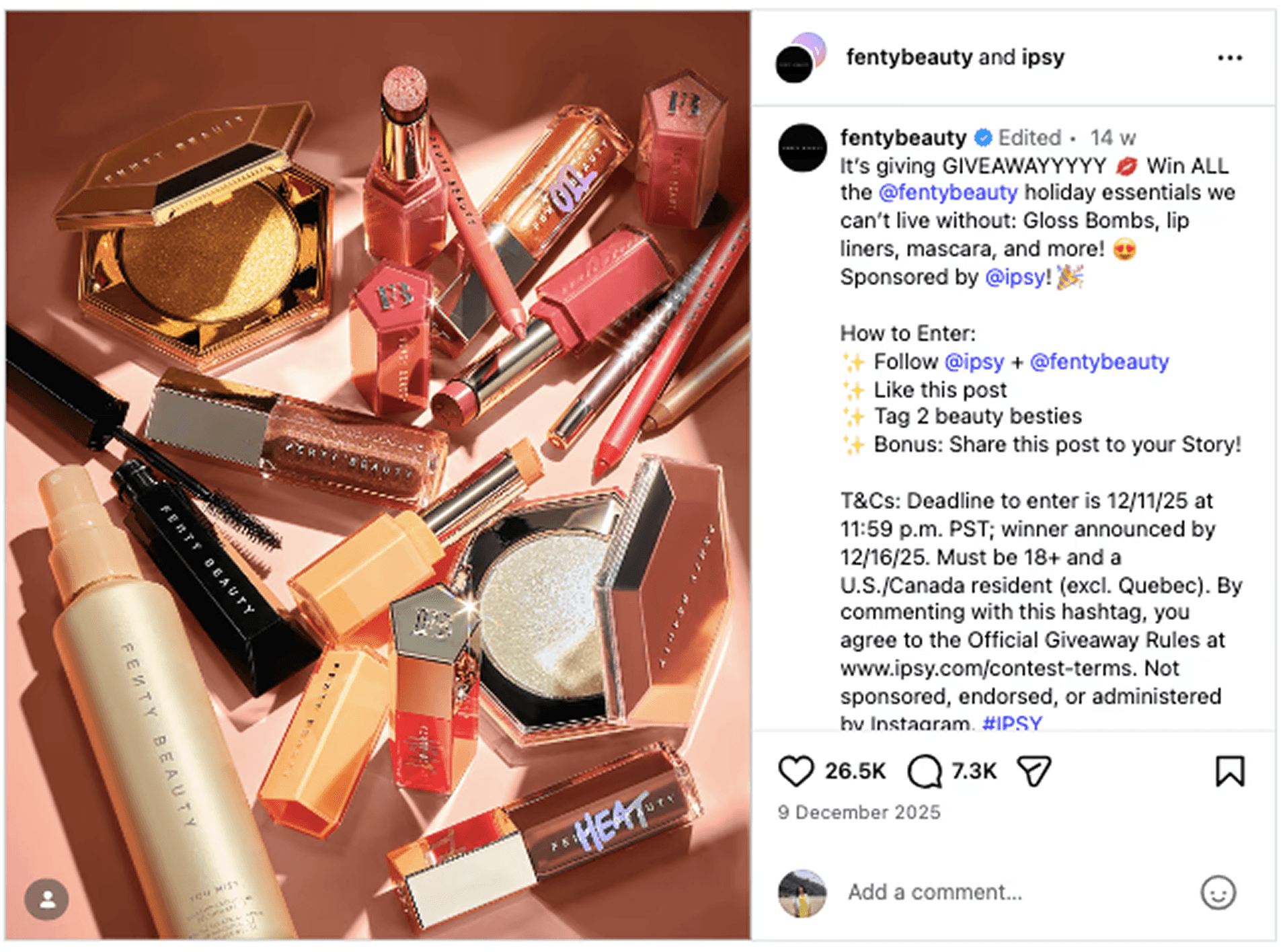
Use this format when your goal is community activation among existing fans rather than cold audience acquisition. It works better for brands that already have an engaged base than for brands trying to build one from scratch.
Comment with a specific answer
This format is the most underused format and often the most valuable. Instead of just asking people to tag friends, ask them something: "Tell us the one skincare product you can't live without" or "What's your biggest challenge when buying gifts for kids?"
The friction filters out passive entrants, the responses give you genuine audience research, and the comment volume signals quality to the algorithm. If you're a newer brand trying to understand your customer rather than just grow your follower count, this format pays dividends well beyond the campaign itself.
User-generated content entry
Post a photo using the product with a specific branded hashtag to enter — this is the highest-friction format and produces the most usable output.
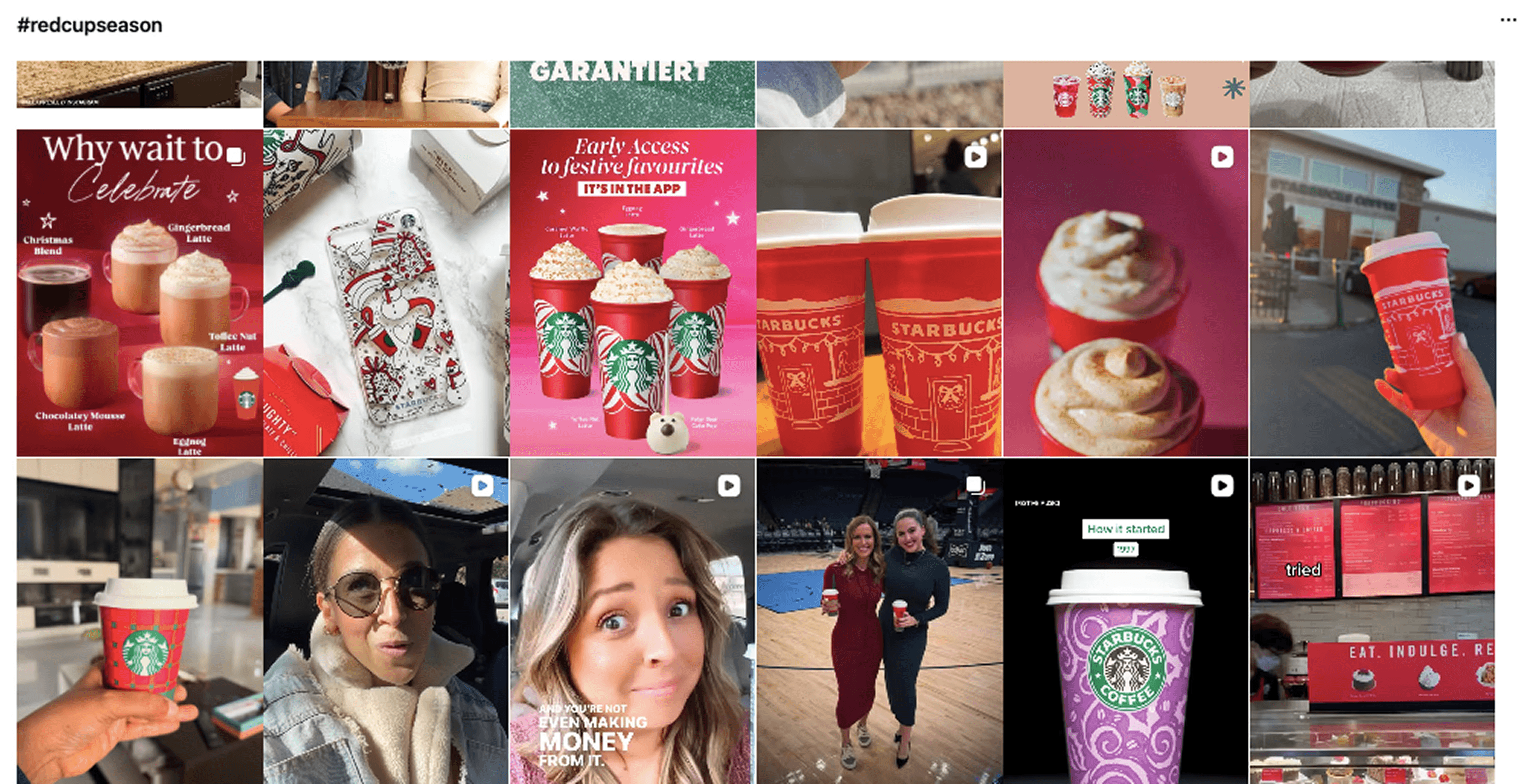
Starbucks has run UGC contests where customers submit cup designs; outdoor brands run photo contests where customers submit trail shots featuring their gear. The content you receive is often directly usable in paid ads and organic posts, which changes the ROI math considerably.
One important note: this structure makes your campaign a contest (skill-based, judged) rather than a giveaway (chance-based, randomly selected), and the two have different legal requirements. Don't blur the line between them or you create compliance issues around how winners are selected.
Collab post format
Now, this is the default best practice for any brand running a giveaway with an influencer. Instagram's collab feature lets the post appear simultaneously on both the brand's feed and the influencer's feed, with all likes, comments, and shares counting toward a shared engagement metric. This means every comment entry benefits the brand account directly, not just the influencer's.
Glossier has used collab posts effectively during product restocks, where the influencer's audience sees the post natively in their feed while Glossier captures the follower and engagement benefit without needing a separate brand post. For giveaways specifically, the collab format removes the awkward dynamic where all the energy lives on the influencer's account while the brand account barely registers the campaign.
Layer it all
One structure worth considering for bigger campaigns is layering mechanics: use the collab post for the core entry (follow both accounts, tag a friend), then add a Stories component for bonus entries, and seed the comment prompt to drive a specific type of response.
OLIPOP does this well during seasonal launches. The base entry is simple, but a bonus entry mechanic encourages people to share why they love the product, which generates authentic testimonial content the brand can repurpose.
The rule of thumb: match your friction level to your goal. If you need volume and reach, keep it simple. If you need quality and retention, add a question.
Step 5: Get the Legal Requirements Right
This section is not optional. Instagram giveaways have real legal obligations that most brands ignore until something goes wrong.
The Instagram disclaimer
Every giveaway post must include a statement that the promotion is not sponsored, endorsed, or administered by Instagram. This is a platform requirement, not just best practice. It should appear in the caption.
FTC disclosure
Since the brand is sponsoring the giveaway, the influencer must disclose the partnership clearly — #ad or #sponsored placed prominently in the caption, not buried in a wall of hashtags. Instagram's "Paid Partnership" label alone is not sufficient per FTC guidelines. Both must appear.
"No purchase necessary" language
In the US, giveaways (chance-based) must make clear that no purchase is required to enter and offer an alternative method of entry. This avoids the legal classification of the giveaway as an illegal lottery.
Official rules
Every giveaway needs a set of official rules covering eligibility, entry method, prize details, odds of winning, selection process, and timeline. These can live in a link in bio or a landing page — the caption should reference where to find them.
State-specific registration
If your prize pool exceeds $500 and you're targeting US residents, some states (Rhode Island, New York, Florida) require registration before the giveaway launches. If you're a small brand running a modest campaign, this is unlikely to apply but worth knowing.
The giveaway caption should therefore include something like: "This giveaway is sponsored by [Brand]. Not affiliated with or administered by Instagram. No purchase necessary. See link in bio for full terms." It's not exciting copy, but it's required.
Step 6: Set the Timeline and Coordinate the Posts
Most brand-influencer giveaways run 5–10 days. Shorter creates urgency; longer loses momentum. A week is the practical sweet spot for most campaigns.
Coordination matters more than most brands realize:
The influencer post and the brand post (as collab, or separately) should go live within the same day, ideally the same time window
Stories from both accounts in the first 24 hours amplify reach while the post is still surfacing in the algorithm
A mid-campaign Story reminder from the influencer ("Last few days to enter!") consistently boosts late entries without requiring a new post
Winner announcement as a separate post or Story keeps the account active post-campaign and gives you another content moment
Step 7: Measure the Right Things
Follower growth during the giveaway is a vanity metric until you see what happens after. Track these instead:
Follower retention rate: Compare your follower count 30 days after the giveaway ends to the peak during the campaign. A drop of more than 30-40% suggests your prize attracted the wrong audience.
Engagement rate of new followers: Do the accounts that followed during the giveaway engage with your subsequent posts? If your engagement rate drops after a follower spike, that tells you everything.
Comment quality: For entry mechanics that required specific answers, review what people wrote. This is primary research about your audience's actual pain points and language.
Conversion from email capture: If you structured entry to include email collection, what percentage of those emails opened your first post-giveaway email? That's your real qualified audience.
The Most Important Step
Instagram giveaways work. The mechanics are proven.
What most brands get wrong is who they attract.
A giveaway built around a generic prize and a broad audience will always spike numbers and then collapse. A giveaway built around the right influencer, the right prize, and the right entry structure will bring in people who actually care about your brand.
That difference comes down to one decision.
Choosing the right creator.
Impulze.ai gives you everything you need to make that call confidently:
Search 400M+ creator profiles across Instagram, TikTok, and YouTube with filters for niche, engagement rate, audience age, gender, and location
Audit audience quality before you reach out. See real engagement data and fake follower detection so you're not paying for reach that doesn't exist
Build and manage your influencer shortlist in one place, from discovery to outreach to campaign tracking
Monitor giveaway performance in real time. Track follower growth, post engagement, and campaign metrics without living in spreadsheets
Start for free — no demo call, no credit card.
Run your first influencer search in under three minutes and find the right giveaway partner before your next campaign window closes.
Instagram giveaway posts generate up to 64 times more comments and 3.5 times more likes than standard posts, and 91% of all Instagram posts with over 1,000 comments are giveaway-related. The mechanics work. The problem is that most brands run them wrong.
The typical execution goes like this: pick a flashy prize, find an influencer with a big following, ask people to follow and tag two friends, watch the follower count spike, then watch it drop back to baseline two weeks later.
What you're left with is a list of people who wanted a free iPad, not people who care about your brand.
The brands that actually get value from influencer giveaways structure them differently, from prize selection to influencer fit to entry mechanics.
Here's the full playbook you can also use to run Instagram giveaways with influencers.
Step 1: Get Clear on What You're Actually Trying to Achieve
Before anything else, decide what success looks like, because that decision shapes every choice that follows.
Follower growth is the most common goal, but it's also the most easily gamed by the wrong prize and the wrong audience. If this is the goal, your prize needs to be brand-specific enough to attract people who'd actually buy from you.
Email list growth is underused but highly valuable. You can structure entry mechanics to capture emails alongside Instagram follows, giving you an owned channel that doesn't depend on an algorithm.
UGC generation is a different structure entirely. This is more of a contest-style, where entry requires people to post content featuring your product. Higher friction, lower entry volume, but the content you get is often usable in paid ads.
Awareness around a launch is where influencer giveaways shine most consistently. Timing a giveaway to coincide with a product drop creates urgency and gives the influencer something genuinely newsworthy to post about.
Be honest about which of these you're after. Trying to achieve all four in one campaign usually results in achieving none of them cleanly.
Step 2: Choose the Right Prize
This is where most giveaways fail.
A generic high-value prize — cash, AirPods, an iPhone — attracts everyone, which means it attracts no one useful. The people who enter for an iPhone follow every giveaway account on Instagram. They will not buy your skincare product.
Your prize should be desirable to your customer and undesirable to everyone else. A $300 bundle of your own products passes this test. A $300 Amazon gift card doesn't.
A few prize structures that work:
Product bundles — your full range, presented as a curated "starter kit." High perceived value to an interested buyer, irrelevant to a freebie hunter.
Experience + product — a consultation, a custom option, early access to something unreleased. This is especially effective in beauty, fitness, or fashion where personalization has real value.
Collab bundles — partner with a complementary brand and bundle both products. This expands reach to both audiences while keeping the prize highly targeted.
The prize value doesn't need to be enormous.
Take example of Google's collaboration with micro-influencers The Sorry Girls for a Pixelbook giveaway.
The entry just required liking a post and commenting on how they'd use the laptop and generateda 59.4% engagement rate, outperforming campaigns run by accounts with 100x the followers.
Step 3: Choose the Right Influencer
The instinct is to go with the biggest account you can afford. For giveaways, this is usually the wrong call.
Micro-influencers (10,000–100,000 followers) drive higher engagement rates than macro accounts, and their audiences are more concentrated around a specific interest or community.
When a micro-influencer in the sustainable fashion space runs a giveaway for your sustainable brand, the entrants are people who already care about what you sell. That's a fundamentally different audience than what you get from a lifestyle account with 2 million followers where the audience is wide and shallow.
What to look for in a giveaway partner specifically:
High comment engagement relative to likes (comments signal active community, not passive scrollers)
Audience demographics that match your customer profile
No history of running giveaways constantly. Creators who do monthly giveaways have trained their audience to follow-for-prizes rather than for content, and that behaviour carries over to your campaign
Genuine use or interest in your product category. An influencer who already posts about your niche will attract an audience that entered because of the brand, not just the prize
Also Read: How to Find Micro-Influencers on Instagram
Step 4: Design the Entry Mechanics
Entry mechanics determine who enters, how many people enter, and whether they stick around afterward. Here are some popular ones you can use:
Follow + tag a friend
This is the standard format and the easiest to execute. The influencer posts the giveaway, asks people to follow your brand account and tag someone in the comments. You get follower growth and organic reach as the tags pull in people who weren't initially exposed to the post.
The entry barrier is low enough to generate thousands of comments within hours. The downside is exactly that: low friction means low intent. A significant portion of entrants are habitual giveaway followers who will unfollow once the winner is announced.
Follow + tag + share to Stories
This adds a layer of commitment and theoretically spreads the giveaway further through participants' own Story audiences. In practice, Instagram's algorithm doesn't surface Story reshares the way it used to, so the reach amplification is less reliable than it once was. Fenty Beauty uses this format regularly for product launches.
Use this format when your goal is community activation among existing fans rather than cold audience acquisition. It works better for brands that already have an engaged base than for brands trying to build one from scratch.
Comment with a specific answer
This format is the most underused format and often the most valuable. Instead of just asking people to tag friends, ask them something: "Tell us the one skincare product you can't live without" or "What's your biggest challenge when buying gifts for kids?"
The friction filters out passive entrants, the responses give you genuine audience research, and the comment volume signals quality to the algorithm. If you're a newer brand trying to understand your customer rather than just grow your follower count, this format pays dividends well beyond the campaign itself.
User-generated content entry
Post a photo using the product with a specific branded hashtag to enter — this is the highest-friction format and produces the most usable output.
Starbucks has run UGC contests where customers submit cup designs; outdoor brands run photo contests where customers submit trail shots featuring their gear. The content you receive is often directly usable in paid ads and organic posts, which changes the ROI math considerably.
One important note: this structure makes your campaign a contest (skill-based, judged) rather than a giveaway (chance-based, randomly selected), and the two have different legal requirements. Don't blur the line between them or you create compliance issues around how winners are selected.
Collab post format
Now, this is the default best practice for any brand running a giveaway with an influencer. Instagram's collab feature lets the post appear simultaneously on both the brand's feed and the influencer's feed, with all likes, comments, and shares counting toward a shared engagement metric. This means every comment entry benefits the brand account directly, not just the influencer's.
Glossier has used collab posts effectively during product restocks, where the influencer's audience sees the post natively in their feed while Glossier captures the follower and engagement benefit without needing a separate brand post. For giveaways specifically, the collab format removes the awkward dynamic where all the energy lives on the influencer's account while the brand account barely registers the campaign.
Layer it all
One structure worth considering for bigger campaigns is layering mechanics: use the collab post for the core entry (follow both accounts, tag a friend), then add a Stories component for bonus entries, and seed the comment prompt to drive a specific type of response.
OLIPOP does this well during seasonal launches. The base entry is simple, but a bonus entry mechanic encourages people to share why they love the product, which generates authentic testimonial content the brand can repurpose.
The rule of thumb: match your friction level to your goal. If you need volume and reach, keep it simple. If you need quality and retention, add a question.
Step 5: Get the Legal Requirements Right
This section is not optional. Instagram giveaways have real legal obligations that most brands ignore until something goes wrong.
The Instagram disclaimer
Every giveaway post must include a statement that the promotion is not sponsored, endorsed, or administered by Instagram. This is a platform requirement, not just best practice. It should appear in the caption.
FTC disclosure
Since the brand is sponsoring the giveaway, the influencer must disclose the partnership clearly — #ad or #sponsored placed prominently in the caption, not buried in a wall of hashtags. Instagram's "Paid Partnership" label alone is not sufficient per FTC guidelines. Both must appear.
"No purchase necessary" language
In the US, giveaways (chance-based) must make clear that no purchase is required to enter and offer an alternative method of entry. This avoids the legal classification of the giveaway as an illegal lottery.
Official rules
Every giveaway needs a set of official rules covering eligibility, entry method, prize details, odds of winning, selection process, and timeline. These can live in a link in bio or a landing page — the caption should reference where to find them.
State-specific registration
If your prize pool exceeds $500 and you're targeting US residents, some states (Rhode Island, New York, Florida) require registration before the giveaway launches. If you're a small brand running a modest campaign, this is unlikely to apply but worth knowing.
The giveaway caption should therefore include something like: "This giveaway is sponsored by [Brand]. Not affiliated with or administered by Instagram. No purchase necessary. See link in bio for full terms." It's not exciting copy, but it's required.
Step 6: Set the Timeline and Coordinate the Posts
Most brand-influencer giveaways run 5–10 days. Shorter creates urgency; longer loses momentum. A week is the practical sweet spot for most campaigns.
Coordination matters more than most brands realize:
The influencer post and the brand post (as collab, or separately) should go live within the same day, ideally the same time window
Stories from both accounts in the first 24 hours amplify reach while the post is still surfacing in the algorithm
A mid-campaign Story reminder from the influencer ("Last few days to enter!") consistently boosts late entries without requiring a new post
Winner announcement as a separate post or Story keeps the account active post-campaign and gives you another content moment
Step 7: Measure the Right Things
Follower growth during the giveaway is a vanity metric until you see what happens after. Track these instead:
Follower retention rate: Compare your follower count 30 days after the giveaway ends to the peak during the campaign. A drop of more than 30-40% suggests your prize attracted the wrong audience.
Engagement rate of new followers: Do the accounts that followed during the giveaway engage with your subsequent posts? If your engagement rate drops after a follower spike, that tells you everything.
Comment quality: For entry mechanics that required specific answers, review what people wrote. This is primary research about your audience's actual pain points and language.
Conversion from email capture: If you structured entry to include email collection, what percentage of those emails opened your first post-giveaway email? That's your real qualified audience.
The Most Important Step
Instagram giveaways work. The mechanics are proven.
What most brands get wrong is who they attract.
A giveaway built around a generic prize and a broad audience will always spike numbers and then collapse. A giveaway built around the right influencer, the right prize, and the right entry structure will bring in people who actually care about your brand.
That difference comes down to one decision.
Choosing the right creator.
Impulze.ai gives you everything you need to make that call confidently:
Search 400M+ creator profiles across Instagram, TikTok, and YouTube with filters for niche, engagement rate, audience age, gender, and location
Audit audience quality before you reach out. See real engagement data and fake follower detection so you're not paying for reach that doesn't exist
Build and manage your influencer shortlist in one place, from discovery to outreach to campaign tracking
Monitor giveaway performance in real time. Track follower growth, post engagement, and campaign metrics without living in spreadsheets
Start for free — no demo call, no credit card.
Run your first influencer search in under three minutes and find the right giveaway partner before your next campaign window closes.
Frequently Asked Questions
How long should an Instagram influencer giveaway run?

How long should an Instagram influencer giveaway run?
How many influencers should I use for a giveaway?
How many influencers should I use for a giveaway?
Do I need a lawyer to run an Instagram giveaway?
Do I need a lawyer to run an Instagram giveaway?
What's the difference between a giveaway and a contest on Instagram?
What's the difference between a giveaway and a contest on Instagram?
Should I require people to follow my account to enter?
Should I require people to follow my account to enter?
We Also Recommend To Read