🥳 Skip the subscription. Pay $299 once for lifetime access— See lifetime plans
🥳 Skip the subscription. Pay $299 once for lifetime access—

7 MIN READ
Strategy
Strategy
Influencer Marketing for Apps: How to Drive Downloads with Creators
Influencer Marketing for Apps: How to Drive Downloads with Creators
Influencer Marketing for Apps: How to Drive Downloads with Creators
Sections
Build your first creator list on Solo, $29 a month.

Blog in Short ⏱️
Blog in Short ⏱️
A quick glance at the highlights—perfect for when you're short on time.
A quick glance at the highlights—perfect for when you're short on time.
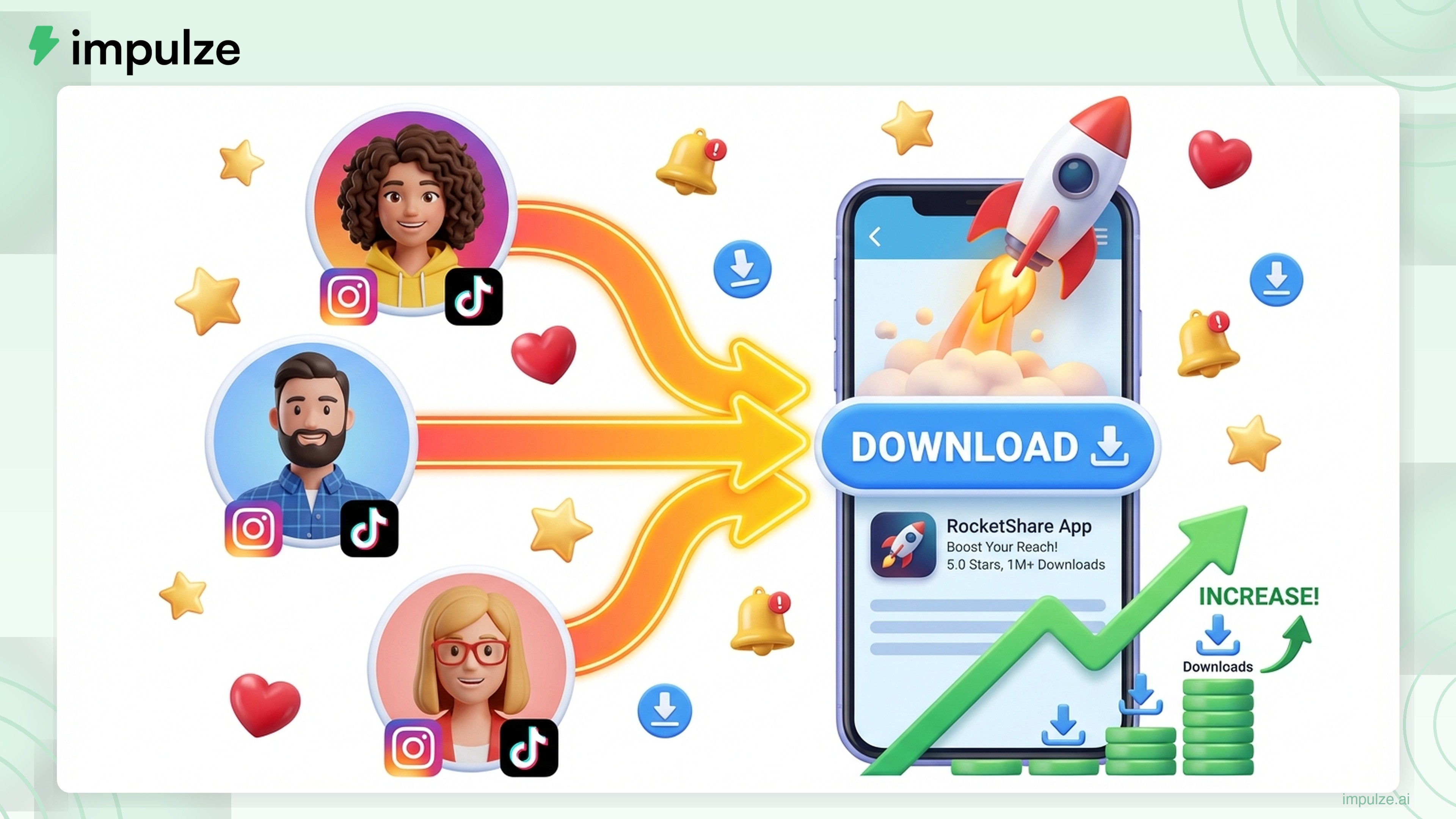
Creators do what ads cannot. They show how an app fits into real life, making users understand the value before they even download it.
Here’s what actually drives results:
• Creator-led demos outperform ads because users see the app in action
• Influencer-driven installs bring higher-quality users with better retention and lifetime value
• Different campaign types serve different goals, from launches to retention and affiliate growth
• Content format matters — walkthroughs, challenges, and real-use videos convert best
• Tracking is everything — use deep links, promo codes, and retention metrics, not just installs
• The right creator fit is critical, based on audience intent, not just niche or follower count
• Always-on programs beat one-off campaigns for sustainable growth
There were 137.8 billion app downloads in 2024. That number is both exciting and terrifying depending on which side of the App Store you're on.
If you're a brand with a big UA budget and a performance marketing team, you already know the standard playbook — Apple Search Ads, Google App Campaigns, Meta installs, TikTok app ads.
But if you're a smaller app trying to compete in a saturated category, or a growth team watching CPI creep up while retention stays flat, the traditional paid acquisition channels start to feel like an arms race you can't win.
Here's where creators come in and not in a vague, brand-awareness kind of way. Influencer-driven installs deliver approximately 11x better ROI than paid ads, and users acquired through influencer content have 37% higher lifetime value compared to other acquisition channels.
According to TikTok's own internal meta-analysis with Adjust, TikTok creator traffic resulted in CPIs 32–56% lower than other paid channels, with significantly higher retention and lower uninstall rates.
The reason isn't complicated. When someone downloads an app after watching an influencer they trust walk through how they use it, they already understand the value proposition. They're not cold traffic, they're pre-sold. And that difference shows up in every retention metric from Day 1 through Day 30.
This guide is for app marketers who want to make influencer marketing a real acquisition channel, with practical strategy, the right content formats, and measurement that actually ties back to business outcomes.
Why Influencer Marketing Hits Different for Apps
Selling a physical product through an influencer is relatively straightforward. You send product, creator posts, audience sees it, some of them buy. The value proposition is visible.
Apps are harder. You can't hold them up to a camera. The value is entirely in the experience and the problem with most app marketing is that ads can tell you an app exists but they can't make you understand why you'd want it in your life.
This is exactly what creators do better than any ad format.
When a productivity creator walks through how they actually use your app in their morning routine, showing the interface, the workflow, the moment it saved them time, that's a demo. When a fitness influencer shows their workout being tracked in real time through your app, you're not being told the app is useful. You're watching it be useful to someone whose judgment you trust.
83.8% of mobile app marketers report that customers acquired through influencer marketing are of higher quality than those acquired from other channels.
The keyword is quality.
You're not just getting downloads, you're getting users who showed up already knowing what the app does and why it matters to someone like them.
The Four Types of App Influencer Campaigns
Not all influencer campaigns serve the same purpose. For apps specifically, there are four distinct use cases and most brands only run one of them.
1. Launch campaigns
This is the most common: you're releasing an app or a major update and need to generate awareness and initial download velocity. The goal is concentrated attention in a short window. You're seeding multiple creators in the same category to post within a similar time period, creating the impression that everyone is talking about this thing at once.
For launch campaigns, timing coordination matters more than creator size. A dozen mid-tier creators posting within the same week is more effective than one macro creator posting alone because the appearance of ubiquity drives FOMO better than any single big placement.
2. Evergreen user acquisition
This is the approach most app marketers underuse.
Rather than one-off campaigns, you build a stable of creators whose content about your app runs continuously — seeding new creators regularly, renewing top performers, and repurposing the best-performing content as paid ads.
The best-performing organic creator content becomes your paid creative library. UGC/creator-driven creatives achieved approximately 20% lower CPI than other video formats according to Liftoff's 2024 Mobile Ad Creative Index. You're essentially using your influencer program as a creative testing lab — the content that performs organically tells you what to put budget behind.
3. Lifecycle and retention campaigns
This one is almost never talked about. Once you have users, influencer content can keep them engaged and reduce churn. This looks like creators showing new features, posting "how I use this app" content that reintroduces functionality existing users might not know about, or building community around the app's use cases.
For subscription apps in particular, this matters enormously. An engaged user who sees their favorite creator using an app they already have is reminded why they paid for it. That reminder is worth real money in terms of renewal rate.
4. Performance affiliate campaigns
This is where influencer marketing for apps starts to look more like performance marketing.
You give creators unique referral links or discount codes, they earn a commission on every install or subscription they drive, and you only pay for results. This works especially well with mid-tier and micro-creators in highly relevant niches who are motivated to drive real conversions rather than just post and collect a flat fee.
Choosing the Right Creator for Your App Category
The most common mistake in app influencer marketing is treating it like consumer product influencer marketing. The creator fit for an app is more specific because the audience needs to not just be interested in your category, but also actively use the kinds of apps that solve the problem yours addresses.
Here's how creator selection typically maps to app category:
Gaming apps:
Twitch streamers and YouTube gaming creators are the primary channels. The content format that works is live gameplay — audiences watch creators play and react to the actual game, which is both entertainment and the most authentic possible product demo.
Early access seeding or giving streamers access before public launch can generate organic buzz that's hard to manufacture any other way.
Fitness and health apps:
Instagram and YouTube fitness creators, with TikTok growing fast in this category.
The content that converts is showing the app being used during an actual workout, not a review of it. "Here's how I tracked today's run" beats "here's a review of this running app" every time.
Finance and fintech apps:
YouTube tends to outperform other platforms here because the audience is in a research mindset and willing to watch longer content.
Personal finance creators who genuinely talk about budgeting, investing, or saving as part of their regular content are the most credible placement as their audience is already primed to care about financial tools.
Productivity and utility apps:
Tutorial-focused creators on YouTube and TikTok.
The "I've been using this tool for 30 days and here's what I learned" format works extremely well because it addresses the biggest objection to productivity apps: does it actually work in practice or is it just good-looking software?
Lifestyle and social apps:
Instagram and TikTok lifestyle creators whose content naturally overlaps with the app's use case. For a travel app, travel creators. For a recipe app, food creators. The audience overlap is everything.
The principle across all of these: you want a creator whose audience already cares about the problem your app solves. A cooking creator's audience is already interested in recipes, not just in the creator. When that creator introduces a recipe app into their content, it lands differently than it would coming from a general lifestyle creator.
Content Formats That Actually Drive Downloads
The content format matters almost as much as the creator. Here's what works and why.
1) The walkthrough
The creator shows how they actually use the app and give a sneak peek into the real interface, real workflow, real outcome. No scripts, no marketing language. Just "here's how I use this thing in my day."
This format converts because it answers the question every potential user is asking: "Is this actually useful or does it just look good?"
Bumble's TikTok campaign is a well-known example of this done right. Creators showed themselves using the app authentically, not performing enthusiasm for a brand. The naturalism of it was the point.
2) The before/after
Common in fitness and productivity categories.
Creators show their situation before the app, then demonstrates the improvement after using it. Works best when the "after" is quantifiable — "I went from spending an hour on this to 15 minutes" lands better than vague claims about efficiency.
3) The challenge
Creator issues a challenge to their audience tied to the app. The best example is gaming apps where creators challenge followers to beat their score, or fitness apps where creators run a 30-day challenge using the app's tracking features.
TikTok's own rise was partly powered by this mechanic. They had YouTube and Instagram influencers create viral challenges with the TikTok app, driving installs from competing platforms.
4) The "I've been using this for X days" review
Long-form YouTube content where a creator gives an honest account of actually living with the app. The format signals authenticity — a 10-minute video about using an app for 30 days is not the kind of content someone makes for a quick brand deal.
Audiences know this, which is why these videos generate comments from people genuinely asking whether the app is worth it.
5) The integration
The creator doesn't make the app the focus. It appears naturally in content about something else. A creator doing a GRWM (get ready with me) video who happens to open a meditation app at the end.
A productivity creator showing their full morning routine where your app is one of their five tools. This format generates lower direct click-through but higher quality installs because the viewer's association is "this person I follow uses this app" rather than "this creator is advertising this app."
The Brief That Gets Results
App influencer campaigns underperform when the brief is too restrictive. Most app marketers, understandably, want the creator to hit specific features, use specific language, show specific screens. This instinct is wrong.
A creator who reads from your brief sounds like they're reading from your brief. Their audience can tell. And sponsored content that feels inauthentic drives lower conversion than no sponsored content at all.
What a good app influencer brief actually includes:
The problem your app solves. Not the features — the problem. "Our app helps people who struggle to stick to a workout routine because tracking feels complicated" is better than a feature list. Let the creator decide how to address that problem in their own voice.
The one thing you need them to include. This is usually the download link (as a unique deep link or promo code), the app name spelled correctly, and the platform it's available on. That's it. Everything else is creative direction, not mandate.
Context about your audience. Who are the people most likely to get value from this? Give the creator enough to understand who they're trying to reach so they can calibrate the content accordingly.
What you're not looking for. This is often more useful than what you are looking for. "We don't want you to screen-record the app for more than 20 seconds" or "please don't use the word 'game-changing'" saves everyone time in the revision process.
The brief is a creative guardrail, not a script. The creators you work with know their audience better than you do. Let them.
Tracking and Measurement: The Part Most Brands Get Wrong
This is where app influencer marketing breaks down for most teams. You ran the campaign, content went live, you got some downloads but you don't really know which creator drove what, which content format performed best, or whether the users who came through creators are actually sticking around.
This is fixable. Here's how to set it up properly.
Unique deep links for every creator
Give each creator their own unique trackable link. This is a link that, when clicked on mobile, takes the user directly to the relevant section of your app or to the App Store/Google Play with attribution. Your Mobile Measurement Partner (MMP) — Adjust, AppsFlyer, Singular — captures where every install came from.
Not just one link per campaign. One link per creator, per platform, per content type if you want granular data. The more granular your attribution, the more clearly you can see which partnerships are actually worth renewing.
Promo codes as backup attribution
Deep links don't always fire correctly — particularly on iOS after App Tracking Transparency. Unique promo codes per creator give you a secondary attribution signal. A user who downloads the app and enters Creator X's promo code on onboarding is attributed to Creator X regardless of what happened with the link click.
This also gives creators something to offer their audience (a discount, a free trial extension, premium features unlock) which consistently improves conversion rates.
The metrics that actually matter
Forget impressions. For apps, the metrics worth tracking are:
CPI (Cost Per Install): Total campaign cost divided by number of installs attributed to that creator. This is your primary efficiency metric. Compare it against your paid channel CPI benchmarks — if a creator is delivering CPI at half your Meta cost, that's significant.
Day 1, Day 7, Day 30 retention: This is where quality shows up. A creator who drives 1,000 installs with 40% Day 7 retention is worth far more than one who drives 2,000 installs with 10% Day 7 retention. Install volume is a vanity metric without retention data behind it.
LTV (Lifetime Value) by creator cohort: More complex to track but the most important long-term signal. If users acquired through Creator A have 2x the LTV of users acquired through Creator B, you know who to invest in for long-term partnerships even if their initial CPI was higher.
CVR (Click to Install Conversion Rate): How many people who clicked the link actually installed the app? Low CVR usually means the App Store listing isn't converting people who arrived pre-warmed by creator content — which is an App Store Optimization problem, not an influencer problem.
Payment Structures for App Campaigns
App influencer campaigns have more payment model flexibility than consumer product campaigns, and the right model depends on what you're optimizing for.
Flat fee: Creator gets paid regardless of install performance. Best for large creators where you're paying partly for reach and brand association. Risk: you pay whether it works or not.
Cost Per Install (CPI): You pay a fixed amount per verified install. Best for performance-focused campaigns with tight attribution set up. Risk: creators are incentivized to drive volume over quality.
Hybrid (flat fee + performance bonus): The most common structure for established creator relationships. Creator gets a base fee for producing the content, plus a bonus per install above a defined threshold. Aligns incentives without putting all the risk on the creator.
Affiliate commission: Creator earns a percentage of subscriptions or purchases generated through their link. Best for mid-tier and micro-creators in highly relevant niches. Scales well because you're only paying for results, but requires strong tracking infrastructure to execute fairly.
Blended programs — running many micro-creators alongside a handful of larger ones — tend to produce the best overall CPI because the micro tier drives efficient installs while the larger tier provides the cultural credibility that makes the app feel worth downloading.
The Retention Play Nobody Talks About
Most app influencer marketing guides focus exclusively on downloads. Here's the thing: your most expensive acquisition problem might not be getting users into the app, it might be keeping them there.
Creators can help with this too, and almost nobody is using them for it.
Once you have an engaged user base, the same creators who drove installs can become community builders. Content that shows "how I use [App] as part of my routine" posted by a creator their followers trust serves as a retention reminder to existing users who may have downloaded and gone quiet. It's much cheaper to reactivate a lapsed user who recognizes the creator from when they discovered the app than to acquire a new one.
For subscription apps, this is particularly high-value. A user who sees their favorite creator post about how they use an app they're currently subscribed to is getting a retention nudge that doesn't feel like marketing. That's worth building into your program explicitly, not just as a side effect of your acquisition campaigns.
Building a Sustainable App Influencer Program
One-off campaigns produce spikes. Programs produce growth.
The brands that consistently win with app influencer marketing treat it like an always-on channel rather than a campaign channel. That means:
A discovery and seeding pipeline. Regularly identifying new creators in your category, sending them app access, and monitoring organic posts before formalizing paid relationships. The creators who post about your app without being paid are your best potential partners — they already believe in it.
A performance-based renewal process. After each creator's content goes live, you review the CPI, Day 7 retention, and overall install quality. The top performers get renewed. The underperformers don't. Over time, you build a pool of proven creators whose audience converts well for your specific app.
Content repurposing as paid ads. The best-performing organic creator content gets licensed and run as paid creative. This is where the unit economics get very attractive — you're paying for content creation once and getting paid ad performance out of it continuously. UGC-driven creatives consistently outperform brand-produced video in terms of CPI and the gap is growing as audiences become more ad-aware.
Where to Start?
Finding the right creators for your specific app category is the part that takes the longest without the right tools. You're not just looking for follower count, you're looking for audience demographics that match your target user, genuine engagement with your category, and posting consistency that tells you someone will actually deliver.
Impulze.ai is built to make this faster:
Search 400M+ creator profiles across Instagram, TikTok, and YouTube filtered by niche, audience demographics, engagement rate, and location so you're finding creators whose audience actually looks like your target user
Audience authenticity checks with fake follower detection before you reach out
Collaboration history showing which apps and brands a creator has worked with before
Campaign tracking from outreach through live content so you're not managing everything in spreadsheets
There were 137.8 billion app downloads in 2024. That number is both exciting and terrifying depending on which side of the App Store you're on.
If you're a brand with a big UA budget and a performance marketing team, you already know the standard playbook — Apple Search Ads, Google App Campaigns, Meta installs, TikTok app ads.
But if you're a smaller app trying to compete in a saturated category, or a growth team watching CPI creep up while retention stays flat, the traditional paid acquisition channels start to feel like an arms race you can't win.
Here's where creators come in and not in a vague, brand-awareness kind of way. Influencer-driven installs deliver approximately 11x better ROI than paid ads, and users acquired through influencer content have 37% higher lifetime value compared to other acquisition channels.
According to TikTok's own internal meta-analysis with Adjust, TikTok creator traffic resulted in CPIs 32–56% lower than other paid channels, with significantly higher retention and lower uninstall rates.
The reason isn't complicated. When someone downloads an app after watching an influencer they trust walk through how they use it, they already understand the value proposition. They're not cold traffic, they're pre-sold. And that difference shows up in every retention metric from Day 1 through Day 30.
This guide is for app marketers who want to make influencer marketing a real acquisition channel, with practical strategy, the right content formats, and measurement that actually ties back to business outcomes.
Why Influencer Marketing Hits Different for Apps
Selling a physical product through an influencer is relatively straightforward. You send product, creator posts, audience sees it, some of them buy. The value proposition is visible.
Apps are harder. You can't hold them up to a camera. The value is entirely in the experience and the problem with most app marketing is that ads can tell you an app exists but they can't make you understand why you'd want it in your life.
This is exactly what creators do better than any ad format.
When a productivity creator walks through how they actually use your app in their morning routine, showing the interface, the workflow, the moment it saved them time, that's a demo. When a fitness influencer shows their workout being tracked in real time through your app, you're not being told the app is useful. You're watching it be useful to someone whose judgment you trust.
83.8% of mobile app marketers report that customers acquired through influencer marketing are of higher quality than those acquired from other channels.
The keyword is quality.
You're not just getting downloads, you're getting users who showed up already knowing what the app does and why it matters to someone like them.
The Four Types of App Influencer Campaigns
Not all influencer campaigns serve the same purpose. For apps specifically, there are four distinct use cases and most brands only run one of them.
1. Launch campaigns
This is the most common: you're releasing an app or a major update and need to generate awareness and initial download velocity. The goal is concentrated attention in a short window. You're seeding multiple creators in the same category to post within a similar time period, creating the impression that everyone is talking about this thing at once.
For launch campaigns, timing coordination matters more than creator size. A dozen mid-tier creators posting within the same week is more effective than one macro creator posting alone because the appearance of ubiquity drives FOMO better than any single big placement.
2. Evergreen user acquisition
This is the approach most app marketers underuse.
Rather than one-off campaigns, you build a stable of creators whose content about your app runs continuously — seeding new creators regularly, renewing top performers, and repurposing the best-performing content as paid ads.
The best-performing organic creator content becomes your paid creative library. UGC/creator-driven creatives achieved approximately 20% lower CPI than other video formats according to Liftoff's 2024 Mobile Ad Creative Index. You're essentially using your influencer program as a creative testing lab — the content that performs organically tells you what to put budget behind.
3. Lifecycle and retention campaigns
This one is almost never talked about. Once you have users, influencer content can keep them engaged and reduce churn. This looks like creators showing new features, posting "how I use this app" content that reintroduces functionality existing users might not know about, or building community around the app's use cases.
For subscription apps in particular, this matters enormously. An engaged user who sees their favorite creator using an app they already have is reminded why they paid for it. That reminder is worth real money in terms of renewal rate.
4. Performance affiliate campaigns
This is where influencer marketing for apps starts to look more like performance marketing.
You give creators unique referral links or discount codes, they earn a commission on every install or subscription they drive, and you only pay for results. This works especially well with mid-tier and micro-creators in highly relevant niches who are motivated to drive real conversions rather than just post and collect a flat fee.
Choosing the Right Creator for Your App Category
The most common mistake in app influencer marketing is treating it like consumer product influencer marketing. The creator fit for an app is more specific because the audience needs to not just be interested in your category, but also actively use the kinds of apps that solve the problem yours addresses.
Here's how creator selection typically maps to app category:
Gaming apps:
Twitch streamers and YouTube gaming creators are the primary channels. The content format that works is live gameplay — audiences watch creators play and react to the actual game, which is both entertainment and the most authentic possible product demo.
Early access seeding or giving streamers access before public launch can generate organic buzz that's hard to manufacture any other way.
Fitness and health apps:
Instagram and YouTube fitness creators, with TikTok growing fast in this category.
The content that converts is showing the app being used during an actual workout, not a review of it. "Here's how I tracked today's run" beats "here's a review of this running app" every time.
Finance and fintech apps:
YouTube tends to outperform other platforms here because the audience is in a research mindset and willing to watch longer content.
Personal finance creators who genuinely talk about budgeting, investing, or saving as part of their regular content are the most credible placement as their audience is already primed to care about financial tools.
Productivity and utility apps:
Tutorial-focused creators on YouTube and TikTok.
The "I've been using this tool for 30 days and here's what I learned" format works extremely well because it addresses the biggest objection to productivity apps: does it actually work in practice or is it just good-looking software?
Lifestyle and social apps:
Instagram and TikTok lifestyle creators whose content naturally overlaps with the app's use case. For a travel app, travel creators. For a recipe app, food creators. The audience overlap is everything.
The principle across all of these: you want a creator whose audience already cares about the problem your app solves. A cooking creator's audience is already interested in recipes, not just in the creator. When that creator introduces a recipe app into their content, it lands differently than it would coming from a general lifestyle creator.
Content Formats That Actually Drive Downloads
The content format matters almost as much as the creator. Here's what works and why.
1) The walkthrough
The creator shows how they actually use the app and give a sneak peek into the real interface, real workflow, real outcome. No scripts, no marketing language. Just "here's how I use this thing in my day."
This format converts because it answers the question every potential user is asking: "Is this actually useful or does it just look good?"
Bumble's TikTok campaign is a well-known example of this done right. Creators showed themselves using the app authentically, not performing enthusiasm for a brand. The naturalism of it was the point.
2) The before/after
Common in fitness and productivity categories.
Creators show their situation before the app, then demonstrates the improvement after using it. Works best when the "after" is quantifiable — "I went from spending an hour on this to 15 minutes" lands better than vague claims about efficiency.
3) The challenge
Creator issues a challenge to their audience tied to the app. The best example is gaming apps where creators challenge followers to beat their score, or fitness apps where creators run a 30-day challenge using the app's tracking features.
TikTok's own rise was partly powered by this mechanic. They had YouTube and Instagram influencers create viral challenges with the TikTok app, driving installs from competing platforms.
4) The "I've been using this for X days" review
Long-form YouTube content where a creator gives an honest account of actually living with the app. The format signals authenticity — a 10-minute video about using an app for 30 days is not the kind of content someone makes for a quick brand deal.
Audiences know this, which is why these videos generate comments from people genuinely asking whether the app is worth it.
5) The integration
The creator doesn't make the app the focus. It appears naturally in content about something else. A creator doing a GRWM (get ready with me) video who happens to open a meditation app at the end.
A productivity creator showing their full morning routine where your app is one of their five tools. This format generates lower direct click-through but higher quality installs because the viewer's association is "this person I follow uses this app" rather than "this creator is advertising this app."
The Brief That Gets Results
App influencer campaigns underperform when the brief is too restrictive. Most app marketers, understandably, want the creator to hit specific features, use specific language, show specific screens. This instinct is wrong.
A creator who reads from your brief sounds like they're reading from your brief. Their audience can tell. And sponsored content that feels inauthentic drives lower conversion than no sponsored content at all.
What a good app influencer brief actually includes:
The problem your app solves. Not the features — the problem. "Our app helps people who struggle to stick to a workout routine because tracking feels complicated" is better than a feature list. Let the creator decide how to address that problem in their own voice.
The one thing you need them to include. This is usually the download link (as a unique deep link or promo code), the app name spelled correctly, and the platform it's available on. That's it. Everything else is creative direction, not mandate.
Context about your audience. Who are the people most likely to get value from this? Give the creator enough to understand who they're trying to reach so they can calibrate the content accordingly.
What you're not looking for. This is often more useful than what you are looking for. "We don't want you to screen-record the app for more than 20 seconds" or "please don't use the word 'game-changing'" saves everyone time in the revision process.
The brief is a creative guardrail, not a script. The creators you work with know their audience better than you do. Let them.
Tracking and Measurement: The Part Most Brands Get Wrong
This is where app influencer marketing breaks down for most teams. You ran the campaign, content went live, you got some downloads but you don't really know which creator drove what, which content format performed best, or whether the users who came through creators are actually sticking around.
This is fixable. Here's how to set it up properly.
Unique deep links for every creator
Give each creator their own unique trackable link. This is a link that, when clicked on mobile, takes the user directly to the relevant section of your app or to the App Store/Google Play with attribution. Your Mobile Measurement Partner (MMP) — Adjust, AppsFlyer, Singular — captures where every install came from.
Not just one link per campaign. One link per creator, per platform, per content type if you want granular data. The more granular your attribution, the more clearly you can see which partnerships are actually worth renewing.
Promo codes as backup attribution
Deep links don't always fire correctly — particularly on iOS after App Tracking Transparency. Unique promo codes per creator give you a secondary attribution signal. A user who downloads the app and enters Creator X's promo code on onboarding is attributed to Creator X regardless of what happened with the link click.
This also gives creators something to offer their audience (a discount, a free trial extension, premium features unlock) which consistently improves conversion rates.
The metrics that actually matter
Forget impressions. For apps, the metrics worth tracking are:
CPI (Cost Per Install): Total campaign cost divided by number of installs attributed to that creator. This is your primary efficiency metric. Compare it against your paid channel CPI benchmarks — if a creator is delivering CPI at half your Meta cost, that's significant.
Day 1, Day 7, Day 30 retention: This is where quality shows up. A creator who drives 1,000 installs with 40% Day 7 retention is worth far more than one who drives 2,000 installs with 10% Day 7 retention. Install volume is a vanity metric without retention data behind it.
LTV (Lifetime Value) by creator cohort: More complex to track but the most important long-term signal. If users acquired through Creator A have 2x the LTV of users acquired through Creator B, you know who to invest in for long-term partnerships even if their initial CPI was higher.
CVR (Click to Install Conversion Rate): How many people who clicked the link actually installed the app? Low CVR usually means the App Store listing isn't converting people who arrived pre-warmed by creator content — which is an App Store Optimization problem, not an influencer problem.
Payment Structures for App Campaigns
App influencer campaigns have more payment model flexibility than consumer product campaigns, and the right model depends on what you're optimizing for.
Flat fee: Creator gets paid regardless of install performance. Best for large creators where you're paying partly for reach and brand association. Risk: you pay whether it works or not.
Cost Per Install (CPI): You pay a fixed amount per verified install. Best for performance-focused campaigns with tight attribution set up. Risk: creators are incentivized to drive volume over quality.
Hybrid (flat fee + performance bonus): The most common structure for established creator relationships. Creator gets a base fee for producing the content, plus a bonus per install above a defined threshold. Aligns incentives without putting all the risk on the creator.
Affiliate commission: Creator earns a percentage of subscriptions or purchases generated through their link. Best for mid-tier and micro-creators in highly relevant niches. Scales well because you're only paying for results, but requires strong tracking infrastructure to execute fairly.
Blended programs — running many micro-creators alongside a handful of larger ones — tend to produce the best overall CPI because the micro tier drives efficient installs while the larger tier provides the cultural credibility that makes the app feel worth downloading.
The Retention Play Nobody Talks About
Most app influencer marketing guides focus exclusively on downloads. Here's the thing: your most expensive acquisition problem might not be getting users into the app, it might be keeping them there.
Creators can help with this too, and almost nobody is using them for it.
Once you have an engaged user base, the same creators who drove installs can become community builders. Content that shows "how I use [App] as part of my routine" posted by a creator their followers trust serves as a retention reminder to existing users who may have downloaded and gone quiet. It's much cheaper to reactivate a lapsed user who recognizes the creator from when they discovered the app than to acquire a new one.
For subscription apps, this is particularly high-value. A user who sees their favorite creator post about how they use an app they're currently subscribed to is getting a retention nudge that doesn't feel like marketing. That's worth building into your program explicitly, not just as a side effect of your acquisition campaigns.
Building a Sustainable App Influencer Program
One-off campaigns produce spikes. Programs produce growth.
The brands that consistently win with app influencer marketing treat it like an always-on channel rather than a campaign channel. That means:
A discovery and seeding pipeline. Regularly identifying new creators in your category, sending them app access, and monitoring organic posts before formalizing paid relationships. The creators who post about your app without being paid are your best potential partners — they already believe in it.
A performance-based renewal process. After each creator's content goes live, you review the CPI, Day 7 retention, and overall install quality. The top performers get renewed. The underperformers don't. Over time, you build a pool of proven creators whose audience converts well for your specific app.
Content repurposing as paid ads. The best-performing organic creator content gets licensed and run as paid creative. This is where the unit economics get very attractive — you're paying for content creation once and getting paid ad performance out of it continuously. UGC-driven creatives consistently outperform brand-produced video in terms of CPI and the gap is growing as audiences become more ad-aware.
Where to Start?
Finding the right creators for your specific app category is the part that takes the longest without the right tools. You're not just looking for follower count, you're looking for audience demographics that match your target user, genuine engagement with your category, and posting consistency that tells you someone will actually deliver.
Impulze.ai is built to make this faster:
Search 400M+ creator profiles across Instagram, TikTok, and YouTube filtered by niche, audience demographics, engagement rate, and location so you're finding creators whose audience actually looks like your target user
Audience authenticity checks with fake follower detection before you reach out
Collaboration history showing which apps and brands a creator has worked with before
Campaign tracking from outreach through live content so you're not managing everything in spreadsheets
Frequently Asked Questions
What type of influencer works best for app marketing?

What type of influencer works best for app marketing?
Should I pay per install or a flat fee?
Should I pay per install or a flat fee?
How many creators should I work with for an app launch?
How many creators should I work with for an app launch?
Can influencer marketing help with app retention, not just downloads?
Can influencer marketing help with app retention, not just downloads?
We Also Recommend To Read