🥳 Skip the subscription. Pay $299 once for lifetime access— See lifetime plans
🥳 Skip the subscription. Pay $299 once for lifetime access—

9 MIN READ
Top Tools & Software
Top Tools & Software
Influencer Management Software: Things to Check Before You Buy
Influencer Management Software: Things to Check Before You Buy
Influencer Management Software: Things to Check Before You Buy

Rashmi Singh
Rashmi Singh
Rashmi Singh
Content Marketer @impulze.ai
Sections
Build your first creator list on Solo, $29 a month.

Blog in Short ⏱️
Blog in Short ⏱️
A quick glance at the highlights—perfect for when you're short on time.
A quick glance at the highlights—perfect for when you're short on time.
Influencer management software helps brands and agencies manage their entire influencer marketing workflow from a single platform. Instead of switching between spreadsheets, emails, and DMs, everything stays organized in one dashboard. Before buying any tool, it’s important to check:
Influencer discovery and search filters
Audience authenticity and fake follower detection
Campaign management and content tracking
Outreach and communication tools
Reporting, analytics, and ROI tracking
Integrations with eCommerce and CRM tools
Pricing, scalability, and data security
Choosing the right software helps you save time, avoid costly mistakes, and scale your influencer marketing with clarity and confidence.
Influencer marketing looks exciting from the outside. But once you’re actually running campaigns—shortlisting creators, sending emails, tracking content, approving posts, handling payments, and measuring ROI—it can quickly turn into chaos. That’s exactly where influencer management software comes in.
Today, there are dozens of tools claiming to be “all-in-one.” But not every tool is built for your needs. Some are great for discovery but weak at management. Others look powerful but are hard to use, overpriced, or filled with outdated data.
Before you invest your budget in any platform, here’s a detailed, no-fluff guide on everything you must check before buying influencer management software—so you don’t end up regretting your decision later.
What Is Influencer Management Software (In Simple Terms)?
Influencer management software helps you handle your entire influencer marketing workflow in one place. With this kind of software, you can:
Find influencers that match your niche, location, and budget
Check if their audience is real (so you don’t end up paying someone with fake followers)
Reach out to them directly through email or built-in outreach tools
Plan and manage campaigns, assign tasks, and track deadlines
Track posts and performance once the content goes live
Measure what actually worked like engagement, clicks, leads, or sales
For example, imagine you’re launching a skincare product. Instead of manually searching Instagram for creators, noting down usernames in a sheet, DM-ing them one by one, and then losing track of who replied, the software lets you discover creators, message them, approve content, and track results.
Why Choose the Right Influencer Management Tool
Here’s the truth: most brands don’t fail at influencer marketing because the strategy is wrong. They fail because the systems behind it are messy. Things start going wrong when you:
End up choosing the wrong creators
Don’t really know what’s working and what’s not
Lose data in spreadsheets and chats
Or spend money on tools that look fancy but don’t actually help
When you use the right influencer management tool, everything feels more under control. You can:
Spot fake or low-quality influencers before wasting your budget
Clearly see your ROI, instead of just guessing
Build long-term relationships with creators, not one-off deals
Track every conversation, post, and result in one place
Scale your campaigns without your workflow turning into chaos
But a wrong tool does the opposite. It adds more steps, more confusion, and more manual work. Instead of saving time, it ends up creating frustration.
Key Things to Check Before You Buy Influencer Management Software
Let’s break this down feature by feature. These are the non-negotiables you should evaluate while selecting an influencer management too.
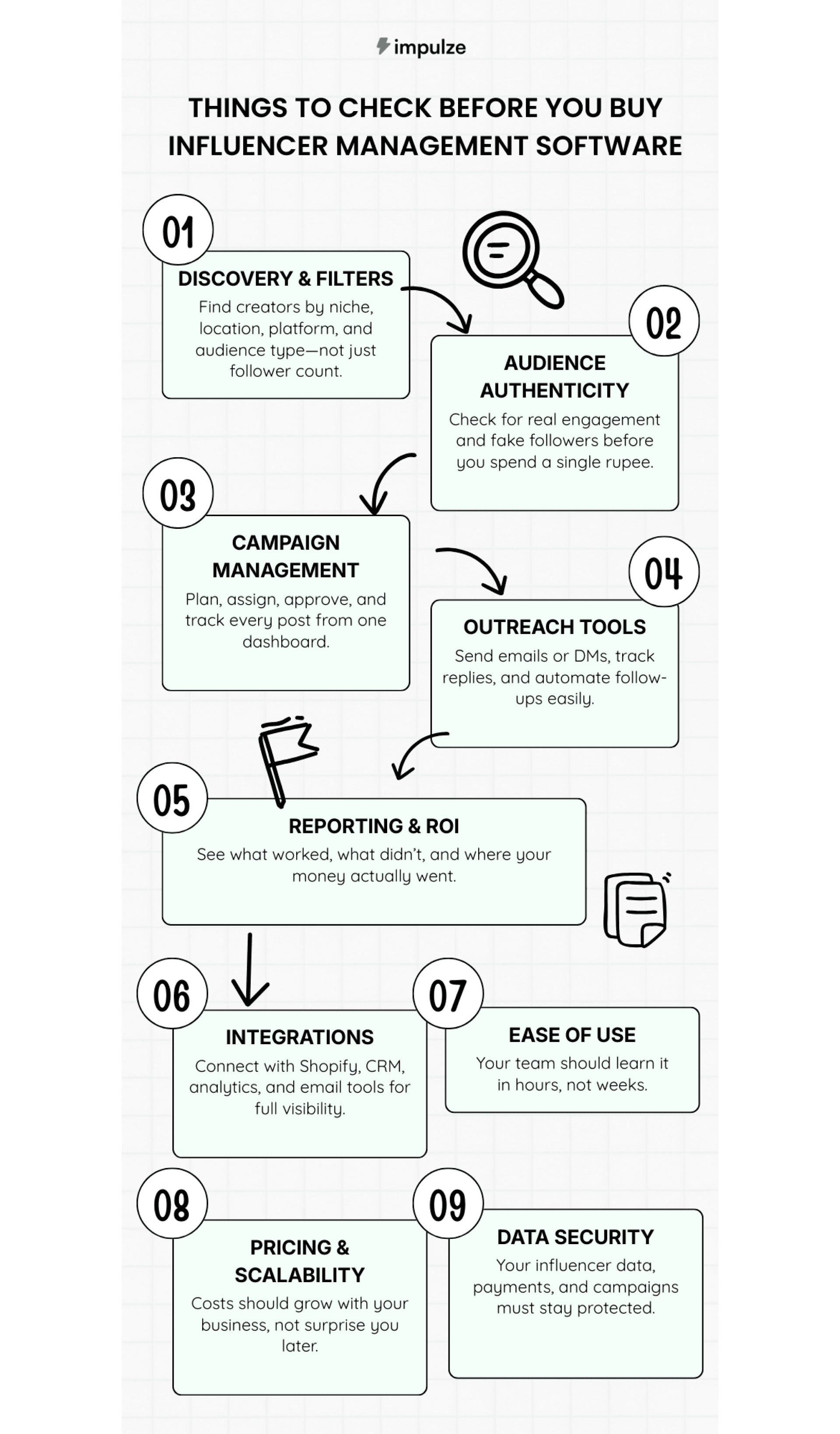
1. Influencer Discovery & Search Capabilities
This is usually the first reason people sign up for a tool. Ask yourself:
Can I search by niche, location, followers, and platform?
Does it support Instagram, YouTube, TikTok, or just one platform?
Can I find micro, macro, and nano influencers easily?
A good tool should help you discover relevant, not just popular, creators. If it only lets you filter by follower count, that’s a red flag. Discovery without relevance is just noise.
2. Audience & Authenticity Checks (This Is Crucial)
This is where many tools look good on the surface but fail in reality.
You should be able to check:
Engagement rate (not just likes)
Fake or inactive followers
Audience location
Age and gender split
Follower growth trends
If a tool doesn’t help you detect fake influencers, you risk wasting your entire budget on creators who look big but deliver no real impact.
Always ask: “How do you verify influencer authenticity?”
3. Campaign Management Features
Discovery is just the start. The real work begins after you’ve chosen the influencers. Look for features like:
Campaign creation
Task assignment
Content upload and approval
Post deadlines
Real-time status tracking
Without proper campaign management, you’ll end up chasing creators on WhatsApp, email, and DMs and still miss deadlines. If a tool only helps you “find” influencers but not “manage” them, it’s incomplete.
4. Outreach & Communication Tools
Outreach is where most deals are won or lost. Your influencer management software should ideally provide:
Built-in email or DM outreach
Follow-up reminders
A history of all conversations
This helps you avoid duplicate messages, forgotten follow-ups, and awkward gaps in communication. It also keeps your entire team on the same page. If your outreach still depends fully on your inbox, you’re missing automation and scale.
5. Reporting & Performance Analytics
This is where ROI becomes real or imaginary. Your influencer management tool must help you track:
Post performance
Engagement metrics
Clicks and conversions (if supported)
Creator-wise performance
Campaign ROI
Also check:
Can you export reports?
Are reports client-ready for agencies?
Can stakeholders access dashboards?
If reporting is weak, your results will always feel like assumptions instead of data-backed decisions.
6. Integrations With Other Tools
A good platform should fit into your existing workflow, not replace everything. Check if the tool integrates with:
Shopify or WooCommerce (for D2C brands)
Google Analytics
CRM tools
Email marketing platforms
Integrations help you connect influencer performance to real business results like traffic, sales, and leads.
7. Ease of Use & Learning Curve
This is often ignored during demos and later becomes the biggest frustration.
So, ask yourself:
Can a new team member learn this in a day?
Is the dashboard cluttered or clean?
Is everything logically placed?
Powerful but complicated software often ends up unused. Also check:
Tutorials
Knowledge base
Onboarding support
8. Pricing & Scalability
Don’t just look at the monthly price. Look deeper.
Is there a free trial?
Are there limits on influencers, campaigns, or exports?
Do you pay extra for reports, users, or outreach?
Will pricing jump sharply as your team grows?
The best tools scale with your business. The worst ones punish growth with surprise costs.
Pro tip: Always calculate cost per influencer managed, not just monthly fee.
9. Data Security & Compliance
You’ll be storing sensitive data like influencer contact details, campaign budgets, payment information, and so on. So make sure the platform offers:
Secure data storage
GDPR compliance
Controlled user access
Regular data backups
Security is boring until it becomes a problem.
Who Actually Needs Advanced Influencer Management Software?
Not everyone needs enterprise-level tools but if you fall into any of these categories, proper software is worth every rupee:
D2C brands running recurring campaigns
Marketing agencies managing multiple clients
Startups scaling influencer partnerships
E-commerce brands relying on UGC
Teams with 3+ people handling campaigns
If you’re running just 1–2 campaigns per year, spreadsheets may still work. But the moment things grow, manual systems start breaking.
Final Buying Tips (From Real-World Experience)
Here are some words of wisdom most sales demos won’t tell you:
Don’t buy a tool just because it has “AI” in the name
Don’t pay for features you won’t use in the next 6 months
Always test with a real campaign, not dummy data
Involve the person who will actually use the tool daily
Prioritize data quality over flashy dashboards
The best influencer management software is the one your team actually enjoys using.
Why Choose impulze.ao for Influencer Management
If you’re looking for a tool that’s powerful yet simple to use, impulze.ai is built exactly for that sweet spot. It’s designed for brands and agencies that want real results without dealing with complicated dashboards or scattered data.
With Impulze, you can:
Discover verified influencers across multiple platforms
Check detailed audience insights and spot fake followers easily
Shortlist and organize influencers in smart lists
Run and track campaigns without juggling spreadsheets
Get clear performance and ROI insights
Collaborate with your team from one shared dashboard
Scale your influencer marketing without increasing manual work
To know more about how we can help you, feel free to book a demo or you can also create a free account to explore the platform before making any major decision.
Influencer marketing looks exciting from the outside. But once you’re actually running campaigns—shortlisting creators, sending emails, tracking content, approving posts, handling payments, and measuring ROI—it can quickly turn into chaos. That’s exactly where influencer management software comes in.
Today, there are dozens of tools claiming to be “all-in-one.” But not every tool is built for your needs. Some are great for discovery but weak at management. Others look powerful but are hard to use, overpriced, or filled with outdated data.
Before you invest your budget in any platform, here’s a detailed, no-fluff guide on everything you must check before buying influencer management software—so you don’t end up regretting your decision later.
What Is Influencer Management Software (In Simple Terms)?
Influencer management software helps you handle your entire influencer marketing workflow in one place. With this kind of software, you can:
Find influencers that match your niche, location, and budget
Check if their audience is real (so you don’t end up paying someone with fake followers)
Reach out to them directly through email or built-in outreach tools
Plan and manage campaigns, assign tasks, and track deadlines
Track posts and performance once the content goes live
Measure what actually worked like engagement, clicks, leads, or sales
For example, imagine you’re launching a skincare product. Instead of manually searching Instagram for creators, noting down usernames in a sheet, DM-ing them one by one, and then losing track of who replied, the software lets you discover creators, message them, approve content, and track results.
Why Choose the Right Influencer Management Tool
Here’s the truth: most brands don’t fail at influencer marketing because the strategy is wrong. They fail because the systems behind it are messy. Things start going wrong when you:
End up choosing the wrong creators
Don’t really know what’s working and what’s not
Lose data in spreadsheets and chats
Or spend money on tools that look fancy but don’t actually help
When you use the right influencer management tool, everything feels more under control. You can:
Spot fake or low-quality influencers before wasting your budget
Clearly see your ROI, instead of just guessing
Build long-term relationships with creators, not one-off deals
Track every conversation, post, and result in one place
Scale your campaigns without your workflow turning into chaos
But a wrong tool does the opposite. It adds more steps, more confusion, and more manual work. Instead of saving time, it ends up creating frustration.
Key Things to Check Before You Buy Influencer Management Software
Let’s break this down feature by feature. These are the non-negotiables you should evaluate while selecting an influencer management too.
1. Influencer Discovery & Search Capabilities
This is usually the first reason people sign up for a tool. Ask yourself:
Can I search by niche, location, followers, and platform?
Does it support Instagram, YouTube, TikTok, or just one platform?
Can I find micro, macro, and nano influencers easily?
A good tool should help you discover relevant, not just popular, creators. If it only lets you filter by follower count, that’s a red flag. Discovery without relevance is just noise.
2. Audience & Authenticity Checks (This Is Crucial)
This is where many tools look good on the surface but fail in reality.
You should be able to check:
Engagement rate (not just likes)
Fake or inactive followers
Audience location
Age and gender split
Follower growth trends
If a tool doesn’t help you detect fake influencers, you risk wasting your entire budget on creators who look big but deliver no real impact.
Always ask: “How do you verify influencer authenticity?”
3. Campaign Management Features
Discovery is just the start. The real work begins after you’ve chosen the influencers. Look for features like:
Campaign creation
Task assignment
Content upload and approval
Post deadlines
Real-time status tracking
Without proper campaign management, you’ll end up chasing creators on WhatsApp, email, and DMs and still miss deadlines. If a tool only helps you “find” influencers but not “manage” them, it’s incomplete.
4. Outreach & Communication Tools
Outreach is where most deals are won or lost. Your influencer management software should ideally provide:
Built-in email or DM outreach
Follow-up reminders
A history of all conversations
This helps you avoid duplicate messages, forgotten follow-ups, and awkward gaps in communication. It also keeps your entire team on the same page. If your outreach still depends fully on your inbox, you’re missing automation and scale.
5. Reporting & Performance Analytics
This is where ROI becomes real or imaginary. Your influencer management tool must help you track:
Post performance
Engagement metrics
Clicks and conversions (if supported)
Creator-wise performance
Campaign ROI
Also check:
Can you export reports?
Are reports client-ready for agencies?
Can stakeholders access dashboards?
If reporting is weak, your results will always feel like assumptions instead of data-backed decisions.
6. Integrations With Other Tools
A good platform should fit into your existing workflow, not replace everything. Check if the tool integrates with:
Shopify or WooCommerce (for D2C brands)
Google Analytics
CRM tools
Email marketing platforms
Integrations help you connect influencer performance to real business results like traffic, sales, and leads.
7. Ease of Use & Learning Curve
This is often ignored during demos and later becomes the biggest frustration.
So, ask yourself:
Can a new team member learn this in a day?
Is the dashboard cluttered or clean?
Is everything logically placed?
Powerful but complicated software often ends up unused. Also check:
Tutorials
Knowledge base
Onboarding support
8. Pricing & Scalability
Don’t just look at the monthly price. Look deeper.
Is there a free trial?
Are there limits on influencers, campaigns, or exports?
Do you pay extra for reports, users, or outreach?
Will pricing jump sharply as your team grows?
The best tools scale with your business. The worst ones punish growth with surprise costs.
Pro tip: Always calculate cost per influencer managed, not just monthly fee.
9. Data Security & Compliance
You’ll be storing sensitive data like influencer contact details, campaign budgets, payment information, and so on. So make sure the platform offers:
Secure data storage
GDPR compliance
Controlled user access
Regular data backups
Security is boring until it becomes a problem.
Who Actually Needs Advanced Influencer Management Software?
Not everyone needs enterprise-level tools but if you fall into any of these categories, proper software is worth every rupee:
D2C brands running recurring campaigns
Marketing agencies managing multiple clients
Startups scaling influencer partnerships
E-commerce brands relying on UGC
Teams with 3+ people handling campaigns
If you’re running just 1–2 campaigns per year, spreadsheets may still work. But the moment things grow, manual systems start breaking.
Final Buying Tips (From Real-World Experience)
Here are some words of wisdom most sales demos won’t tell you:
Don’t buy a tool just because it has “AI” in the name
Don’t pay for features you won’t use in the next 6 months
Always test with a real campaign, not dummy data
Involve the person who will actually use the tool daily
Prioritize data quality over flashy dashboards
The best influencer management software is the one your team actually enjoys using.
Why Choose impulze.ao for Influencer Management
If you’re looking for a tool that’s powerful yet simple to use, impulze.ai is built exactly for that sweet spot. It’s designed for brands and agencies that want real results without dealing with complicated dashboards or scattered data.
With Impulze, you can:
Discover verified influencers across multiple platforms
Check detailed audience insights and spot fake followers easily
Shortlist and organize influencers in smart lists
Run and track campaigns without juggling spreadsheets
Get clear performance and ROI insights
Collaborate with your team from one shared dashboard
Scale your influencer marketing without increasing manual work
To know more about how we can help you, feel free to book a demo or you can also create a free account to explore the platform before making any major decision.
Frequently Asked Questions
What is influencer management software mainly used for?

What is influencer management software mainly used for?
Is influencer management software only for big brands?
Is influencer management software only for big brands?
Can I detect fake influencers using these tools?
Can I detect fake influencers using these tools?
Do these tools support multiple social platforms?
Do these tools support multiple social platforms?
How much does influencer management software usually cost?
How much does influencer management software usually cost?
Can I track ROI with influencer management software?
Can I track ROI with influencer management software?
What should I prioritize more—features or ease of use?
What should I prioritize more—features or ease of use?
Author Bio
Author Bio
Rashmi Singh
Rashmi Singh
Rashmi Singh is a writer and strategist with more than 7 years of experience. When not writing, she is either spending time with her friends or planning her next trip. You can learn more about her here.
Rashmi Singh is a writer and strategist with more than 7 years of experience. When not writing, she is either spending time with her friends or planning her next trip. You can learn more about her here.
We Also Recommend To Read