🥳 Skip the subscription. Pay $299 once for lifetime access— See lifetime plans
🥳 Skip the subscription. Pay $299 once for lifetime access—

8 MIN READ
Discovery
Discovery
Does Influencer Marketing Help SEO? Real Data and Examples
Does Influencer Marketing Help SEO? Real Data and Examples
Does Influencer Marketing Help SEO? Real Data and Examples

Rashmi Singh
Rashmi Singh
Rashmi Singh
Content Marketer @impulze.ai
Sections
Try Influencer marketing tools for free

Blog in Short ⏱️
Blog in Short ⏱️
A quick glance at the highlights—perfect for when you're short on time.
A quick glance at the highlights—perfect for when you're short on time.
Influencer marketing doesn’t directly improve Google rankings, but it can support SEO in powerful, indirect ways when used correctly. This blog explains how influencer campaigns influence the signals search engines actually care about, and what to avoid.
You’ll learn how influencer marketing helps SEO through:
Backlinks from blogs, YouTube descriptions, and media mentions
Increased branded searches and demand creation
High-quality referral traffic with stronger engagement
Content amplification that attracts natural links over time
The blog also clears common SEO myths and shows how to use influencer marketing for long-term organic growth, not just short-term visibility.
Most brands try influencer marketing to get views, clicks, or sales. But a growing number of marketers are asking a quieter question:
Does influencer marketing actually help SEO?
You see creators talking about your brand. You see traffic spikes after campaigns. Sometimes you even notice new backlinks you never asked for. But is that a coincidence, or is influencer marketing quietly shaping how Google sees your brand?
This blog breaks down what actually impacts SEO, what doesn’t, and how influencers fit into the picture without the fluff.
Does Influencer Marketing Really Help SEO?
While I will definitely discuss in depth how influencer marketing and SEO work together, let’s start with the short and honest answer.
Yes, influencer marketing can help SEO, but it does not work in a direct or instant way.
It helps indirectly by increasing brand visibility, driving branded searches, earning backlinks from creator content, and sending engaged traffic to your website. All of these are signals that search engines pay attention to over time.
It does not help SEO when influencer campaigns stop at social media posts with no links, no discoverable content, and no long-term value beyond short bursts of engagement.
Understanding this difference is the key to using influencer marketing in a way that actually supports organic growth.
Now, it’s time to dive deeper to see how all this actually works.
How Google Actually “Sees” Influencer Marketing
Google does not see influencer marketing the way humans do. It does not see Instagram posts, likes, comments, or follower counts as ranking signals.
Instead, Google looks at what influencer activity creates outside social platforms.
Here’s what that means in simple terms.
When an influencer posts about your brand on Instagram, Google mostly ignores that post. But when that same influencer writes a blog, publishes a YouTube video, or gets mentioned in an article that links to your website, Google pays attention.
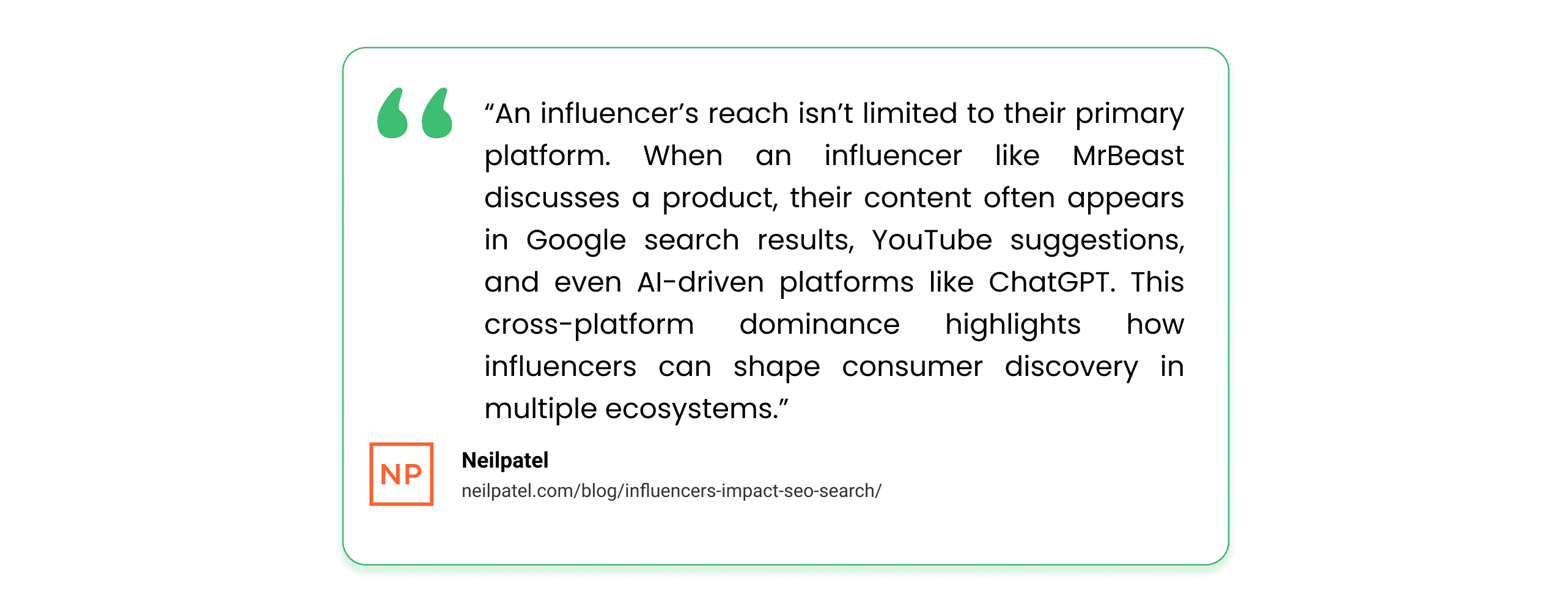
Neil Patel also highlighted an interesting fact:
What Google Pays Attention To
Links: If an influencer links to your website from a blog, YouTube description, or online publication, Google sees this as a signal of trust.
Search Demand: When people discover your brand through influencers, many of them search for your brand name later. For instance, after a creator talks about your tool in a video, users search “your brand pricing” or “your brand reviews.” Google reads this as growing brand interest.
Traffic and Engagement: Influencers send visitors to your site. If those visitors stay, read, and explore, Google sees your site as useful.
Content Discovery: Influencer content helps your pages reach new audiences who may later reference or link to them.
What Google Does Not Care About
Likes, shares, or comments on social posts
Influencer follower counts
Paid mentions without links or discoverable content
Google does not rank popularity. It ranks signals created by popularity. That is why influencer marketing supports SEO indirectly. It shapes how your brand shows up across the web, not just on social feeds.
5 Ways Influencer Marketing Supports SEO
After reading the last section, I am sure you are wondering where influencer marketing actually fits into SEO in a practical sense.
It does not change rankings overnight. But it influences several signals that search engines trust over time.
Let’s break down the five most important ways influencer marketing supports SEO and why each one matters.
1. Backlinks From Influencer Blogs, YouTube, and Media Mentions
Backlinks are one of the strongest SEO signals, and this is where influencer marketing creates the clearest impact.
When influencers publish blogs, YouTube videos, podcasts, or newsletter mentions and link to your website, those links help Google understand that your brand is credible and worth referencing.
Why blog and YouTube description links matter
Blog links are crawlable and can pass authority directly to your site
YouTube descriptions often rank on Google and send consistent referral traffic
These links live longer than social posts, which means long-term SEO value
Dofollow vs nofollow (in simple terms)
Dofollow links pass ranking authority
NoFollow links do not pass direct authority, but still drive traffic and discovery
In practice, both matter. Google has publicly stated that it now treats nofollow links as “hints,” not strict rules. That means even nofollow links can contribute to trust and visibility when they come from strong sources.
Note: One contextual link from a respected creator blog or industry site is more valuable than 50 low-quality links from random pages.
2. Brand Searches and Demand Creation
Influencer marketing creates demand before it creates rankings.
When people hear about your brand through creators, they often search for you later by name. This includes searches like your brand name, pricing, reviews, or comparisons.
How influencer exposure leads to brand searches
Viewers want to validate what they saw
They look for reviews, pricing, or tutorials
They return later, even if they did not click immediately
Multiple SEO case studies have shown that brands with higher branded search volume tend to rank more easily for non-branded keywords over time. Brand demand strengthens overall domain trust.
Why branded search volume is a trust signal
Google wants to rank brands that people actively look for. When search demand grows organically, it signals legitimacy, awareness, and relevance.
3. Referral Traffic That Improves Engagement Metrics
One of the most overlooked SEO benefits of influencer marketing is the quality of traffic it brings, not just the volume. People who arrive from influencer content already have context and trust, which changes how they behave on your site.
Because expectations are aligned, these visitors are less likely to leave immediately. They land on pages that match what the influencer just talked about, which naturally lowers bounce rate. For example, when a creator links to a guide they have already explained in a video, users arrive interested and ready to read.
This kind of traffic also spends more time on your site. Influencer-driven visitors tend to scroll, read, and explore multiple pages instead of skimming and leaving. Analytics studies consistently show that referral traffic from trusted sources has longer session durations compared to cold or purely paid traffic.
Google aims to rank pages that satisfy search intent. While engagement metrics are not direct ranking factors, they strongly correlate with better rankings because they signal relevance and usefulness. When influencer traffic consistently engages with your content, it supports stronger SEO performance over time.
4. Content Amplification That Attracts Natural Links
Great content does not earn links if no one sees it.
Influencers act as distribution engines for your best SEO assets, whether that is a guide, research report, free tool, or case study.
How influencer posts help content get seen
They introduce your content to new audiences
They validate it through association
They increase the chance of secondary sharing
How journalists, bloggers, and creators discover your brand
Many backlinks do not come directly from influencers. They come from people who discovered your content because an influencer shared it.
Example: Let’s say a marketer finds your research through an influencer's tweet. Weeks later, they reference it in their own article and link to your site. That second link often carries more SEO value than the original mention.
5. SERP Visibility Beyond Your Own Website
SEO is not just about ranking your pages. It is about owning more space on the search results page.
Influencer content often ranks alongside or even above brand websites.
Influencer content ranking on Google:
Blog reviews
Comparison articles
YouTube tutorials
These pieces can rank for high-intent keywords related to your brand or category.
Beyond this, YouTube videos frequently appear on page one for product and tool-related searches. When influencers publish videos about your brand, you gain visibility even if your own page does not rank first.
What Influencer Marketing Does Not Help With (SEO Myths)
Before going further, it is important to clear up a few common misunderstandings. Many brands expect influencer marketing to improve SEO in ways it simply cannot. These myths often lead to wasted budgets and unrealistic expectations.
Here are the most common SEO myths around influencer marketing, and what actually happens instead.
Myth 1: Instagram posts directly improve Google rankings
Instagram posts do not get indexed or ranked by Google in a meaningful way. Likes, comments, and reach on Instagram have no direct impact on how your website ranks in search results. An influencer post may create awareness, but unless it leads to searches, links, or traffic outside the platform, Google does not see it.
Myth 2: More followers mean better SEO results
An influencer’s follower count has no SEO value on its own. A creator with a million followers but no website, blog, or long-form content may generate visibility, but very little SEO impact. Smaller creators who publish blogs, YouTube videos, or newsletters often contribute more to SEO because their content is discoverable by search engines.
Myth 3: Social likes and shares are ranking factors
Google has repeatedly clarified that social engagement is not a direct ranking signal. High likes or shares do not push pages up the search results. What matters is what happens after that engagement, such as people searching for your brand, linking to your content, or spending time on your site.
Myth 4: Paid influencer links always help SEO
Not all influencer links are valuable. Paid links without context, relevance, or proper disclosure may pass little to no SEO value. In some cases, aggressively paid link placement can even work against long-term trust. Links that appear naturally within helpful content are far more effective.
Myth 5: Influencer marketing replaces SEO
Influencer marketing does not replace SEO strategy. It supports it. Without solid content, clear messaging, and a strong website foundation, influencer exposure fades quickly. SEO growth comes from consistency, relevance, and long-term signals, not one-off campaigns.
Understanding these limits helps you use influencer marketing in a way that complements SEO instead of working against it.
Influencer Marketing for SEO vs Influencer Marketing for Sales
Not all influencer campaigns are built for the same outcome. Some focus on organic growth, while others aim for immediate conversions. Seeing the difference clearly helps you choose the right strategy from the start.
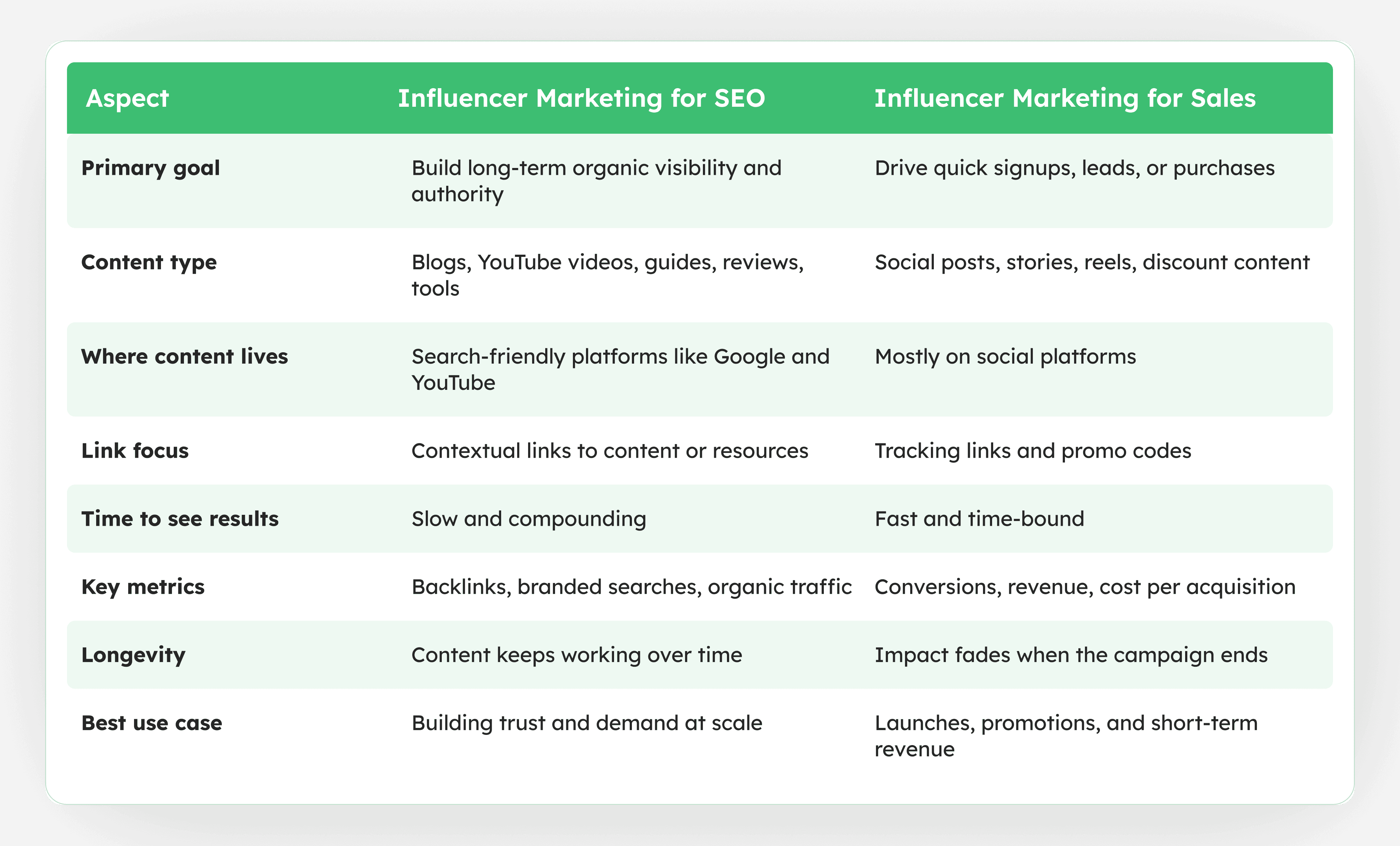
Both approaches work best when used together. Sales-focused campaigns deliver immediate results, while SEO focused campaigns quietly compound value in the background and strengthen long term growth.
How to Use Influencer Marketing Specifically for SEO
Step 1: Pick the right influencer type
Prioritize creators who publish on places Google can index, like blogs, YouTube, podcasts with show notes, newsletters with web pages, or creators who get featured in online publications. Social-only creators can still help, but they are not ideal for SEO first campaigns.
Step 2: Choose an SEO goal before you brief anyone
Pick one primary goal so the campaign is focused. Examples include earning backlinks to a specific page, increasing branded searches, or getting consistent referral traffic to a guide or free tool.
Step 3: Create a link-worthy asset on your site
Do not send influencers to your homepage. Build or use an asset that deserves a link, like a detailed guide, a free calculator, a checklist, a research report, or a comparison page.
Step 4: Match the asset to the creator’s content format
Make the content feel natural to their audience.
Example:
A YouTuber does a walkthrough and links your tool in the description.
A blogger includes your guide as a resource inside an article.
Step 5: Give clear link placement instructions
Ask for a contextual link inside the main content, not just a random link dump. Contextual links are more trusted and more likely to drive the right traffic.
Step 6: Use smart landing pages for each campaign
Create a dedicated page for the campaign angle, so the traffic is relevant and engaged. This improves session duration and reduces bounce rate, which supports overall SEO performance.
Step 7: Repurpose the influencer content into SEO assets
Turn their video into a blog summary, add it to your relevant blog post, create a short FAQ section from it, and use screenshots or quotes with permission. This expands your searchable footprint.
Step 8: Track SEO impact with the right metrics
Track four things only:
- Backlinks gained
- Referral traffic and engagement
- Branded search growth
- Organic ranking movement on related pages
Step 9: Build a second wave of links
Take the influencer content and pitch it to newsletters, communities, and niche blogs. One influencer post can spark multiple natural backlinks when distributed well.
Step 10: Repeat with a system, not one-offs
SEO compounding happens through consistency. Run smaller influencer SEO collaborations every month, focused on one asset at a time, and build a growing library of links and discoverable content.
So, Does Influencer Marketing Help SEO? Final Take
Yes, influencer marketing helps SEO when it’s done with the right intent and structure.
It doesn’t directly push your site up Google rankings. Instead, it creates long-term SEO leverage. Influencer content builds awareness that drives branded searches. It earns natural links through blogs, videos, and mentions. It brings in engaged traffic that signals relevance and trust to search engines. Over time, these signals compound and strengthen your organic visibility.
Brands that see real SEO impact stop treating influencer marketing as a short-term social tactic. They use it as a content discovery and distribution channel.
This is where impulze.ai fits in.
impulze.ai helps you run influencer campaigns with SEO in mind by:
Discovering creators who publish blogs, YouTube videos, and long-form content
Identifying creators who already rank or have search visibility
Tracking links, traffic, and content performance beyond likes
Managing influencer workflows end-to-end without messy spreadsheets
When influencer marketing is planned like a growth channel—not a one-off post—it continues to deliver value long after the campaign ends. So start today with a free account.
Most brands try influencer marketing to get views, clicks, or sales. But a growing number of marketers are asking a quieter question:
Does influencer marketing actually help SEO?
You see creators talking about your brand. You see traffic spikes after campaigns. Sometimes you even notice new backlinks you never asked for. But is that a coincidence, or is influencer marketing quietly shaping how Google sees your brand?
This blog breaks down what actually impacts SEO, what doesn’t, and how influencers fit into the picture without the fluff.
Does Influencer Marketing Really Help SEO?
While I will definitely discuss in depth how influencer marketing and SEO work together, let’s start with the short and honest answer.
Yes, influencer marketing can help SEO, but it does not work in a direct or instant way.
It helps indirectly by increasing brand visibility, driving branded searches, earning backlinks from creator content, and sending engaged traffic to your website. All of these are signals that search engines pay attention to over time.
It does not help SEO when influencer campaigns stop at social media posts with no links, no discoverable content, and no long-term value beyond short bursts of engagement.
Understanding this difference is the key to using influencer marketing in a way that actually supports organic growth.
Now, it’s time to dive deeper to see how all this actually works.
How Google Actually “Sees” Influencer Marketing
Google does not see influencer marketing the way humans do. It does not see Instagram posts, likes, comments, or follower counts as ranking signals.
Instead, Google looks at what influencer activity creates outside social platforms.
Here’s what that means in simple terms.
When an influencer posts about your brand on Instagram, Google mostly ignores that post. But when that same influencer writes a blog, publishes a YouTube video, or gets mentioned in an article that links to your website, Google pays attention.
Neil Patel also highlighted an interesting fact:
What Google Pays Attention To
Links: If an influencer links to your website from a blog, YouTube description, or online publication, Google sees this as a signal of trust.
Search Demand: When people discover your brand through influencers, many of them search for your brand name later. For instance, after a creator talks about your tool in a video, users search “your brand pricing” or “your brand reviews.” Google reads this as growing brand interest.
Traffic and Engagement: Influencers send visitors to your site. If those visitors stay, read, and explore, Google sees your site as useful.
Content Discovery: Influencer content helps your pages reach new audiences who may later reference or link to them.
What Google Does Not Care About
Likes, shares, or comments on social posts
Influencer follower counts
Paid mentions without links or discoverable content
Google does not rank popularity. It ranks signals created by popularity. That is why influencer marketing supports SEO indirectly. It shapes how your brand shows up across the web, not just on social feeds.
5 Ways Influencer Marketing Supports SEO
After reading the last section, I am sure you are wondering where influencer marketing actually fits into SEO in a practical sense.
It does not change rankings overnight. But it influences several signals that search engines trust over time.
Let’s break down the five most important ways influencer marketing supports SEO and why each one matters.
1. Backlinks From Influencer Blogs, YouTube, and Media Mentions
Backlinks are one of the strongest SEO signals, and this is where influencer marketing creates the clearest impact.
When influencers publish blogs, YouTube videos, podcasts, or newsletter mentions and link to your website, those links help Google understand that your brand is credible and worth referencing.
Why blog and YouTube description links matter
Blog links are crawlable and can pass authority directly to your site
YouTube descriptions often rank on Google and send consistent referral traffic
These links live longer than social posts, which means long-term SEO value
Dofollow vs nofollow (in simple terms)
Dofollow links pass ranking authority
NoFollow links do not pass direct authority, but still drive traffic and discovery
In practice, both matter. Google has publicly stated that it now treats nofollow links as “hints,” not strict rules. That means even nofollow links can contribute to trust and visibility when they come from strong sources.
Note: One contextual link from a respected creator blog or industry site is more valuable than 50 low-quality links from random pages.
2. Brand Searches and Demand Creation
Influencer marketing creates demand before it creates rankings.
When people hear about your brand through creators, they often search for you later by name. This includes searches like your brand name, pricing, reviews, or comparisons.
How influencer exposure leads to brand searches
Viewers want to validate what they saw
They look for reviews, pricing, or tutorials
They return later, even if they did not click immediately
Multiple SEO case studies have shown that brands with higher branded search volume tend to rank more easily for non-branded keywords over time. Brand demand strengthens overall domain trust.
Why branded search volume is a trust signal
Google wants to rank brands that people actively look for. When search demand grows organically, it signals legitimacy, awareness, and relevance.
3. Referral Traffic That Improves Engagement Metrics
One of the most overlooked SEO benefits of influencer marketing is the quality of traffic it brings, not just the volume. People who arrive from influencer content already have context and trust, which changes how they behave on your site.
Because expectations are aligned, these visitors are less likely to leave immediately. They land on pages that match what the influencer just talked about, which naturally lowers bounce rate. For example, when a creator links to a guide they have already explained in a video, users arrive interested and ready to read.
This kind of traffic also spends more time on your site. Influencer-driven visitors tend to scroll, read, and explore multiple pages instead of skimming and leaving. Analytics studies consistently show that referral traffic from trusted sources has longer session durations compared to cold or purely paid traffic.
Google aims to rank pages that satisfy search intent. While engagement metrics are not direct ranking factors, they strongly correlate with better rankings because they signal relevance and usefulness. When influencer traffic consistently engages with your content, it supports stronger SEO performance over time.
4. Content Amplification That Attracts Natural Links
Great content does not earn links if no one sees it.
Influencers act as distribution engines for your best SEO assets, whether that is a guide, research report, free tool, or case study.
How influencer posts help content get seen
They introduce your content to new audiences
They validate it through association
They increase the chance of secondary sharing
How journalists, bloggers, and creators discover your brand
Many backlinks do not come directly from influencers. They come from people who discovered your content because an influencer shared it.
Example: Let’s say a marketer finds your research through an influencer's tweet. Weeks later, they reference it in their own article and link to your site. That second link often carries more SEO value than the original mention.
5. SERP Visibility Beyond Your Own Website
SEO is not just about ranking your pages. It is about owning more space on the search results page.
Influencer content often ranks alongside or even above brand websites.
Influencer content ranking on Google:
Blog reviews
Comparison articles
YouTube tutorials
These pieces can rank for high-intent keywords related to your brand or category.
Beyond this, YouTube videos frequently appear on page one for product and tool-related searches. When influencers publish videos about your brand, you gain visibility even if your own page does not rank first.
What Influencer Marketing Does Not Help With (SEO Myths)
Before going further, it is important to clear up a few common misunderstandings. Many brands expect influencer marketing to improve SEO in ways it simply cannot. These myths often lead to wasted budgets and unrealistic expectations.
Here are the most common SEO myths around influencer marketing, and what actually happens instead.
Myth 1: Instagram posts directly improve Google rankings
Instagram posts do not get indexed or ranked by Google in a meaningful way. Likes, comments, and reach on Instagram have no direct impact on how your website ranks in search results. An influencer post may create awareness, but unless it leads to searches, links, or traffic outside the platform, Google does not see it.
Myth 2: More followers mean better SEO results
An influencer’s follower count has no SEO value on its own. A creator with a million followers but no website, blog, or long-form content may generate visibility, but very little SEO impact. Smaller creators who publish blogs, YouTube videos, or newsletters often contribute more to SEO because their content is discoverable by search engines.
Myth 3: Social likes and shares are ranking factors
Google has repeatedly clarified that social engagement is not a direct ranking signal. High likes or shares do not push pages up the search results. What matters is what happens after that engagement, such as people searching for your brand, linking to your content, or spending time on your site.
Myth 4: Paid influencer links always help SEO
Not all influencer links are valuable. Paid links without context, relevance, or proper disclosure may pass little to no SEO value. In some cases, aggressively paid link placement can even work against long-term trust. Links that appear naturally within helpful content are far more effective.
Myth 5: Influencer marketing replaces SEO
Influencer marketing does not replace SEO strategy. It supports it. Without solid content, clear messaging, and a strong website foundation, influencer exposure fades quickly. SEO growth comes from consistency, relevance, and long-term signals, not one-off campaigns.
Understanding these limits helps you use influencer marketing in a way that complements SEO instead of working against it.
Influencer Marketing for SEO vs Influencer Marketing for Sales
Not all influencer campaigns are built for the same outcome. Some focus on organic growth, while others aim for immediate conversions. Seeing the difference clearly helps you choose the right strategy from the start.
Both approaches work best when used together. Sales-focused campaigns deliver immediate results, while SEO focused campaigns quietly compound value in the background and strengthen long term growth.
How to Use Influencer Marketing Specifically for SEO
Step 1: Pick the right influencer type
Prioritize creators who publish on places Google can index, like blogs, YouTube, podcasts with show notes, newsletters with web pages, or creators who get featured in online publications. Social-only creators can still help, but they are not ideal for SEO first campaigns.
Step 2: Choose an SEO goal before you brief anyone
Pick one primary goal so the campaign is focused. Examples include earning backlinks to a specific page, increasing branded searches, or getting consistent referral traffic to a guide or free tool.
Step 3: Create a link-worthy asset on your site
Do not send influencers to your homepage. Build or use an asset that deserves a link, like a detailed guide, a free calculator, a checklist, a research report, or a comparison page.
Step 4: Match the asset to the creator’s content format
Make the content feel natural to their audience.
Example:
A YouTuber does a walkthrough and links your tool in the description.
A blogger includes your guide as a resource inside an article.
Step 5: Give clear link placement instructions
Ask for a contextual link inside the main content, not just a random link dump. Contextual links are more trusted and more likely to drive the right traffic.
Step 6: Use smart landing pages for each campaign
Create a dedicated page for the campaign angle, so the traffic is relevant and engaged. This improves session duration and reduces bounce rate, which supports overall SEO performance.
Step 7: Repurpose the influencer content into SEO assets
Turn their video into a blog summary, add it to your relevant blog post, create a short FAQ section from it, and use screenshots or quotes with permission. This expands your searchable footprint.
Step 8: Track SEO impact with the right metrics
Track four things only:
- Backlinks gained
- Referral traffic and engagement
- Branded search growth
- Organic ranking movement on related pages
Step 9: Build a second wave of links
Take the influencer content and pitch it to newsletters, communities, and niche blogs. One influencer post can spark multiple natural backlinks when distributed well.
Step 10: Repeat with a system, not one-offs
SEO compounding happens through consistency. Run smaller influencer SEO collaborations every month, focused on one asset at a time, and build a growing library of links and discoverable content.
So, Does Influencer Marketing Help SEO? Final Take
Yes, influencer marketing helps SEO when it’s done with the right intent and structure.
It doesn’t directly push your site up Google rankings. Instead, it creates long-term SEO leverage. Influencer content builds awareness that drives branded searches. It earns natural links through blogs, videos, and mentions. It brings in engaged traffic that signals relevance and trust to search engines. Over time, these signals compound and strengthen your organic visibility.
Brands that see real SEO impact stop treating influencer marketing as a short-term social tactic. They use it as a content discovery and distribution channel.
This is where impulze.ai fits in.
impulze.ai helps you run influencer campaigns with SEO in mind by:
Discovering creators who publish blogs, YouTube videos, and long-form content
Identifying creators who already rank or have search visibility
Tracking links, traffic, and content performance beyond likes
Managing influencer workflows end-to-end without messy spreadsheets
When influencer marketing is planned like a growth channel—not a one-off post—it continues to deliver value long after the campaign ends. So start today with a free account.
Frequently Asked Questions
How long does it take to see SEO results from influencers?

How long does it take to see SEO results from influencers?
What is influencer marketing in SEO?
What is influencer marketing in SEO?
Can social media improve SEO?
Can social media improve SEO?
Do influencer backlinks help SEO?
Do influencer backlinks help SEO?
Are nofollow influencer links useless for SEO?
Are nofollow influencer links useless for SEO?
Is influencer marketing better for SEO or sales?
Is influencer marketing better for SEO or sales?
How do you track the SEO impact of influencer marketing?
How do you track the SEO impact of influencer marketing?
Do you need special tools to run influencer marketing for SEO?
Do you need special tools to run influencer marketing for SEO?
Author Bio
Author Bio
Rashmi Singh
Rashmi Singh
Rashmi Singh is a writer and strategist with more than 7 years of experience. When not writing, she is either spending time with her friends or planning her next trip. You can learn more about her here.
Rashmi Singh is a writer and strategist with more than 7 years of experience. When not writing, she is either spending time with her friends or planning her next trip. You can learn more about her here.
We Also Recommend To Read